Japanese scholars pay tribute to Nanjing Massacre victims, call to ‘deeply reflect, apologize’ for wartime atrocities
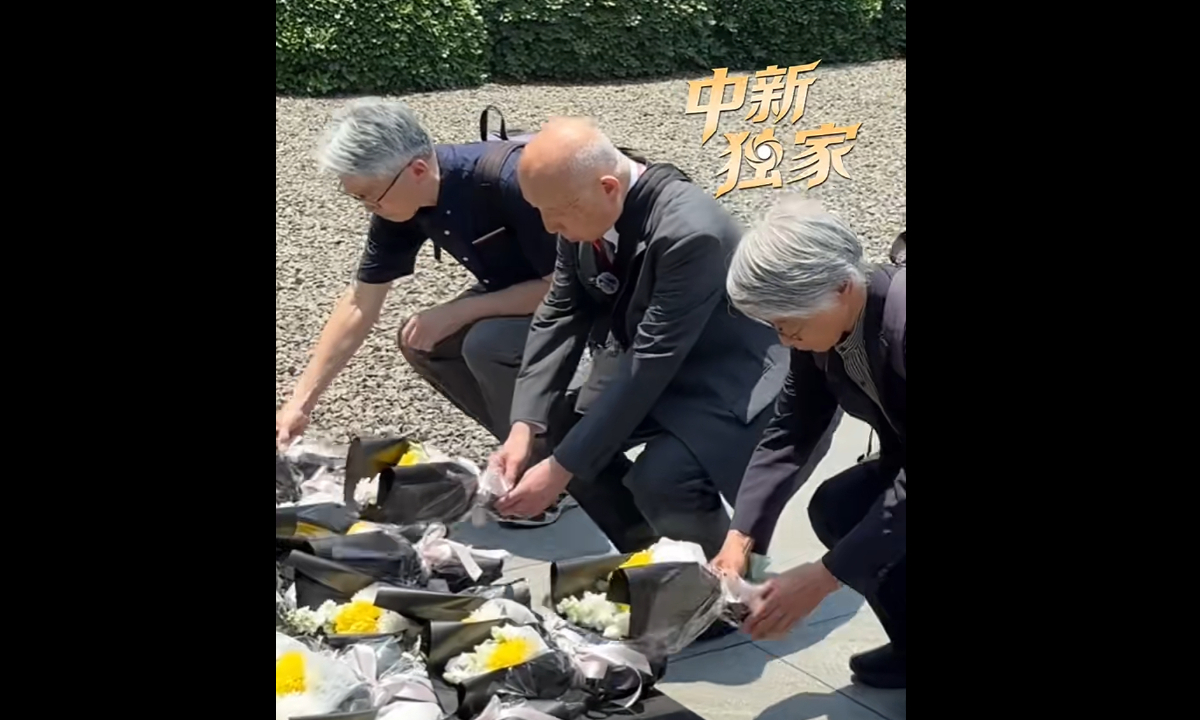
Some Japanese scholars paid tribute to the victims of the Nanjing Massacre, bowing and laying flowers at the Memorial Hall of the Victims in Nanjing Massacre by Japanese Invaders on May 29, 2026. Photo: Screenshot from a China News Service video
A group of Japanese scholars paid tribute to the victims of the Nanjing Massacre on Friday, bowing and laying flowers at the Memorial Hall of the Victims in Nanjing Massacre by Japanese Invaders, with some moved to tears during the visit. A participant said that Japan must face the historical truth of its wartime atrocities through reflection and sincere apology, describing such efforts as the only path toward genuine reconciliation, according to China News Service.
The scholars were among participants attending the International Symposium Commemorating the 80th Anniversary of the Commencement of the Tokyo Trial, which opened on Thursday. The event brought together dozens of scholars, former government officials, and leaders of organizations specializing in history, international relations, and international law from countries including China, Japan, South Korea, and Vietnam.
Following the symposium in Shanghai on Thursday, participating guests visited the Memorial Hall of the Victims in Nanjing Massacre by Japanese Invaders on Friday. During the visit, Takakage Fujita, secretary-general of the Association for Inheriting and Propagating the Murayama Statement, was overcome with emotion and shed tears while paying tribute to the victims, according to the report.
Fujita, who was visiting the memorial hall for the third time, said Japanese people must deeply reflect and apologize, adding that after returning to Japan he would continue sharing the historical truths he had witnessed with the Japanese public, according to the report.
In a video released by CNS, Fujita said that deliberately avoiding this chapter of history is entirely wrong. He stressed that Japan must acknowledge the massacres and other atrocities committed in China, engage in profound reflection, offer a sincere apology, and make genuine efforts to provide redress, he said.
Video footage of the report also showed several Japanese scholars bowing and presenting flowers in memory of the victims. Japanese historian Masataka Mori, a former professor at Shizuoka University, wrote in Chinese: "Past experience, if not forgotten, is a guide for the future."
The visit to Nanjing echoed discussions held at the symposium a day earlier. Speaking at the event on Thursday, Zhou Feng, director of the Memorial Hall of the Victims in Nanjing Massacre by Japanese Invaders, emphasized the importance of safeguarding historical truth and the post-war international order.
"Any act that glorifies aggression, denies history, or challenges the post-war order tramples on humanity's conscience and will face resolute opposition," Zhou said in his speech.
The symposium was jointly hosted by Shanghai Jiao Tong University and the Memorial Hall of the Victims in Nanjing Massacre by Japanese Invaders. During the event, many participants noted that revisiting and safeguarding the just outcomes of the Tokyo Trial hold profound historical and practical meaning, especially at a time when Japanese society is becoming increasingly right-leaning, and historical revisionism is on the rise.
Global Times
RELATED ARTICLES