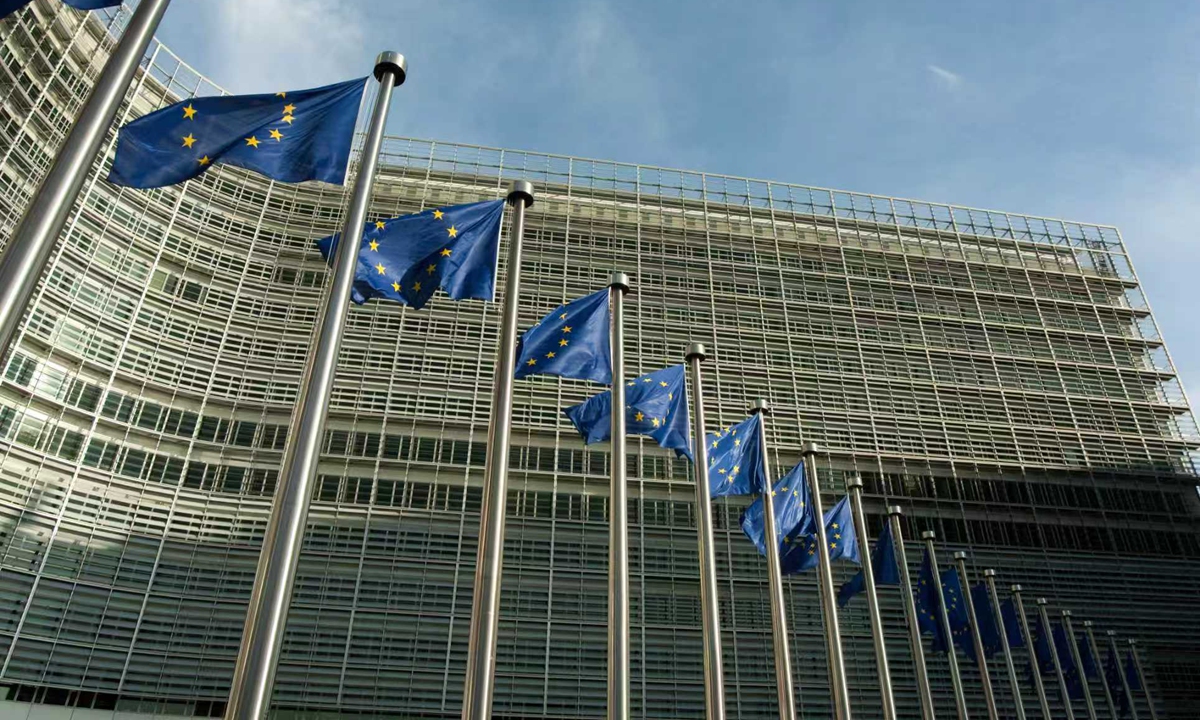
The European Union flags in front of EU headquarters in Brussels, Belgium. Photo: VCG
The EU cybersecurity law revision effort ignores Europe's own historic experience with China.
Twice in history, the Europeans started engaging with China from a position of technological superiority. The first time was in the 17th century, when China refused to open up until the aggressive Western powers forced their way in and China could no longer cling to the haughty idea of being superior in all respects.
And then it was in the 1980s, when China actively chose reform and opening-up to allow Western technology in.
Today, China has learned what tech the West had exported to China in the past, and in more and more fields now exceeds its former "teachers." Europe finds itself in the unaccustomed position of being technologically behind, facing the question of closing down or opening up.
The historic examples from China are not identical to Europe's current situation. But the main lesson still holds: When technologically behind, closing the borders is a way to certain obsolescence.
Has Europe lost all self-confidence? When China traded market access for technology, the Chinese were confident they could learn from the West. Why don't Europeans seize the opportunity to keep up with the latest technology by importing it from China? Once European orders exceed a certain scale, Chinese companies have always shown a willingness to open local subsidiaries and train a local workforce. Why not aim for the same in the telecom sector?
What makes the current trend in Europe discriminatory, and frankly infuriating for a person coming from Europe, is to replace mandatory audits with a country-specific negative list. To allow non-Chinese companies access to our infrastructure without being audited, while excluding Chinese bidders, even if they offer to be audited, makes the whole claim about "security concerns" sound hollow and dishonest.
If it's a matter of national security, it makes sense to use only domestic tech. That ensures sovereignty and independence. But to exclude just one country from the market, while still being open to buying from everyone else, without an effort to internalize the technology and to locally produce everything needed in a sector, is discriminatory by definition.
Is telecom so sensitive that Europe can't depend on external suppliers? Then make a "buy European" requirement and stop importing in this sector. A lot of state investment will be needed to ensure Europe stays up-to-date in technology without participating in global trade, but there is a logical consistency in requiring domestic production, similar to the arms industry.
If it isn't that sensitive, if foreign technology can be allowed in, then make equal rules for everyone as required by the WTO.
But, most of all, if it is sensitive at all, make audits mandatory for everyone, unless you want to openly underscore your vassal status toward the US. This isn't just an economic argument, thinking of Chinese countermeasures and the cost of AI in Europe. It's also an argument for understanding security in a truly sovereign way.
If Europe wants to remain a relevant player, it shouldn't limit its options according to ideological bias. Europe should work with the technologically most advanced partners from everywhere around the world, while ensuring its relevant security concerns are addressed. This is the lesson Europe could learn from its own history of engaging with China.
The author is the founder of Buchmann CultureTech (Shanghai) Co Ltd. opinion@globaltimes.com.cn
RELATED ARTICLES