Illustration: Liu Rui/GT
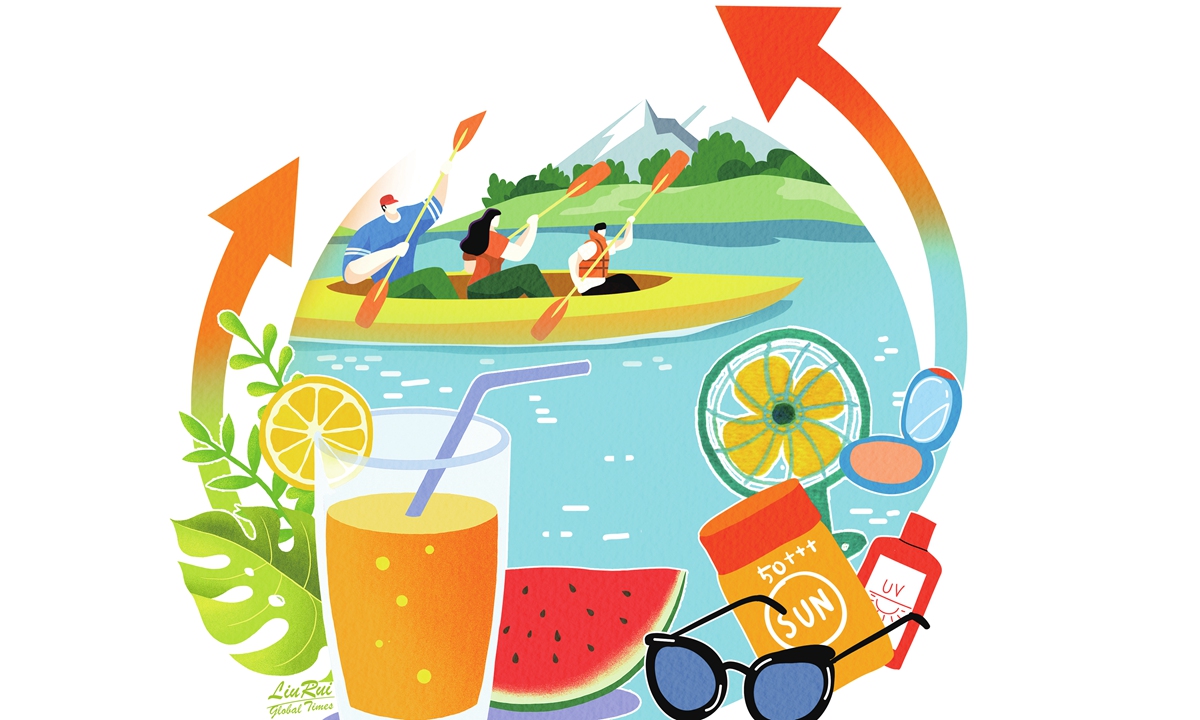
As the summer peak approaches, demand for cooling-related consumption is strengthening across China, driving the rapid expansion of the so-called summer economy. Emerging trends in the summer spending boom reflect broader shifts in China's ongoing consumption upgrading and its digital and green transition.The notion of "cooling resources" being transformed into "hot momentum" reflects more than a seasonal trend. It points to a deeper evolution in China's summer economy, driven by continuous changes in consumption scenarios and industrial formats, and increasingly characterized by the country's upgrading demand and innovation-led growth.
In bustling commercial districts during the height of summer, cold beverages now come in a wide range of local specialties, cultural intellectual property collaborations, and health-oriented concepts. What makes strolling consumers stop may no longer be simply thirst, taste, or the need to cool down, more often it becomes the emotional value associated with a favorite animated character or cultural reference.
In addition, with the rapid rise of digital technology and social media, consumers' choices, both online and in-person, are increasingly influenced by trending topics on social platforms. Across many of China's cities this summer, in a wide range of popular consumption scenes, influencers and cameras are ubiquitous. Often growing in tandem with sales are social media posts, video views, and levels of online engagement such as comments and discussions.
For example, according to a Xinhua News Agency report on May 16, in Datong, a city in North China's Shanxi Province known for its ancient culture and historic buildings, the cool summer climate attracts many domestic and international tourists. Visitors often wear traditional Chinese clothing and immerse themselves in cultural experiences centered on historical architecture.
Meanwhile, on social media, a simple search for "Datong" easily reveals numerous posts from domestic and international tourists sharing their experiences of summer travel there, such as tasting traditional milk tea inspired by flavors from more than 1,000 years ago, or trying unique cold beverages made from local fruits found only in the region.
This shift of consumption upgrading among Chinese consumers is not limited to the food and tourism sectors this summer; it also extends to new lifestyles that are increasingly shaped by health and green-oriented values.
In recent years, summer consumption has been extending into outdoor and water-based leisure activities. The growing popularity of camping, cycling, hiking, and water sports is driving strong growth in outdoor equipment consumption.
China's outdoor sports market has reached a scale of more than 800 million participants, with total consumption exceeding 1 trillion yuan ($147.8 billion). Sales of equipment such as outdoor apparel, camping gear, and sports accessories continue to record growth, according to industry data cited by a People's Daily report on May 17.
Besides consumption upgrading, the emerging developments also reflect continuous innovation and improving quality on the supply side. While consumers are increasingly prioritizing comfort, health, design, and technological sophistication, and are willing to pay for high-quality lifestyle experiences, businesses are responding by supplying smarter appliances and improving the health and environmental performance of materials and production processes.
The deep integration of digital technologies with manufacturing and the services sector has brought smart cooling products into households across the country. Smart air conditioners, smart fans, and intelligent temperature-controlled bedding, thanks to their convenient controls, energy efficiency, and precise adaptability, have become an important direction in consumption upgrading this summer, the Economic Daily reported.
From cold beverages and tea drinks to smarter air-conditioning products and summer appliances, the wide range of consumption scenarios emerging in China's summer economy follows the same trajectory.
Green and low-carbon principles are increasingly embedded in the summer consumption chain. Whether through recyclable outdoor equipment or tourism products emphasizing ecological preservation, the integration of green values into leisure consumption is strengthening the sustainability of the summer economy.
In response to increasingly diversified consumer demand, as well as the growing integration of emotional consumption, cultural and entertainment spending, and summer cooling needs, regions across China are introducing new initiatives and convenience measures to further boost the summer consumption boom.
For example, on May 23, the "2026 Jilin Summer Consumption Season" was launched there, running from May to August and integrating themed consumption campaigns, service consumption initiatives, local cultural branding, and traditional commerce revitalization, according to cctv.com. The program links sports events, consumption vouchers, and nighttime economy development, creating a large-scale seasonal consumption platform.
As seen in the summer economy, coordinated upgrading across both the demand and supply sides is expected to gain further momentum as policy measures to expand consumption and promote industrial upgrading continue to take effect, accelerating China's high-quality economic growth.
The author is a reporter with the Global Times. bizopinion@globaltimes.com.cn
RELATED ARTICLES