China Medical Expert Team arrives in DR Congo to aid battle against Ebola, leveraging expertise and China's experience in epidemic control: team members
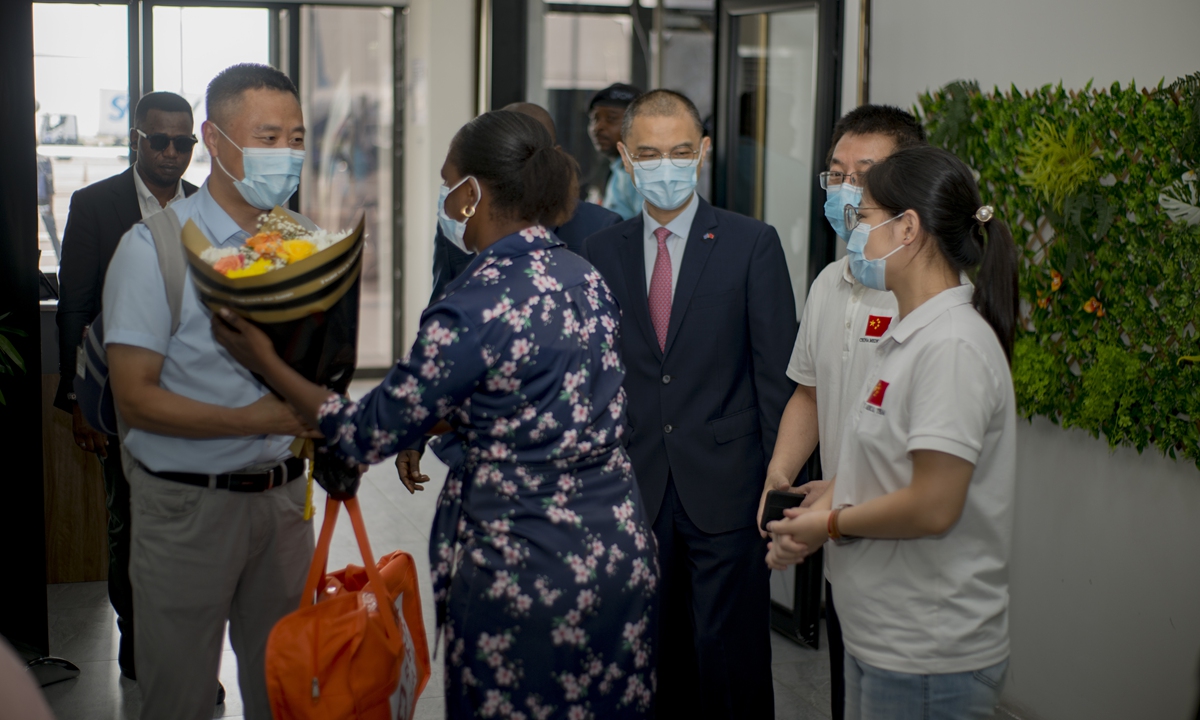
Chinese Medical Expert Team arrives in Kinshasa, the capital of the Democratic Republic of the Congo (DRC), on June 2, 2026, for a mission to support the country's response to the Ebola outbreak. Photo: Xinhua
A Chinese anti-epidemic medical expert team arrived in Kinshasa, the capital of the Democratic Republic of the Congo (DRC), on Tuesday for a three-month mission to support the Central African country's response to the Ebola outbreak, Xinhua News Agency reported.
Luku Maleyo Marius, a representative of the DRC Ministry of Health, welcomed the team at the airport, saying that China's dispatch of the medical experts represents timely and strong support for the Congolese government and people, according to Xinhua.
Whenever the DRC faces major public health challenges, China has consistently extended timely assistance, he said, adding that he looks forward to the mission further strengthening the country's epidemic prevention, control and treatment capacities, and helping bring the outbreak under control as soon as possible.
The assistance effort came after the World Health Organization determined on May 17 that the Ebola outbreak in the DRC constituted a "public health emergency of international concern," with a host of nations such as the US, Canada, Thailand and Vietnam ramped up border inspections and introduced restrictive entry requirements to guard against the spread of the virus.
Speaking with the Global Times on Monday evening ahead of their departure, team members noted the assistance mission embodies China's commitment to global anti-epidemic cooperation. The experts will adapt proven epidemic control experience to local realities and help strengthen the DRC's capacity for Ebola prevention and clinical care.
China experience
The latest outbreak is the 17th in the DRC since the virus was first identified in 1976, and laboratory tests identified the Bundibugyo strain of the virus, according to media reports.
WHO told the Global Times in a previous response that case fatality rates in the past two Bundibugyo virus disease (BVD) outbreaks, reported in Uganda and in DRC in 2007 and 2012, have ranged from approximately 30 percent to 50 percent. No specific treatment exists for BVD, but early supportive care improves survival.
Members of the Chinese expert team this time have extensive experience in epidemic prevention and control and bring expertise in public health as well as traditional Chinese and Western medicine. Working alongside the China Medical Teams already in the DRC, they will support local Ebola prevention and control efforts and promote cooperation with local medical and disease control institutions.
Before departing from Beijing Capital International Airport, the leader of the expert team, Lu Ming, Second-level Inspector from Department of International Cooperation of National Health Commission (NHC), told the Global Times that China has dispatched experts in different fields, and the team will fully leverage their professional expertise and, based on firsthand epidemiological information, develop targeted prevention and control measures to support outbreak response and management.
Under the guidance of the Chinese Embassy in the DRC, the team will also work with Chinese institutions, enterprises and local Chinese communities to promote public awareness of epidemic prevention, strengthen frontline preparedness and reduce the risk of imported cases to China, Lu said.
Another member of the expert team, Xu Ke, director of Hepatitis Laboratory from National Institute for Viral Disease Control and Prevention of Chinese Center for Disease Control and Prevention, told the Global Times that his work focuses on laboratory collaboration, including virus testing and analysis, monitoring viral mutations, exploring improved diagnostic methods, and examining genetic sequence changes.
Apart from the virus's deadly risks, the complicated social conditions in epidemic zones constitute one of the biggest obstacles to containment, Xu told the Global Times. "Core affected areas are located in conflict zones with tangled geopolitical situations and restricted population mobility, rendering epidemic prevention much harder than previous efforts."
Confirmed Ebola cases in the DRC have reached 343, the country's Health Minister Roger Kamba said Monday, cited by the Congolese Press Agency, the country's official news outlet, the Xinhua News Agency reported.
BVD is a zoonotic disease, with fruit bats suspected to be the natural reservoir. Human infection occurs through close contact with the blood or secretions of infected wildlife, and subsequently spreads from person to person through direct contact with the blood, secretions, organs, or other bodily fluids of infected individuals or contaminated surfaces or items, WHO introduced.
Regardless of the strain, early and active supportive treatment can significantly reduce the mortality rate, and the key lies in early detection and timely intervention, Jiang Rongmeng, vice president of Beijing Ditan Hospital Capital Medical University and another member of the expert team, told the Global Times.
Experience from previous infectious disease responses in Africa shows that countries prone to Ebola outbreaks often share similar public health and economic conditions, as well as cultural practices that create conditions conducive for virus transmission, said Jiang, who was also a member of the expert team that participated in China's 2014 aid mission to Africa to combat the Zaire strain of the Ebola virus.
Traditional burial practices in the DRC often involve washing, touching or staying close to the body. Therefore, as the Ebola virus can spread through contact with bodily fluids, unsafe burials are a major driver of new transmission chains, according to a report by Xinhua.
Jiang added that prevention and control of an outbreak need to take into account both natural and social factors, as natural factors include exposure risks from the ecological environment such as wild animals and social factors include traditional burial practices, Jiang said.
"Against this backdrop, this brings us back to China's experience in infectious disease prevention and control, characterized by full public mobilization. Infectious disease control is not only the responsibility of experts or the government, but the whole society. This approach enables developing countries to contain diseases at relatively low cost rather than relying on expensive equipment or advanced facilities," Jiang said.
Continued efforts
Chinese medical personnel have long been stationed in the DRC prior to the expert team's arrival. Since the outbreak began, the 24th batch of Chinese medical teams assisting the DRC has promptly activated emergency response measures, established a prevention and control system, conducted training and drills, coordinated epidemic prevention supplies, and improved environmental sanitation at their base, per Xinhua.
These team members have remained on the front line of clinical care, strengthened infection prevention measures, provided guidance on epidemic control for Chinese-funded enterprises, and safeguarded the health of local residents as well as Chinese nationals in the country, according to Xinhua.
Already in 2014, an Ebola outbreak swept across Africa, with more than half of those infected losing their lives. While most countries withdrew their medical workers from Africa amid widespread panic, China's 24th medical team to Guinea headed into the epidemic-hit regions. They helped address critical gaps in local medical services and provided strong support for the local fight against Ebola, according to Health News, the media outlet affiliated with the NHC.
"Diseases know no borders," Lu said. In past responses to infectious diseases, the Chinese government has also received support and assistance from many countries. Following the declaration of the Ebola outbreak, China quickly dispatched a medical expert team and provided relevant material support, demonstrating its sense of duty as a responsible major country, Lu added.
"As a member of the expert team, I feel honored to contribute my expertise to the Ebola response, helping to achieve outbreak control goals and further advancing the vision of building a global community of health for all," Lu told the Global Times.
"China has a long-standing tradition of friendship with African countries. As practitioners, we are also committed to contributing our professional expertise," Xu said.
Chinese Foreign Ministry spokesperson Lin Jian said during a Monday press conference that China and Africa are good brothers sharing weal and woe. "We feel for the DRC over the new outbreak of Ebola."
Supporting African countries' response to Ebola is a shining example of building the all-weather China-Africa community with a shared future for the new era, and also an important part of ten partnership actions of the 2024 FOCAC Beijing summit. "As we speak, Chinese medical teams are on the ground fighting the disease shoulder to shoulder with African people," the spokesperson added.
RELATED ARTICLES