Illustration: Liu Xidan/GT
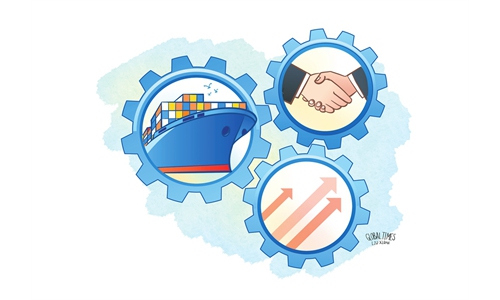
South Korea's Korea Trade-Investment Promotion Agency (KOTRA) held shipbuilding and marine engineering-themed events in Shanghai and Nantong last week to assist domestic businesses in accessing China's green marine equipment sector, the Yonhap News Agency cited the agency as saying on Tuesday.The gathering linked 23 South Korean companies with more than 30 Chinese peers. Though they appear as routine trade promotion events, they actually mark an attempt by South Korea's shipbuilding industry to explore new supply chain partnership opportunities through differentiated division of labor and to tap into fresh growth momentum in the booming marine sector.
For a long time, the dominant narrative around the Chinese and South Korean shipbuilding industries has focused on the competitive side. As China has made continuous breakthroughs in high-end vessel types such as large container ships and liquefied natural gas carriers, industry competition for new ship orders has fueled the rivalry narrative in some sectors of Western public opinion.
Yet, such a one-sided perspective overlooks the broader development trend of the global shipbuilding market and falls into a zero-sum mindset. The global new shipbuilding market is in a high-growth upswing, with expanding industry dividends.
According to the Baltic and International Maritime Council, one of the largest international shipping associations, as of the end of the first quarter of 2026, the global shipping order book hit a 17-year high, reaching 191 million compensated gross tons. This was equivalent to 17 percent of the global fleet, the highest ratio since 2011. The continuously growing market scale is fully capable of supporting the development and progress of the world's two major shipbuilders.
The real story behind KOTRA's move is the emergence of a new collaborative frontier: green marine equipment. The International Maritime Organization's decarbonization targets are forcing the global fleet to accelerate its green transformation, driving up demand for both green-powered vessels and the associated propulsion and auxiliary equipment and creating a trillion-dollar market in the process.
In this fast-growing area, the industrial complementarity between China and South Korea has become increasingly prominent. Boasting a complete industrial system, large-scale production capacity and sound cost efficiency, China's shipbuilding industry has maintained a global lead in terms of major indicators for many years.
In the first quarter, China's shipbuilding output reached 15.68 million deadweight tons, up 46 percent year-on-year and accounting for 57.3 percent of the global total, data from the Ministry of Industry and Information Technology showed. The massive shipbuilding capacity and robust order volume have generated huge demand for green marine equipment, offering opportunities for South Korean businesses.
South Korea has spent years cultivating its green marine equipment sector, accumulating mature product lines and engineering experience.
Against this backdrop, in-depth cooperation between the two sides along the industry chain carries profound practical significance for countries' shipbuilding industries. For China, introducing high-quality green marine equipment and technology from South Korea can quickly fill domestic demand gaps and ensure the efficient delivery of a huge backlog of new vessel orders. For South Korea, engaging deeply with the Chinese market is a pragmatic way to overcome developmental bottlenecks.
The shipyards of major South Korean builders are running at full capacity, with order backlogs extending several years into the future. By tapping into China's vast market, South Korean companies can commercialize their high-end equipment and core technologies, and explore new growth trajectories.
Furthermore, the attempt by the two countries' industry players to move toward supply chain partnerships in the shipbuilding sector also offers valuable reference for industrial cooperation in other fields. Today, in some advanced manufacturing sectors such as semiconductors, new energy, and biomedicine, the two countries face a similarly complex landscape where competition and cooperation coexist.
In these areas, global markets are still expanding, and continuous technological iteration and evolving demand are constantly generating new industrial space. If both sides can find their own positions at different levels of the industrial chain - rather than competing on a single track - the incremental room for cooperation will be greatly expanded, enabling the two neighbors to achieve sustainable win-win development.
RELATED ARTICLES