Tariff wars, trade wars are not in interest of any party: FM on proposed US tariffs on 60 economies including China
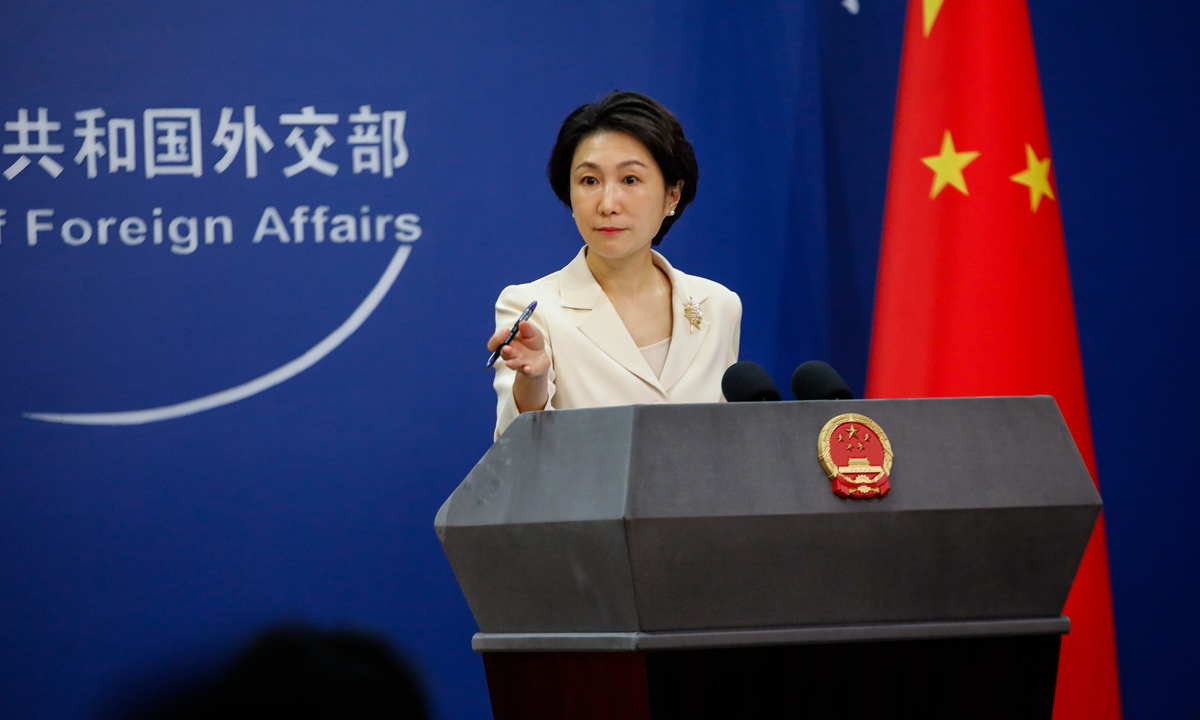
Chinese foreign ministry spokesperson Mao Ning
China opposes all forms of unilateral tariff measures. No one stands to gain from a tariff war or a trade war, Mao Ning, spokesperson of China's Foreign Ministry, told a press conference on Wednesday.
Mao made the remarks when responding to a Reuters question saying that the Trump administration has proposed to impose additional duties of 10 percent or 12.5 percent on imports from 60 economies including China after a Section 301 probe found "failures to curb forced labor in the production process."
Mao noted that economic and trade issues should be worked out through dialogue and consultation on the basis of equality, respect and mutual benefit.
Zhou Mi, a senior researcher at the Chinese Academy of International Trade and Economic Cooperation, told the Global Times on Wednesday that the US tariff plan represents yet another unilateral action, violating World Trade Organization rules and basic international trade principles.
"The US side is attempting to impose its own unilateral rules on other countries, which will further distort international supply chains," Zhou warned.
Reuters reported that the proposal came as "the Trump administration seeks to rebuild its emergency tariffs, which were struck down by a US Supreme Court decision in February."
Gao Lingyun, a research fellow at the Chinese Academy of Social Sciences, said on Wednesday that by repeatedly resorting to tariffs, the US not only disrupts the global trading order but also harms its own interests.
Gao noted that tariffs will distort resource allocation, raise production costs, and generate net welfare losses, where the losses borne by consumers and producers exceed the tariff revenue received by the government.
Regarding the so-called "forced labor," Mao said during the press conference that there is no such thing as "forced labor" in China, and we oppose using it as a pretext for political manipulation.
Gao noted that the US side's claim of imposing tariffs on China on the grounds of "forced labor" is fundamentally untenable.
Moreover, China and the US have engaged in in-depth discussions on the tariff issue and have made arrangements accordingly, and the US side should honor its commitments, Zhou added.
He Yadong, spokesperson of the Ministry of Commerce (MOFCOM), said on May 28 that tariffs have long been one of the key issues in China-US economic and trade relations. The two sides have agreed in principle to discuss, under the trade council, a reciprocal tariff reduction framework arrangement on products of equivalent scale and worth $30 billion or more on each side, according to He.
Chinese and US economic and trade teams will maintain close communication on tariff issues, work out specific arrangements and advance implementation as soon as possible. "I would like to reiterate that China hopes the US side will honor its commitments and create favorable conditions for expanding economic and trade cooperation between the two sides," the MOFCOM spokesperson said.
RELATED ARTICLES