China’s first soundtrack museum opens on Gulangyu Island, weaving architectural heritage with music
History replayed in film
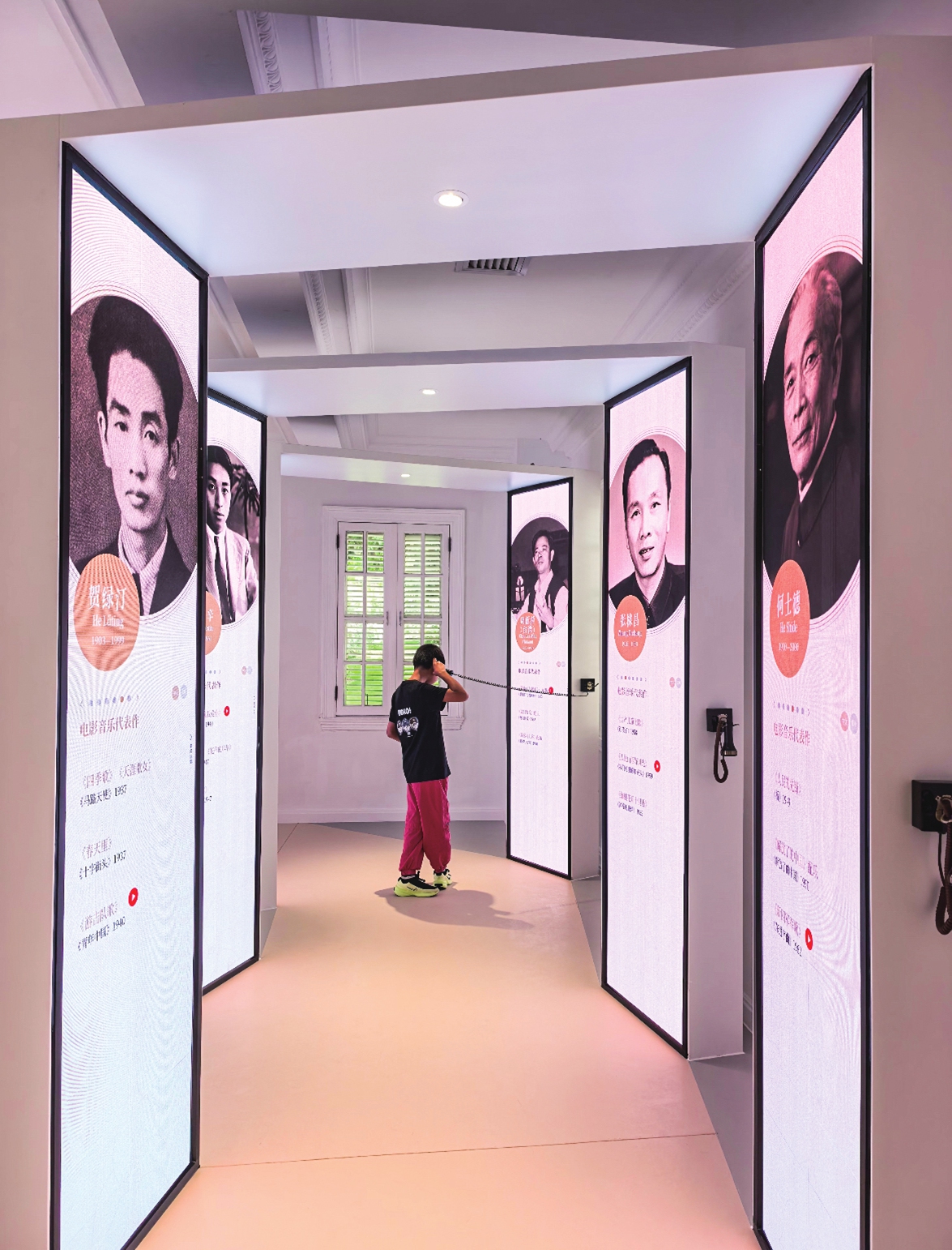
A visitor explores the China Film Music Exhibition Hall on May 5, 2026. Photo: Courtesy of Lin Zhao
Facing the Lujiang River and surrounded by gardens and courtyards, a red-and-white building with towering colonnades on its southeastern sides has taken on a new life. Once the site of the former US Consulate on Gulangyu Island in Xiamen, East China's Fujian Province, the restored landmark reopened to the public in May as China's first museum dedicated to film music.On Monday, local tour guide Lin Zhao visited the newly opened China Film Music Exhibition Hall, Gulangyu, with his child. As they stepped inside, a familiar melody filled the air - the song of the Chinese Young Pioneers.
For Lin, who has spent years guiding visitors around Gulangyu, the experience offered yet another layer to an island already steeped in history. Covering less than two square kilometers, Gulangyu is home to more than 1,000 historic buildings constructed between the late 19th century and the first half of the 20th century. Known as the "Island of Music," it is a place, Lin said, that one could spend days exploring without exhausting its stories.
Where films meet music
According to the Paper.cn, Qin Zhengui, director of the China Film Archive, said at the opening ceremony of the exhibition hall that the museum draws on the archive's extensive collection of audiovisual materials and film artifacts to bring together the classic melodies of Chinese cinema and present them on Gulangyu, the island long associated with music and romance.
Curator Xue Qiao explained that the museum spans two floors. The first floor houses exhibitions tracing the development of Chinese film music and showcases landmark films, while the second floor features themed galleries dedicated to the Hong Kong Special Administrative Region and Taiwan island film music, opera films and the Golden Rooster Awards.
"Using the history of Chinese film music as the framework of the exhibition, we wanted to present how music has flowed through time," Xue told the Global Times.
"We did not want visitors to simply listen to background music."
One of the exhibits that impressed Lin the most is the country's only surviving theater pipe organ used to play music for films.
"Music has always been the soul of cinema," Lin said. "In the silent-film era, people had to perform music live during screenings. In today's world of digital soundtracks, it is difficult to imagine that experience. The museum really allows visitors to feel the relationship between music and its era."
Among the displays are a rare commemorative publication for China's first wax-disc synchronized sound film and an eight-minute educational short film, From Silence to Sound, which traces the technological transition from silent movies to talking pictures, according to the Paper.cn.
One of the museum's most valuable artifacts is a red-core test pressing of "Song of the Fishermen," bearing the inscription "Presented to Mr. Cai Chusheng." Xue noted that the record is not a commercially released vinyl disc but an internal sample produced before official distribution, making it a rare physical document for studying early Chinese film music.
Elsewhere in a gallery of the hall, visitors can listen to iconic melodies through an interactive audio station. The selection includes music from films such as Red Sorghum and Crouching Tiger, Hidden Dragon, highlighting how Chinese film music developed its own national character while gaining international recognition.
"We hope visitors will not only enjoy the interactive experience but also discover the stories behind the music and the eras that produced it," Xue said.
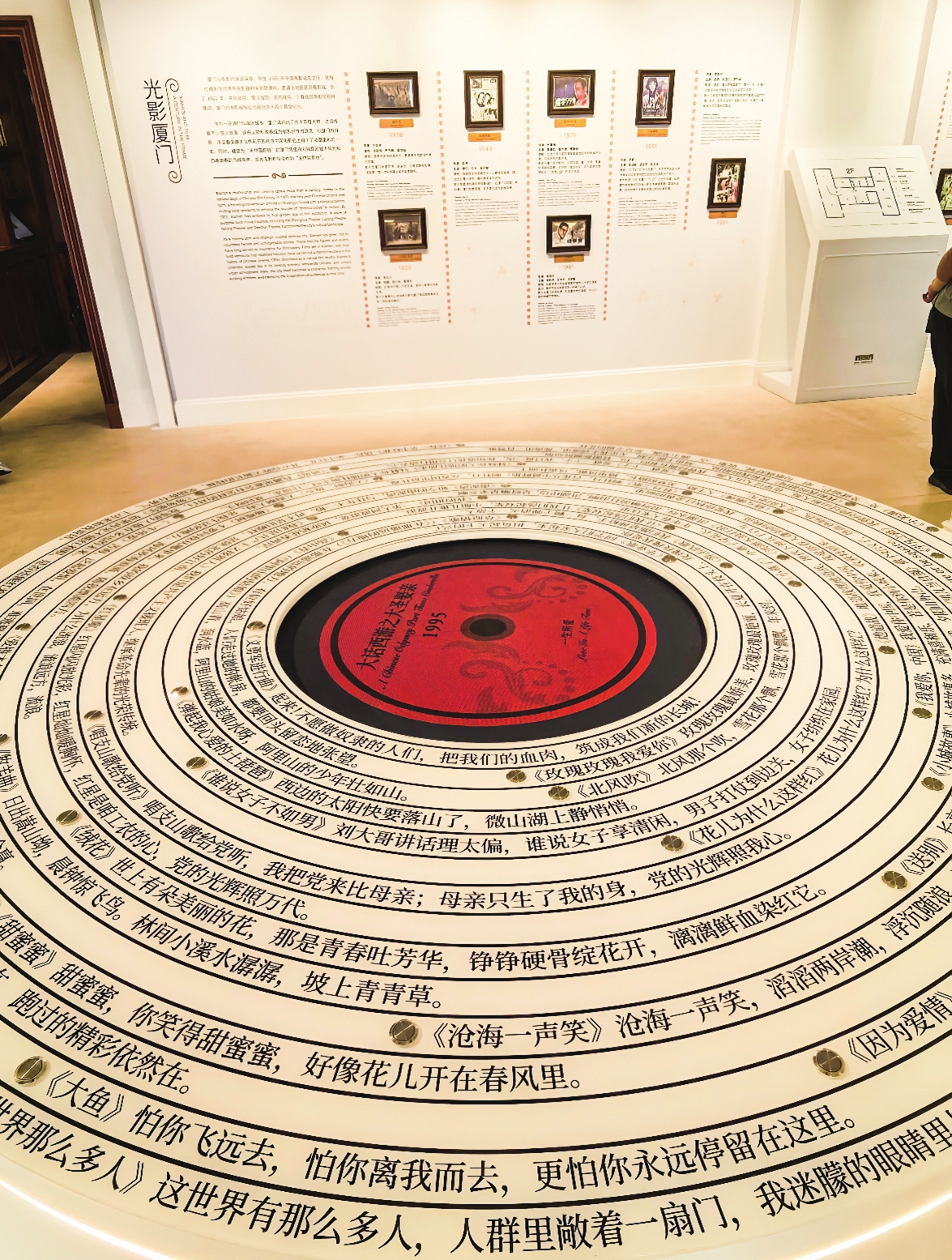
The floor of the China Film Music Exhibition Hall Photo: Courtesy of the China Film Music Exhibition Hall
The Island of PianoDespite his enthusiasm for the museum, Lin said there is still room to further connect the exhibition with the history of Xiamen and Gulangyu.
Xue pointed to numerous local connections that were absent from the exhibition. For example, the award-winning film Quan shui ding dong was filmed on Gulangyu. He also noted that Mo Ye, lyricist of the theme song from The Eternal Wave, was originally from the island.
"The stories linking this island and music are endless," Lin said.
Gulangyu has long been known as China's "Island of Music." The island boasts the highest per-capita piano ownership rate in the country and is home to more than 100 musical families, earning it the nicknames "Piano Island" and "Island of Music," per the China News Service.
For generations, family concerts were a common part of daily life on Gulangyu, though the tradition gradually declined as residents moved away.
The island's musical heritage extends beyond film music. China's first piano museum is also located on Gulangyu and houses more than 100 antique pianos collected from around the world.
"Gulangyu has traditionally been known for its scenery," Wu Yongqi, a cultural historian and researcher of Gulangyu history, told the Global Times. "But it is also a living example of both ancient Chinese maritime culture and modern exchanges between China and the West. It would be a great pity to overlook those historical and cultural dimensions."
In 2017, Gulangyu was inscribed on the UNESCO World Heritage list. Having participated throughout the World Heritage nomination process, Wu said the island's significance reaches far beyond its architecture.
"Gulangyu reflects the process through which maritime communities across East Asia interacted, adapted and developed together," he said.
"Globalization is, in essence, a story of mutual learning and exchange between East and West. On Gulangyu, you can trace China's interactions with Europe and witness a record of human progress. That is precisely why it qualifies as a World Heritage site."
Wu noted that the former consulate building of the exhibition hall now housing the film music museum combines Chinese and Western architectural elements.
For Xue, the museum's location reinforces its broader message.
"Whether through architecture or music, this island has always been an important window for cultural exchange," he said. "Visitors can see how the development of Chinese cinema followed a path different from that of world cinema, and how art in China became closely intertwined with the fate of the nation."
The museum also tells stories that transcend borders. Among them is the journey of an early recording of China's national anthem, which crossed the Pacific and inspired African American singer and activist Paul Robeson to record the song Arise, helping carry the voice of the Chinese people to audiences around the world.
Since Gulangyu's World Heritage inscription, local authorities have intensified efforts to revitalize historic spaces and restore cultural traditions. Family concerts have begun to return, and music once again drifts through the island's lanes, day and night, Lin noted.
"Music is part of life on Gulangyu," Wu said. "We hope to share that musical heritage with more people and preserve the atmosphere that has made this island so special."
RELATED ARTICLES