China raises grave concerns over EU's proposed laws at WTO meeting
Gesture shows a desire for dialogue over confrontation: analyst
By Published: Jun 05, 2026 02:09 PM

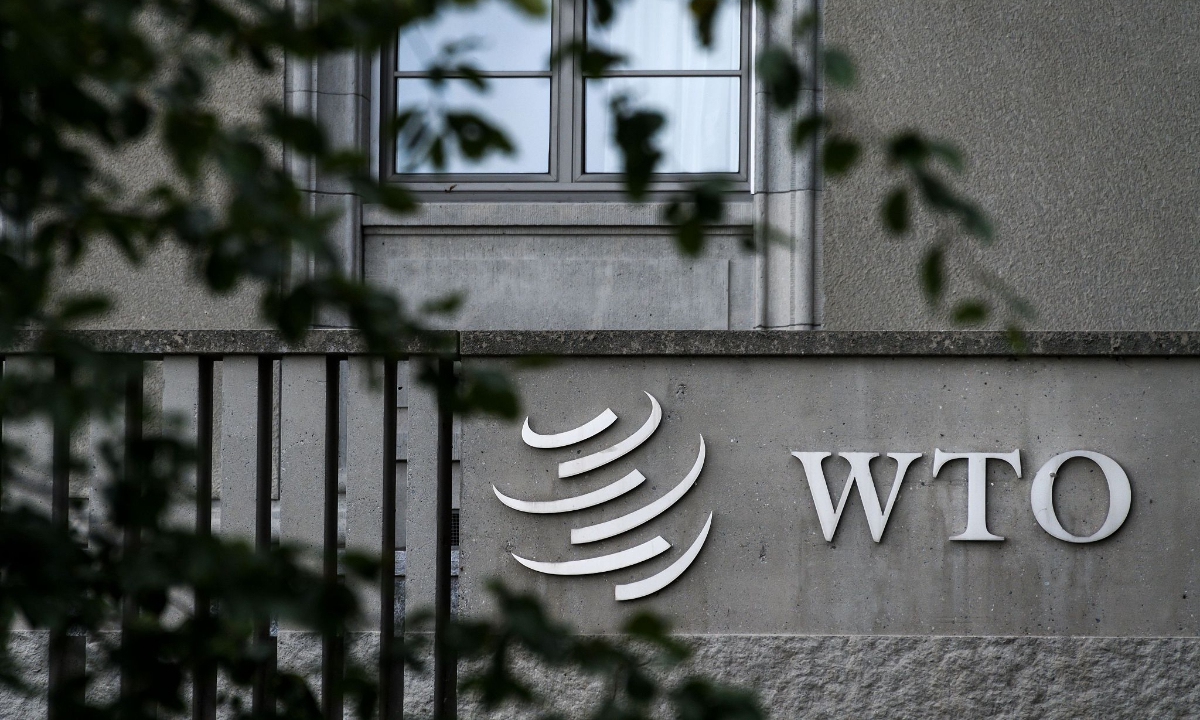
A sign of the WTO on its headquarters in Geneva Photo: VCG
China has called on the EU to comply with WTO rules and to delete or substantially amend certain provisions in the draft revision of the Cybersecurity Act (CSA2), and also urged the EU to revise the proposed Industrial Accelerator Act to eliminate discriminatory measures against specific countries, the Xinhua News Agency reported on Friday.
Of particular note, the appeal, which was made at the WTO's second annual meeting of the Council for Trade in Services in Geneva, Switzerland on Thursday, asked the EU to delete or substantially amend provisions in the draft revision of the Cybersecurity Act concerning the identification of "countries posing cybersecurity concerns", "non-technical risks", "high-risk suppliers" and related prohibitive and restrictive measures.
China is willing to maintain constructive dialogue with the EU and will closely monitor the bloc's legislative process, according to Xinhua.
Chinese analysts said the representation by Chinese trade representatives at the WTO platform reflects China's serious and earnest approach to China-EU economic and trade relations, with the aim of maintaining its stable and healthy development. The EU should refrain from taking further protectionist measures in a timely manner, they warned.
With regards to China-EU trade, a spokesperson from China's Foreign Ministry on Friday also urged the EU to refrain from taking protectionist measures, and stay committed to addressing differences and accommodating each other's concerns through consultation and dialogue.
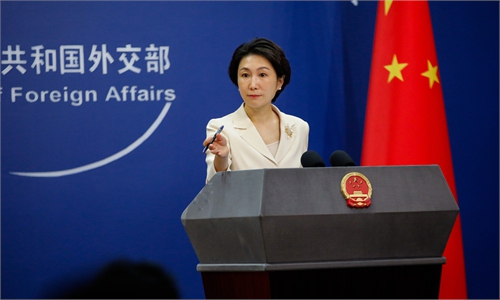
"The China-EU economic and trade relations are mutually beneficial and win-win in nature, and China has never deliberately pursued a trade surplus. We have noted the EU's statements on dialogue and are closely watching its moves," Chinese Foreign Ministry spokesperson Mao Ning said at a regular press conference on Friday, in response to a question over what topics have been discussed between China and the EU so far and whether China is concerned that the EU may take measures against China's trade practices, since an EU trade official has asked his Chinese counterpart to address China's so-called unsustainable trade balance issues.
China stands ready to engage in dialogue and communication with the EU, and hopes that the EU will abide by the fundamental principles of a market economy - free trade, fair competition, and open cooperation, Mao said.
At the WTO meeting, China proactively set the agenda by raising grave concerns over the EU's draft revision of the Cybersecurity Act and the Industrial Accelerator Act. China pointed out that the relevant provisions violate WTO rules and once implemented, would severely undermine the authority and effectiveness of multilateral trade rules. China urged the EU to amend or adjust them as soon as possible.
The EU's draft revision of the Cybersecurity Act, made under the pretext of safeguarding "cybersecurity", requires the identification of "countries posing cybersecurity concerns" based on "non-technical risks", which are highly unreasonable and arbitrary factors. EU regulatory authorities could thereby classify relevant enterprises as "high-risk suppliers" and, through mandatory "one-size-fits-all" measures, arbitrarily and systematically exclude enterprises from specific countries from entering the EU market, per the Xinhua report.
The measures stipulated in the Cybersecurity Act 2 draft will have a wide scope of impact and are highly discriminatory. Their significant negative effects on trade restrictions amount to disguised industrial protectionist measures, violating the General Agreement on Trade in Services (GATS) and other rules, as well as the EU's commitments to the WTO.
The Chinese delegation also noted that the EU's Industrial Accelerator Act imposes unreasonable restrictive requirements on foreign investment in four major emerging strategic industries within the EU: batteries, electric vehicles, photovoltaics, and key raw materials. The act forcefully imposes numerous restrictive clauses on specific foreign investments, including technology transfer, equity caps, local content requirements, and local employee ratio mandates, according to Xinhua.
In addition, this act affects services related to manufacturing, violates fundamental principles of a market economy such as commercial voluntariness and fair competition, constitutes investment barriers and institutional discrimination, and seriously contradicts WTO rules including the GATS, said the Chinese delegation.
The Chinese move to raise grave concerns came as Brussels has recently been preparing or rolling out a series of trade and industrial instruments, which industry insiders describe as increasingly discriminatory and exclusionary.
Reuters reported on May 29 that the European Commission was weighing stronger trade and industrial measures toward China after claiming that current EU-China trade and investment relations were "not sustainable", with specific measures not expected to be announced until the third quarter of this year.
"China has demonstrated a sincere willingness for rational communication and enhanced cooperation, expressing a commitment to resolving issues through mechanism-based and constructive consultations, rather than through unilateral measures, and is trying to avoid falling into purely argumentative or non-constructive confrontations," Jian Junbo, director of the Center for China-Europe Relations at Fudan University's Institute of International Studies, told the Global Times on Friday.
The EU's relevant practices are inconsistent with international rules and are illegal. Regarding the Cybersecurity Act 2, the designation of highly sensitive countries or regions could be based on purely political judgments and manipulation, lacking technical standards and norms, Jian said. "These provisions constitute political interference in economic and trade relations, which goes against WTO rules."
Meanwhile, the equity caps and controlling rights restrictions in the investment sector mentioned in the Industrial Accelerator Act would violate the principle of national treatment and directly contravenes WTO rules, Jian said, noting that China's explicit raising of these concerns at the relevant WTO meeting is highly appropriate.
Zhang Jian, a vice president of the China Institutes of Contemporary International Relations, told the Global Times on Friday that China has consistently advocated upholding the authority and effectiveness of the WTO and other evolving trade rules.
"China's serious concerns demonstrate its desire to resolve issues through communication within the WTO framework and further expose the EU's rule-breaking and protectionist behavior to the world," Zhang said. "The EU's blatant violations of WTO rules must be stopped."
On May 30, in response to questions regarding a recent meeting held by the European Commission to discuss its relationship with China, a spokesperson for China's Ministry of Commerce (MOFCOM) said that the communication channels between China and the EU remain smooth, and both sides are exploring the establishment of a trade and investment consultation mechanism and will hold relevant dialogues.
The spokesperson expressed hopes that the EU will work in the same direction as China to jointly implement the consensus reached by the leaders of the two sides, properly resolve differences and frictions through dialogue and consultation, and promote the stable and healthy development of China-EU economic and trade relations.
Should the EU side unilaterally introduce new trade instruments and adopt discriminatory restrictions, China will take resolute countermeasures and effective actions to safeguard its own interests, the MOFCOM spokesperson said.
RELATED ARTICLES