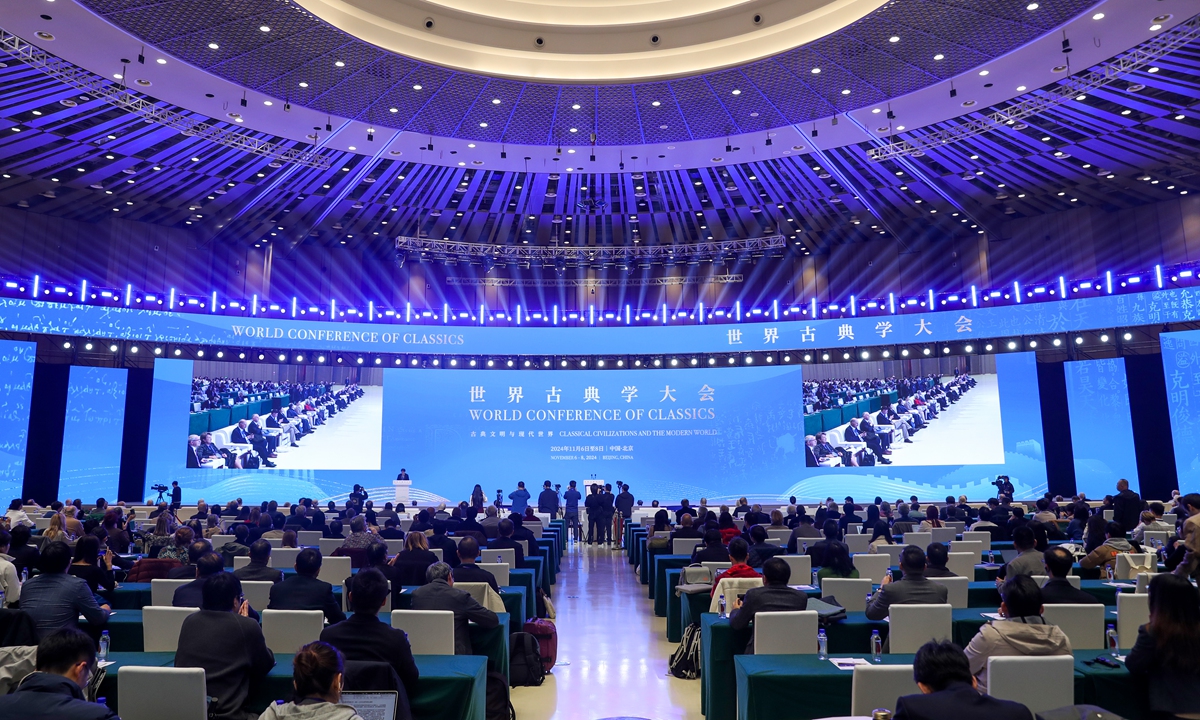
The first World Conference on Classics concludes at the Yanqi Lake International Convention & Exhibition Center in Beijing on November 8, 2024. Photo: VCG
The second World Conference on Classics will open in Athens in Greece on June 9. With the theme "Dialogue between Ancient and Modern: Contemporary Inspirations from Classical Wisdom," the event is jointly organized by the Chinese Academy of Social Sciences, the Ministry of Education and the Ministry of Culture and Tourism of China, the Greek Ministry of Culture, and the Academy of Athens. In fact, classical studies explore not only classical theories and canonical texts. Through the successive efforts of generations of scholars, there is a shared aspiration for classical wisdom to traverse the long river of history, shine with renewed vitality, and illuminate contemporary life.
Why should we still study a world that existed more than 2,000 years ago and explore how the ancient Greeks and Romans lived and thought?
Today, science, technology and productivity are flourishing, and the advent of the digital-intelligent era has connected the world in unprecedented ways. However, modern society is also confronting pressing challenges, including disordered values, restless utilitarianism, and the alienation of the individual. In this context, the seemingly distant ancient world becomes a valuable intellectual resource for reflecting upon and improving contemporary life. By comparing past and present, we have gained new perspectives to examine our own strengths and weaknesses, and to explore how to preserve the humanistic spirit, cultivate ideal character.
For the Chinese people, the significance of studying classical studies also lies in understanding Western civilization - different from our own - at its very origins. Since the Opium War, the Chinese people have engaged in a prolonged struggle for national survival and rejuvenation. The study of ancient Greek and Roman civilization has likewise become an integral part of absorbing Western intellectual resources and reshaping the spirit of the Chinese nation.
Over the past two decades and more, the growth of China's national strength and the sustained efforts of academia have enabled us to understand Western civilization from a more balanced and confident perspective. Research on ancient Greece and Rome helps us comprehend Western civilization at its roots, thereby promoting exchanges and mutual learning among civilizations, and enabling Chinese civilization, on its path of rejuvenation, to draw upon all the outstanding achievements of human civilization.
After the decline of ancient Greek and Roman civilization, the reason classical texts and wisdom have endured uninterrupted for millennia lies in the dedicated transmission by generations of classicists. Fritz-Heiner Mutschler, a German classicist with deep ties to China, stands as a model among them.
In recent years, incorporating China's classical studies into the global landscape of classical scholarship has become a shared aspiration among Chinese and international academic communities. To this end, Professor Mutschler devoted himself to creating opportunities for Chinese scholars to engage in equal dialogue with the international academic world, helping China's classical studies reach a global stage. He invited scholars from China and the West to participate in comparative research projects on the Roman Empire and ancient China, and organized international conferences. In 2024, he attended the first World Conference on Classics held in Beijing. However, before he could witness the convening of the second conference, he passed away in April this year.
Mutschler represents a generation of scholars who dedicated their energies to contributing to the development of classical studies in China. The seeds they sowed through tireless effort have now spread far and wide. Today, a new generation of scholars is taking up the responsibility of continuing the tradition of classical studies and safeguarding the wisdom of civilization. China's classical studies have already achieved fruitful results: The "Classics and Interpretations" series, dedicated to translating and studying Western classical texts and scholarship, has published more than 800 volumes; specialized research institutions such as the Center for Classical and Medieval Studies at Peking University have been established; and as a bridge connecting Chinese and Western classical civilizations, the first World Conference on Classics was successfully held, and The Chinese School of Classical Studies was established in Athens. These are the enduring achievements to which earlier scholars devoted themselves with unwavering commitment. As scholars of classical studies, we are fortunate to witness the convergence of disciplinary mission and national strategy, and a profound sense of duty and honor continues to well up within us, unceasing and undiminished.
The second World Conference on Classics is about to take place. Through dialogue and exchange, scholars from different cultural traditions will transcend geographical and perspectival limitations, transform classical wisdom into modern relevance, and respond to the urgent issues facing today's world. Through the study of the classics, civilizations can, in mutual reflection and respect, provide inspiration for contemporary human life. This is the best inheritance of classical scholarship and the most fitting testament to its contemporary significance.
The author is an assistant research fellow at the Chinese School of Classical Studies at Athens, Chinese Academy of Social Sciences. opinion@globaltimes.com.cn
RELATED ARTICLES