Chinese FM slams Nagasaki museum plan to downplay the Nanjing Massacre by using term ‘incident’
Chinese Foreign Ministry
China on Friday urged Japan to deeply reflect on its war crimes and make a clean break with militarism, saying history must not be overturned after reports that the city of Nagasaki planned to alter references to the "Nanjing Massacre" as "Nanjing Incident" in the updating of display panels at the Nagasaki Atomic Bomb Museum.According to Japanese broadcaster Nagasaki Bunka Hoso (NCC), the proposal was presented by the Nagasaki city government to the museum's operating advisory council on Thursday as part of preparations for a renovation project scheduled to begin in September 2026. Under the revision plan, a timeline entry currently stating "Occupation of Nanjing, Nanjing Massacre occurs" would be changed to "Nanjing Incident."
Responding to the reported revision at Friday's regular press conference, Foreign Ministry spokesperson Mao Ning said there is abundant evidence for the Nanjing Massacre—a horrendous war crime of Japanese militarists that shall never be erased. The Tokyo Trials ruled in black and white that the wartime atrocities of the Japanese army in Nanjing were a "massacre", not a mere "incident".
The Judgement of the International Military Tribunal for the Far East dedicated a special chapter to detail "the Rape of Nanking". With numerous survivors' testimonies, records of third-country witnesses and Japanese army files, the judgement, in the form of the ruling of international justice, made it very clear that the Japanese army who invaded China committed the heinous crime of the Nanjing Massacre. The Massacre's chief perpetrator Iwane Matsui was sentenced to death by hanging as a class-A war criminal.
The verdict of history must not be overturned. I noted that many survivors of the atomic bombs in Japan, Nagasaki citizen groups and people with insights have called for fully and accurately depicting the crimes and history of Japanese militarists as victimizers, according to the spokesperson.
"We urge the Japanese side to deeply reflect on its war crimes and make a clean break with militarism," Mao said.
The Nanjing Massacre remains one of the most horrific chapters of Japan's invasion of China. According to the People's Daily, on December 13, 1937, invading Japanese troops occupied Nanjing. Over the following six weeks or more, more than 300,000 innocent civilians and disarmed Chinese soldiers were brutally killed. Approximately 20,000 cases of rape occurred in the city, and about one-third of the buildings were burned down, creating the shocking Nanjing Massacre that stunned the world.
Terminology used to distort history
The manipulation of historical terminology is intended to beautify Japan's history of aggression, and reflects the lingering influence of militarism, Lü Chao, a research fellow at the Liaoning Academy of Social Sciences, told the Global Times on Friday. He noted that Japan has long distorted historical facts through the manipulation of terminology, for example by avoiding the term "surrender" in favor of "end of the war" or "defeat."
Such practices, Lü said, are part of a broader pattern among right-wing forces of denying the Nanjing Massacre and refusing to reflect on Japan's wartime aggression. He said they seriously hurt the feelings of victims and people in affected countries, and constitute a form of deliberate provocation.
It not only runs counter to abundant historical evidence and the international consensus, but also hampers Japan's ability to become a truly normal country and achieve genuine reconciliation with its neighbors, he added.
The planned move also recalls what scholars have described as the deliberate political use of the term "incident" in Japan's wartime narrative. Zhang Sheng, a professor at the School of History at Nanjing University, previously told the Global Times that newly uncovered archives belonging to William F. Webb, president of the International Military Tribunal for the Far East, showed Japan's use of the term was far from neutral.
During the Tokyo Trial, Akira Muto, a Class-A war criminal who bore significant responsibility for the Nanjing Massacre, acknowledged that Japanese authorities had consciously chosen to describe the war of aggression against China as an "incident" rather than a war in an attempt to deny its status as a formal war and avoid the constraints of international law. Webb explicitly pointed out this intention in his personal archives, Zhang said.
Such practices carry important implications for efforts today to shape historical discourse and ensure accurate historical representation, Zhang noted.
Deep divisions in Japanese society
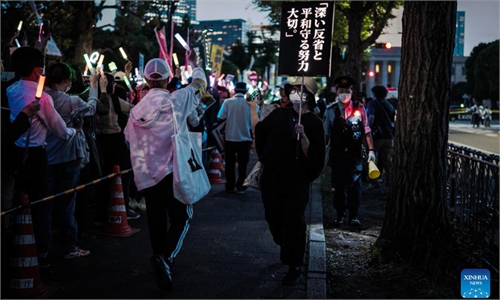
While the proposed change in terminology on the Nanjing Massacre has drawn criticism from both within Japan and abroad, including from civic groups urging the city not to downplay the country's wartime atrocities, Japanese media coverage has largely focused on another aspect of the draft revision, highlighting that the new exhibition panels explicitly identify the "invasion" by the former Japanese army as the cause of the war.
According to the Yomiuri Shimbun on Friday, the draft revision includes a description of the process through which the September 18th Incident developed into the Japanese war of aggression against China, stating that Japan "further advanced its invasion into North China." The report, citing a city official, explained that the reason for the wording was that, after examining junior high and high school textbooks, the term "invasion" was found to be the most frequently used expression, the Yomiuri Shimbun reported.
Although one committee member expressed the view that the term "invasion" may be inappropriate because its meaning can vary depending on standpoint and era, another member stated that the international community at the time recognized it as an act of invasion and therefore saw no issue, the Yomiuri Shimbun reported.
Experts noted that this reflects deep divisions within Japanese society over historical memory. While some voices within Japan's academic and civil circles call for confronting historical facts, the official mainstream stance remains ambiguous and at times dismissive of Japan's aggression against China. Narratives emphasizing Japan as a victim of the war tend to blur the distinction between aggressor and victim, thereby distorting public understanding of history, they stressed.
"Genuine peace education must be based on complete and honest historical facts. It should remember all victims, while also facing up to the responsibility for aggression. Only in this way can we avoid repeating cycles of distorted history rooted in selective memory," Lü added.
RELATED ARTICLES