Japan holds second expert meeting on security documents revision with media hyping ‘hegemonic tendencies of China’; Chinese expert warns Tokyo’s dangerous security policy shift
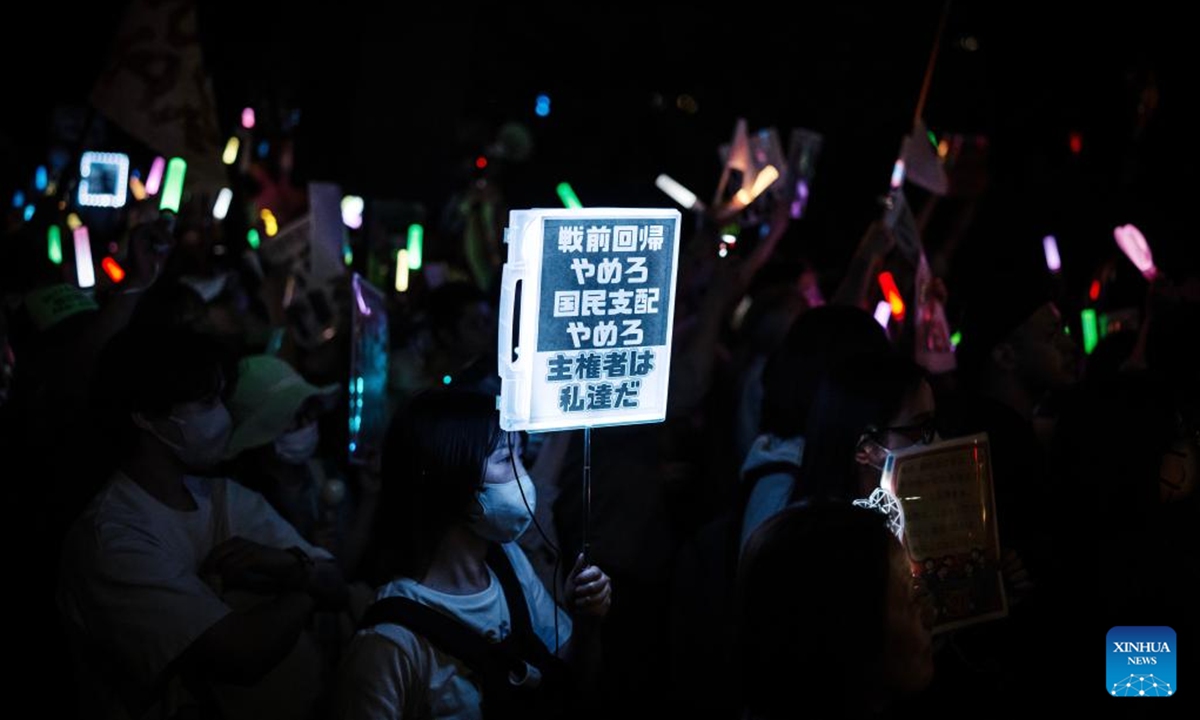
A woman holding a sign attends a protest rally in front of the National Diet Building in Tokyo, Japan, May 29, 2026. Around 10,000 people gathered in front of Japan's National Diet Building in Tokyo on Friday evening for an anti-war rally, protesting what they described as a series of dangerous policy moves pursued by the government of Prime Minister Sanae Takaichi. (Xinhua/Jia Haocheng)
The Japanese government on Monday convened its second expert meeting as part of its attempts to revise the three national security documents, with Japanese media claiming that one of the considerations behind the meeting is the so-called "increasingly aggressive hegemonic tendencies of China." A Chinese expert said that if Japan regards China - which plays the role of a peace promoter in the Asia-Pacific region - as an adversary, then it further confirms Japan's dangerous tendency to accelerate its shift toward military confrontation and allow the revival of militarism.
The government convened a meeting of experts at the Prime Minister's Official Residence on Monday to discuss the revision of three national security documents, including the National Security Strategy, Japan's Kyodo News reported. The meeting, titled "Expert Panel on Security from the Perspective of Comprehensive National Power," comprises 15 members in total, including experts on artificial intelligence (AI) and economic security, as well as senior representatives from the business community and media outlets, per Kyodo News.
Focusing on diplomatic and defense capabilities, the participants are expected to exchange views on forging closer coordination with like-minded partners to build a "free and open Indo-Pacific" vision amid what Japan views as China's so-called "growing hegemonic moves," as well as on bolstering defense capabilities covering cyber and space domains, Kyodo News report claimed.
Japanese right-wing forces have long harbored the ambition to re-establish a military power and revive militarism. The Japanese government's latest convening of an expert meeting to discuss revising the three security documents reflects Japan's schemes to openly promote arms expansion and push beyond the constraints of its exclusively defensive policy, Lü Chao, a research fellow at the Liaoning Academy of Social Sciences, told the Global Times on Monday.
This also signals that Japan's neo-militarism has taken firm root and gained considerable momentum, Lü added.
The top priority of Monday's meeting is the increase in defense spending, Japanese newspaper The Asahi Shimbun reported. The government has long kept defense expenditure at 1 percent of its gross domestic product. Yet the three incumbent security documents adopted in 2022 stipulated that this ratio would be raised to 2 percent by fiscal 2027.
Lü said against the backdrop of having yet to engage in profound reflection on its past war aggression crimes, Japan's drastic expansion of its armaments poses a grave threat to the security and stability of neighboring countries and the entire Asia-Pacific region, representing an extremely dangerous trend.
According to another report published by The Asahi Shimbun on Monday, given that Japan-China relations have continued to deteriorate due to the impact of Japanese Prime Minister Sanae Takaichi's erroneous remarks on Taiwan in November 2025, how the three documents define the perception of China has likewise become a focal point of attention.
In the current draft proposal by the Liberal Democratic Party (LDP), while it specifically references China's increasingly active military activities, it does not incorporate an assessment of the situation similar to that included in the 2022 proposal, according to the report.
However, during the first expert meeting held on April 27, Takaichi voiced so-called concerns over the military movements of certain countries including China, claiming that "to resolutely safeguard our nation's peace and independence, it is imperative to proactively advance the fundamental reinforcement of defense capabilities. The revision of the three [national security] documents constitutes a crucial measure bearing on the trajectory of national destiny," Jiji News reported.
Lü said from Japan's moves and strategic calculus, it has increasingly viewed China as a potential adversary, adding that the country's dominant ruling forces continue to insist on adopting a tough stance toward China and keep escalating tensions. "This will have a significant negative impact on the long-term development of China-Japan relations," he noted.
How Japan handles its relations with China serves as a key indicator of where its militaristic tendencies are heading, said Lü. By deliberately treating China — a core force safeguarding the post-war order and peace and stability across the Asia-Pacific — as a rival, Japan has further evidenced its dangerous drift toward military confrontation and its acquiescence to the resurgence of militarism, he added.
Fear-mongering of so-called threats to justify military buildup is a go-to tactic for Japanese militarism, Mao Ning, spokesperson from Chinese Foreign Ministry, said during a press conference on June 2 in response to a question about the review of the three principles on defense equipment transfer.
As explicitly stipulated in international instruments such as the Potsdam Proclamation, Japan is obligated under international law to be "completely disarmed" and not to maintain industries that "would enable her to re-arm for war." Japan, however, has been lifting the ban on lethal weapon export, rebuilding the war machine, and rapidly shifting to offense-oriented security and defense policies, Mao said.
Those dangerous moves bear an alarming resemblance to the course of actions taken by militarists in pre-war Japan. History has taught the world a painful lesson on appeasing and condoning militarism. Once that Pandora's box is opened, no one will be safe from the danger of raising a monster, the spokesperson said.
RELATED ARTICLES