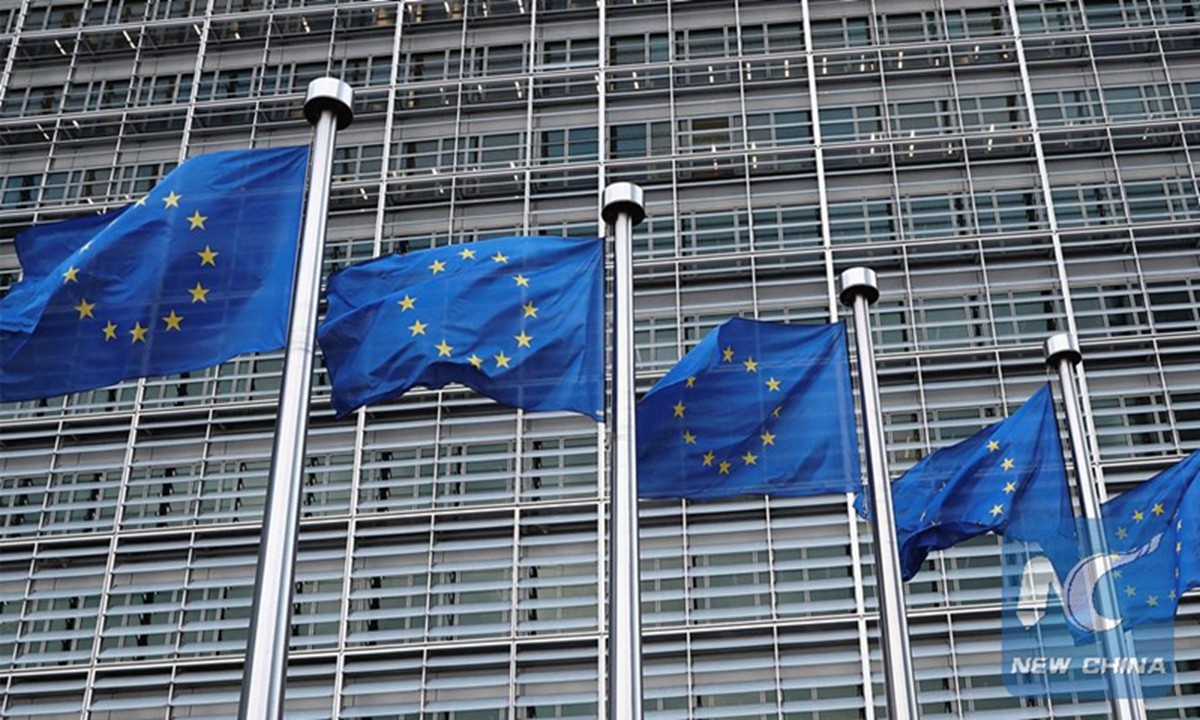
The European Union flags in front of EU headquarters in Brussels, Belgium. Photo: Xinhua
In recent years, amid growing geopolitical turbulence, as well as widening fractures and uncertainties in transatlantic relations, some European policymakers increasingly view strategic autonomy, particularly reducing absolute dependence on the US in key sectors, as an essential prerequisite for safeguarding Europe's future development and long-term interests.A recent article published by Foreign Policy, titled "Europe is slowly getting ready to ditch America," argues that European countries "can slowly move away from US overreliance by making long-term decisions that return strategic sovereignty to Europe."
Europe's most pressing challenge remains its heavy dependence on the US in the defense sector, including American military presence, security guarantees, defense equipment and military technologies.
In the short term, European leaders recognize that a sudden US withdrawal would severely undermine the continent's existing security architecture. As a result, Europe is focusing on gradually reducing American influence through institutional reforms, joint defense projects, defense industrial development and diversified security partnerships.
Within the NATO framework, European countries have taken a more proactive role. At the 2025 NATO Summit in The Hague, members made a commitment to investing 5 percent of GDP annually on core defense requirements and defense- and security-related spending by 2035.
Europe is also seeking greater leadership in strategic planning, military exercises and deployments in key regions such as Greenland, the Baltic Sea and the Arctic, thereby enhancing its capacity to shape regional security outcomes. In the defense industrial sphere, the EU continues to advance initiatives such as the ReArm Europe Plan/Readiness 2030 and Security Action for Europe, both designed to facilitate defense financing among member states.
At the same time, the EU is strengthening cooperation with countries such as Canada and the UK under existing frameworks, using these partnerships to facilitate broader defense-industrial cooperation among Western allies.
In building capabilities in critical defense sectors, Europe has advanced multinational cooperation in the development and procurement of military equipment and weapons systems.
However, the challenge extends beyond dealing with a US that appears increasingly distant in terms of values, security commitments and economic interests. Europe must also consider how to navigate a global environment characterized by rising conflicts, intensifying competition, and increasingly fragile international rules and institutions.
In fact, both the EU's self-perception as a normative power and the reality that its prosperity and development have long been embedded in an open and peaceful international order suggest that Europe's pursuit of strategic autonomy, as well as its efforts to mitigate risks associated with the US, depends on building closer and more constructive cooperation with other major powers.
As two major markets and two major civilizations, China and the EU continue to share substantial common interests in maintaining international stability, addressing global challenges, and strengthening mutually beneficial cooperation. There remains significant potential for collaboration in areas such as climate governance, the global green transition, WTO reform, development financing for the Global South, AI governance and public health. Given their respective capabilities and comparative advantages, China and the EU could play an important role in shaping and implementing global rules and standards in these fields.
Many of the recent difficulties in China-EU economic and trade relations stem from the EU's tendency to view pressure and coercive measures as tools for strengthening strategic autonomy and enhancing competitiveness, while underestimating the damage that protectionist policies can inflict on its own strategic credibility and market attractiveness.
The EU should therefore adopt a broader understanding of the relationship between competition and cooperation, engage major partners through openness and mutual respect, and work together to create greater stability and predictability in an increasingly uncertain world.
The author is an associate research fellow at the Belt and Road Academy of Beijing Language and Culture University. opinion@globaltimes.com.cn
RELATED ARTICLES