China ranks second globally in intelligent computing power as digital integration gains pace: report
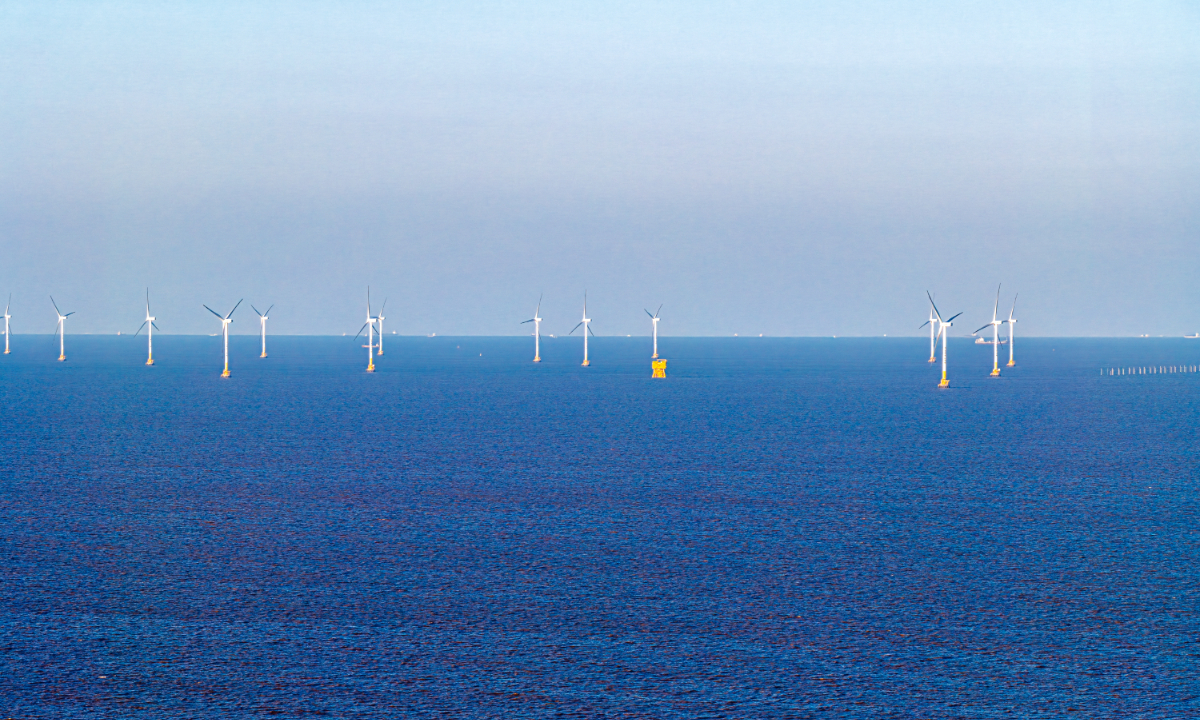
An offshore data center powered directly by wind energy is seen in waters east of the Lingang Special Area in Shanghai on May 29, 2026. The facility is the world’s first undersea data center connected directly to offshore wind power. Photo: VCG
China’s intelligent computing power scale reached 1.59 million PFLOPS by the end of 2025, giving the country the world’s second-largest pool of high-end AI computing capacity, according to the Digital China Development Report 2025 released by the National Data Administration (NDA).
The report, which reviewed China’s digital progress in 2025, said the country will move faster in 2026 to integrate the real economy with AI and other digital tech, leveraging its strong digital infrastructure, rich application scenarios and high-quality talent.
China’s computing infrastructure became increasingly concentrated and efficient last year, with the country operating more than 13.73 million standard racks of computing facilities at the end of 2025 and building 42 large intelligent computing clusters, the report said.
Computing power refers to the combined capacity to process information, transmit data through networks and store digital data. Chinese authorities see computing power as part of digital infrastructure, alongside networking and application facilities.
China’s computing sector also made progress in green development, with the average power usage effectiveness, or PUE, of ultra-large computing facilities falling to 1.34 by the end of 2025 and more than 160 computing facilities receiving a green and low-carbon rating of 4A or above, according to the report.
The national integrated computing power trial and verification platform has been put into operation, monitoring 1,129 computing facilities and making 110,000 PFLOPS of computing power schedulable to support the national economy, major scientific research and government services, the report said.
China’s digital development is entering a new phase in which computing power is becoming a basic condition for industrial upgrading rather than merely a technological indicator, Liu Dingding, a veteran industry analyst, told the Global Times on Tuesday.
As AI models, industrial software and digital public services all require computing power, China’s priority is shifting from simply expanding capacity to making that capacity easier to coordinate and use across regions, which will help lower application costs and allow digital technologies to play a more direct role in the real economy, Liu said.
Regarding AI, China has shown strong technological capability and robust development momentum, with the report describing the country as among the fastest globally in the iteration of large models, the report noted. By the end of 2025, China had completed filing procedures for 748 generative AI services, including 446 newly filed during the year.
The user base for AI applications has also grown rapidly. China had 602 million generative AI users at the end of 2025, up 141.7 percent from a year earlier, as the country’s internet penetration rate reached 80.1 percent, according to the report.
Generative AI is already becoming part of everyday life for different groups in China, with young and middle-aged users and those with higher education levels forming the core user base. Users under the age of 40 accounted for 74.6 percent of the users.
The year 2026 marks the beginning of the 15th Five-Year Plan period (2026-2030) and the start of the second decade of Digital China Initiative, a concept first put forward in 2015, according to the report.
As China enters this new stage, the report said the country still faces challenges, including gaps in some core technologies, the need to broaden and deepen digital applications, and the task of strengthening the security governance system. It called for a more systematic effort to ramp up the construction of Digital China.
In 2026, the so-called intelligent economy is expected to take shape at a faster pace, while digital and intelligent technologies upgrade the service sector, computing resources become larger, more integrated and greener, and international cooperation moves to a higher level, the report said.
This year’s Government Work Report set the goal of achieving further progress in advancing the Digital China Initiative and raising the value added of core digital industries to 12.5 percent of GDP.
“Reaching the target would require the major digital industries to grow faster than the overall economy during the next five years,” Wang Wei, director of the data resources research department at the National Data Development Research Institute, said in March. “The digital economy will truly become a main engine and ballast stone for driving the country’s economic growth,” Wang said.
According to the report, China will further integrate the real economy with the digital economy this year, with the “AI Plus” initiative continuing to upgrade traditional industries and emerging pillar sectors such as semiconductors, the low-altitude economy and intelligent robots expected to greatly improve efficiency.
Global Times
RELATED ARTICLES