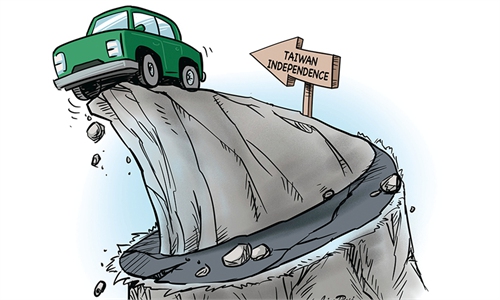
Big picture settled: Petty Taiwan visit by a handful of South Korean lawmakers doomed to fail
Taiwan Photo: VCG
Xi Jinping, general secretary of the Communist Party of China (CPC) Central Committee and Chinese president, returned to Beijing on Tuesday afternoon after concluding his state visit to the Democratic People's Republic of Korea (DPRK). The two-day visit covered a wide range of topics and was of far-reaching significance. Xi reviewed the traditional friendship between China and the DPRK and deliberated on the development of the bilateral relationship with Kim Jong-un, general secretary of the Workers' Party of Korea and president of the State Affairs of the DPRK. The two leaders strengthened top-level planning and strategic guidance for China-DPRK relations in the new era and reached important consensus.The most noteworthy aspects of this visit were Xi's elaboration on the three "no changes" and four proposals on developing China-DPRK relations in Pyongyang. The three "no changes" are: No matter how the international situation changes, the Chinese party and government's firm stance on highly valuing China-DPRK traditional friendship will not change, the firm support for General Secretary Kim in leading the DPRK's socialist cause will not change, and the firm commitment to safeguarding the shared interests of the two countries and preserving a favorable strategic environment will not change. They underscore China's consistent approach to developing China-DPRK relations and demonstrate that the traditional friendship between the two countries is unbreakable and grows stronger with time.
The four proposals, meanwhile, chart a course for advancing China-DPRK relations in step with the times and achieving greater development across four dimensions: high-level exchanges, benefits to the people, the inheritance of friendship, and fairness and justice.
The intensive high-level diplomacy over the past month fully demonstrates China's strategic initiative in coordinating relations with major powers and neighboring countries, as well as its responsibility as a major country in maintaining regional peace and stability, against the backdrop of a century of profound changes and global turmoil.
Against this general trend, the petty maneuvers of certain individuals look utterly ridiculous.
On Monday, a small number of South Korean lawmakers made a sneaky visit to China's Taiwan region. The Chinese Embassy in South Korea has lodged a solemn protest, expressing its firm opposition and emphasizing that the Taiwan question is purely China's internal affair and lies at the core of China's core interests, and that the one-China principle is the political foundation for the development of China-South Korea relations. The Chinese Ministry of Foreign Affairs urges the South Korean side to earnestly abide by the one-China principle, not engage in any form of official exchanges with China's Taiwan region, avoid being exploited by "Taiwan independence" separatists or send wrong signals to them, and take concrete actions to safeguard the healthy and stable development of China-South Korea ties.
No matter how much they jump up and down and make a fuss, these petty maneuvers by a handful of South Korean lawmakers will only end up embarrassing themselves.
First, they cannot alter the foundation of the one-China principle. No matter how much individual lawmakers may stir up trouble, they cannot change the historical and legal fact that Taiwan is part of China's territory, nor can they shake the fundamental framework upheld by the international community adhering to the one-China principle.
Second, they undermine South Korea's own diplomatic credibility. Seoul has repeatedly reaffirmed its respect for the one-China principle, yet it turns around to condone certain individuals exploiting the Taiwan question for their own ends. Such inconsistency between words and deeds will only lead the outside world to suspect a tendency toward political opportunism.
Third, it will not affect China's strategic arrangements. Today, China no longer passively responds to issues in its neighborhood; instead, it proactively plans, shapes the situation and sets the agenda. A few lawmakers making a trip to the Taiwan region is nothing more than a minor nuisance. It simply cannot make any waves.
Meanwhile, certain Japanese officials and politicians claim to be keeping a close eye on interactions between China and the DPRK. What exactly are they watching for? Most likely, they are tracking new developments in China's diplomacy with its neighbors. In recent years, Japan has frequently sought to assert its presence in regional affairs. The problem, however, is that for all its talk of safeguarding security, its real aim is expansion; while it ostensibly advocates for stability, it constantly stirs up trouble, thereby exposing its underlying strategic anxiety.
This is precisely a striking feature of the current situation in Northeast Asia: The forces that can truly shape the broader landscape are those with strategic resolve, comprehensive strength and a clear direction; whereas those who attempt to create ripples through petty maneuvers, petty tricks and gimmicks will only appear increasingly marginalized in the face of the prevailing trend.
The broader picture is already set; petty maneuvers are doomed to go nowhere. The tricks of certain South Korean lawmakers merely serve to embarrass themselves. Moreover, Japanese officials keeping a close eye on interactions, when all is said and done, reflects nothing more than a complex mix of emotions - watching the situation unfold while being unable to intervene. The timing and momentum are firmly in China's hands.
RELATED ARTICLES