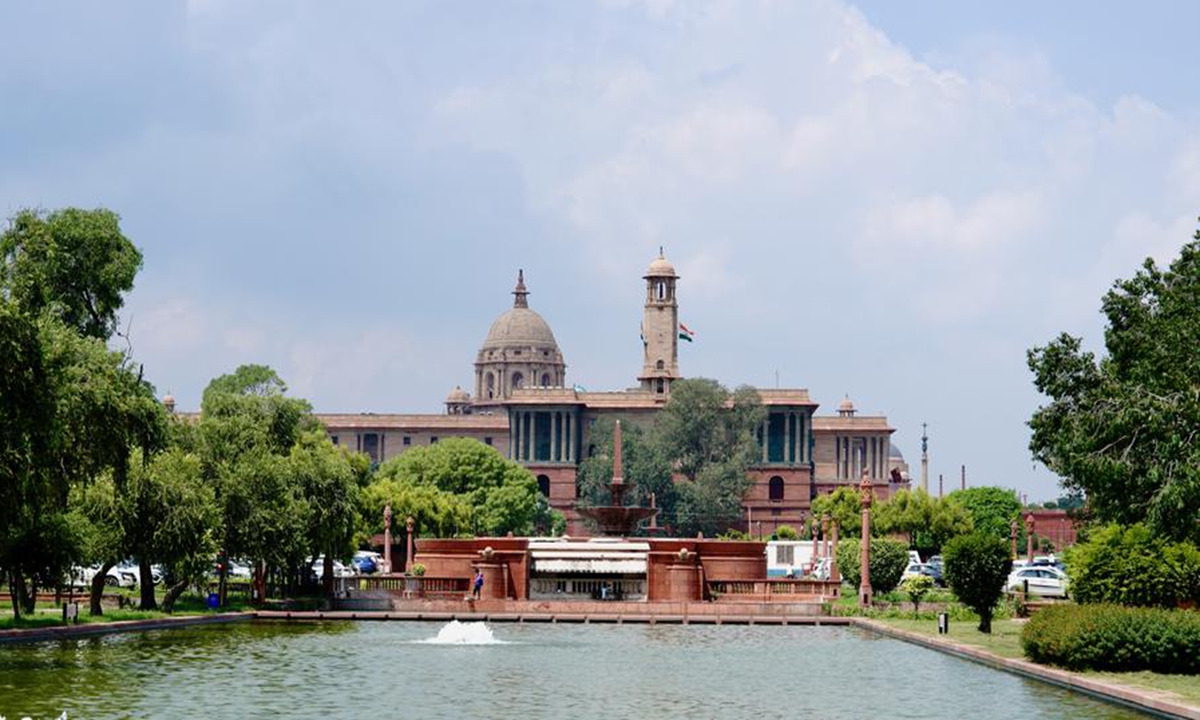
A view of the Rashtrapati Bhavan in New Delhi, India Photo:Xinhua
Although a week has passed since US Secretary of State Marco Rubio's visit to India, the extent to which it has "repaired" US-India relations or "reassured" New Delhi's strategic anxieties remains under scrutiny. Against the backdrop of profound changes in the international landscape and complex adjustments in major-power relations, lingering doubts about Washington's reliability continue to haunt segments of India's strategic and public discourse.The pursuit of "strategic autonomy" has been a consistent declaration of India's foreign policy across successive governments. However, policy formulations and their practical outcomes have varied across different periods.
When India's diplomacy is mentioned, many first think of "non-alignment," an approach that India's first prime minister, Jawaharlal Nehru, made the cornerstone of India's foreign policy. During the Cold War between the US and the Soviet Union, "non-alignment" allowed India to avoid choosing sides between the two blocs. Instead, under a framework of strategic autonomy and pragmatic policy, India maintained relations with both sides, obtaining substantial aid and support from the US and the Soviet Union.
Beginning in the 1950s and 1960s, under the banner of "non-alignment," countries such as India and Yugoslavia jointly initiated and advanced the Non-Aligned Movement. In 1964, many countries across Asia, Africa and Latin America established the Group of 77 in an effort to safeguard their sovereignty and national interests. One key motivation was to avoid being drawn into the US-Soviet bloc confrontation and to adhere to "non-alignment." In this historical context, India not only benefited from maneuvering between the US and the Soviet Union but also enhanced its image within the "Third World."
Entering the 21st century, especially after the Bharatiya Janata Party (BJP) came to power in 2014, the term "non-alignment" has gradually faded from India's diplomatic discourse. On the one hand, this reflects an adjustment made by the BJP government for domestic political considerations. "Non-alignment" is often seen as a legacy of Nehru and the Indian National Congress (INC). To weaken the political influence and appeal of its rival, the ruling BJP has tended to downplay or even repudiate certain policies under INC's rule. One manifestation of this is that the term "non-alignment" is rarely mentioned in foreign policy statements anymore, with the term "multi-alignment" being used more and more frequently instead.
On the other hand, today's international landscape, which is different from that of the Cold War, provides the external context for New Delhi's shift toward "multi-alignment." Global multipolarity has become an irreversible trend. The collective rise of the Global South is a defining feature of today's international transformation. Following the same pragmatic logic, India now emphasizes "multi-alignment," describing this as a realistic path to achieving strategic autonomy.
However, the "alignment" in New Delhi's "multi-alignment" is clearly different from both the Non-Aligned Movement and alliance structures in the US-led system. This "multi-alignment" means making decisions to align or not align on different issues according to one's own national interests, with the aim of effectively managing multiple major-power relationships. A typical example is India's response to the ongoing Russia-Ukraine conflict: It has refused to follow the US and its Western allies in sanctioning Russia, continuing Russian oil purchases and bilateral economic and trade cooperation, while striving to sustain sound ties with Washington. Yet in practice, this balancing diplomacy has struggled to prevent India's varied diplomatic "alignments" from conflicting with one another, contrary to New Delhi's expectation of "mutual non-interference."
It is thus evident that, whether under the INC's "non-alignment" policy or the current government's emphasis on "multi-alignment," the underlying principle guiding New Delhi remains the pursuit of strategic autonomy and the safeguarding of national interests.
Based on this logic, India should not wait for "reassurance" from any external power; instead, it should reassess its own strategic situation and move more quickly and decisively toward adjustments that genuinely advance its strategic autonomy and serve its core national interests. In this regard, making greater efforts to improve, stabilize and develop relations with China, and promoting China-India relations along a healthy and stable trajectory, is undoubtedly of critical importance. The history of China-India relations shows that it is the right choice for both sides to become partners for mutual success and "have the dragon and elephant dance together." This is also fully in line with the fundamental interests of both countries and their peoples.
The author is the director of the Institute for South Asian Studies of the China Institutes of Contemporary International Relations. opinion@globaltimes.com.cn
RELATED ARTICLES