Former LDP president Yohei Kono passes away; Japan’s Takaichi administration should learn from his legacy of facing history: Chinese experts
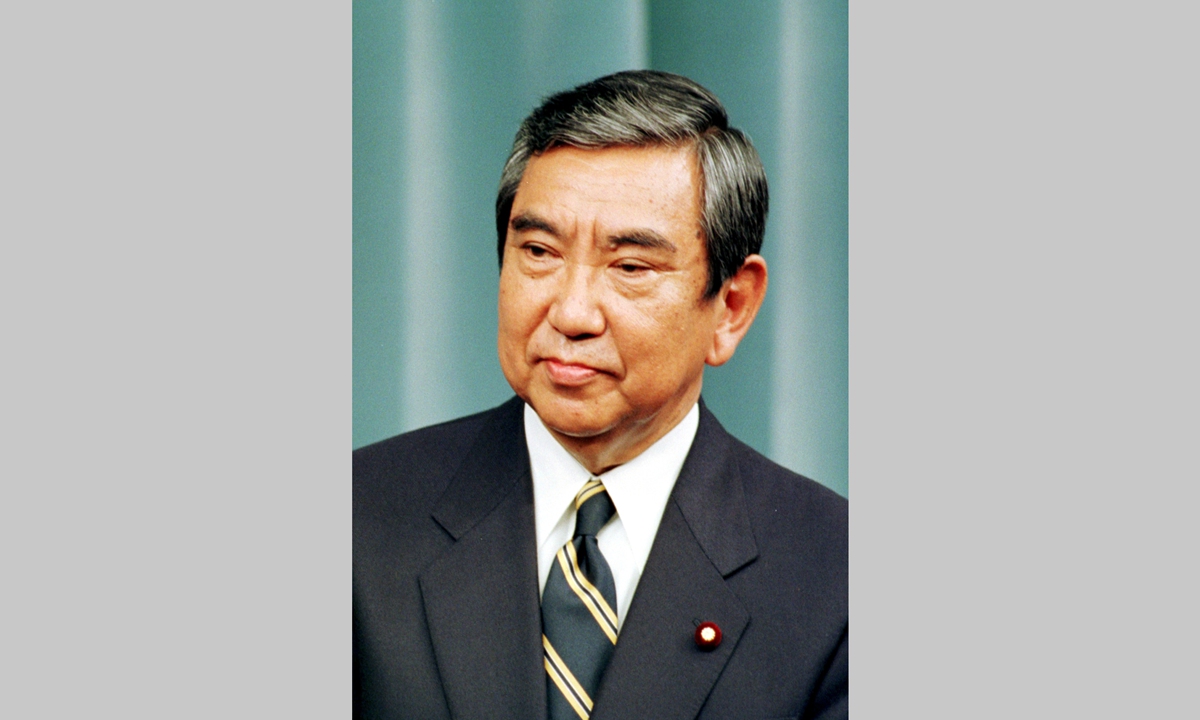
File Photo of Yohei Kono in 1999 Photo: VCG
Japan's former House of Representatives speaker Yohei Kono, who served as president of the Liberal Democratic Party (LDP) and foreign minister, passed away on Monday at the age of 89, according to Japanese media reports. He was widely known for issuing the landmark 1993 Kono Statement acknowledging Japan's wartime responsibilities and had been working for China ties.Chinese experts noted that Kono represented a generation of Japanese politicians who were willing to confront historical facts and promote friendly ties with China despite huge domestic political pressure. At a time when China-Japan relations remain strained due to Japanese Prime Minister Sanae Takaichi's erroneous remarks regarding Taiwan, Japan should reflect on Kono's political legacy rather than continue down a wrong path.
According to TBS News, Kono was born in 1937. In 1976, he left the LDP after criticizing the party's money-driven political culture and founded the New Liberal Club, before returning to the LDP. In 1993, as chief cabinet secretary in the Miyazawa Cabinet, he issued the Kono Statement.
The full text of the Kono Statement has been publicly released on the official website of Japan's Ministry of Foreign Affairs. The statement acknowledged the Japanese military's direct involvement in the establishment of "comfort stations" on the Korean Peninsula, in China and other places, as well as the coercion of local women into serving as "comfort women," and expressed apologies and remorse over the issue.
The Kono Statement, together with the 1982 Miyazawa Statement and the 1995 Murayama Statement, constitutes the most important set of official statements by the Japanese government reflecting on historical issues stemming from its wartime aggression.
"These three statements were particularly valuable given the broader political climate in Japan at the time, when much of the political establishment avoided confronting historical responsibility and remained reluctant to face their mistakes of the war," Lian Degui, director of the Center for Japanese Studies at Shanghai International Studies University, told the Global Times.
"The three statements represented the official position of the Japanese government. They constituted a rare and full official acknowledgment of issues related to Japan's war of aggression in the postwar era," Lian said.
Lü Chao, a professor at the Liaoning Academy of Social Sciences, told the Global Times that the statements demonstrated that there had once been a group of clear-minded and historically responsible figures within Japan's political establishment.
"The core of today's Japanese right-wing politics is characterized by extreme populism and narrow nationalism, while the three statements challenged such erroneous thinking from the very beginning," Lü said, adding that Japan should face history squarely. "Peaceful and friendly relations across generations remain the shared aspiration of the Chinese and Japanese peoples," Lü said.
Major Japanese media outlets reported on the death of the former LDP president, with some highlighting the significance of the Kono Statement in their coverage of his death.
Japan's Mainichi Shimbun specifically referred to the Kono Statement on the comfort women issue and noted that Kono had issued the statement acknowledging the responsibility of the former Japanese military and apologizing over the matter.
Yomiuri Shimbun noted that Kono became speaker of the House of Representatives in November 2003 and served for 2,029 days. In September 2008, he announced that he would not run in the next House of Representatives election.
International media coverage focused heavily on Kono's role in addressing Japan's wartime past. AP News ran the headline "Yohei Kono, who apologized for Japan's wartime sexual abuses of 'comfort women,' dies at 89," while noting in the article that Kono had placed great importance on promoting friendly ties with China, South Korea and other Asian countries that suffered Japanese atrocities before and during World War II.
The Kono Statement led to Japan's broader apology over its wartime atrocities in a 1995 statement by then prime minister Tomiichi Murayama. Both statements were regarded internationally as signs that Japan had come to terms with its wartime past, and they helped to improve relations with its Asian neighbors, according to AP.
"But the statements have become unpopular among Japanese conservatives who say Japan should stop focusing on negative history to restore national pride," AP reported.
Beyond historical issues, Kono was also widely recognized for his longstanding commitment to improving China-Japan relations. After stepping down as the speaker of the Japanese House of Representatives, Kono devoted his efforts to strengthening Japan-China relations, Yomiuri Shimbun reported.
In 2018, Kono attended an event held as part of the third Understanding China Conference. According to the China Institute for Innovation & Development Strategy (CIIDS), which hosted the event, Kono said he had maintained ties with China for more than 50 years and had visited China many times.
The Mainichi Shimbun reported that Kono was serving as chairman of the Association for the Promotion of International Trade (JAPIT) and had planned to lead a delegation to China later this month. Meetings with senior Chinese officials were reportedly under discussion.
According to the report, official visits to China by major Japanese business organizations have largely stalled following erroneous remarks made by Takaichi regarding Taiwan in November last year. Had the association's visit taken place, it would have been the first such trip since those remarks.
Observers had been closely watching whether Kono's planned exchanges with the Chinese side could help ease tensions in bilateral relations, the Mainichi Shimbun reported.
A person who accompanied Kono on multiple visits to China told the Global Times that Kono was approachable and down-to-earth in daily interactions and devoted decades of efforts to promoting exchanges between the two countries.
The source said Kono made substantial contributions to bilateral relations and, because of his stance, he often faced attacks, smears and criticism from Japanese right-wing forces. Nevertheless, he consistently defended China-Japan relations in public settings.
The source recalled attending an event in Tokyo where a Japanese diplomat made inappropriate remarks about China. Kono immediately reminded the diplomat to "mind your words."
"At a time when bilateral relations have been severely damaged by Takaichi's erroneous remarks and by Japanese right-wing forces, it is even more valuable to have politicians in Japan committed to friendship with China, and continued to push back against the current anti-China tendencies within the Japanese government," Lü said.
"Kono was one of the most representative figures. He consistently advocated friendship with China, faced historical facts directly, and publicly apologized over sensitive historical issues such as the 'comfort women' issue. Such vision and sense of responsibility are rare in Japanese politics and stand in sharp contrast to the short-sighted approach of the Takaichi administration, which prioritizes short-term political gain over long-term regional peace," Lü said.
Lü added that China-Japan relations have now reached their lowest point since the normalization of diplomatic relations between the two countries.
"If Takaichi does not retract and apologize for her erroneous remarks concerning Taiwan, there will be no possibility of restoring China-Japan relations, " he said, adding that "this situation is also deeply saddening for the generations of Japanese politicians and people who have worked to promote China-Japan friendship and improve bilateral relations over the decades."
RELATED ARTICLES