‘Innovative, inspiring and enlightening,’ Bangladeshi students take close look at China’s social and economic devt, seeking experience for Bangladesh
By Published: Jun 11, 2026 08:42 PM

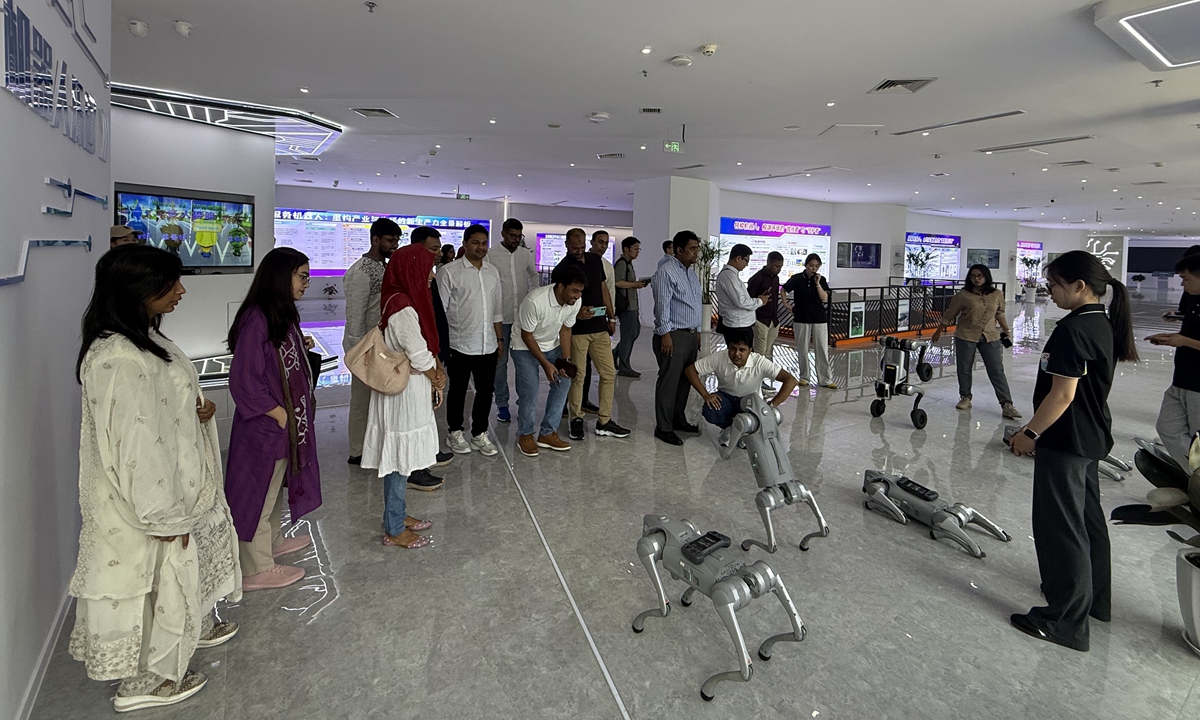
A delegation of youth, women, and student representatives from the Bangladesh Nationalist Party (BNP) visits Chongqing Robot AI Application Exhibition Center on June 6, 2026. Photo: Courtesy of the delegation
In recent days, a delegation of youth, women, and student representatives from the Bangladesh Nationalist Party (BNP) visited Southwest China's Chongqing and Shanghai, taking a close look at various aspects of China's economic and social development. "Innovative, inspiring, and enlightening," Md. Abidul Islam Khan, a student leader of the BNP's student wing, told the Global Times on Thursday when describing the ongoing trip.
The aspect that surprised me most was the practical use of advanced technology and automation. At the Chongqing Robot AI Application Demonstration Center, I saw robots and AI systems being used in real industrial and service applications, not just as future ideas, the Bangladeshi student leader said.
"I was also impressed by the management style in the companies we visited, especially the focus on efficiency, teamwork, and continuous innovation. At Shanghai Xincheng Information Technology Co., Ltd., it was clear that technology development is closely connected with education and industry needs," Abidul Islam Khan said.
The Bangladeshi student representative also noted that there was a moment during these visits when he thought about Bangladesh's young population and growing economy. "We have enormous potential, but we need stronger investment in technical education, digital skills, and innovation. Seeing how China connects technology, training, and industry made me feel that this is exactly the kind of experience Bangladesh can learn from."
This is the second delegation of Bangladeshi youth to gain a glimpse of their country's technological future during a visit to China. In April, the Global Times reporter accompanied a high-level Bangladeshi delegation on a visit to Beijing's E-Town area, which is now home to more than 300 robotics companies and a complete industrial chain.
Before departing for China, the Chinese Embassy in Bangladesh held a pre-departure exchange meeting where the Chinese Ambassador to Bangladesh Yao Wen said China attaches great importance to the visit and has carefully arranged a diverse program of tours, exchanges, and discussions, according to a readout released by the embassy.
Yao also expressed hope that the delegation would make full use of the opportunity to observe, learn, and reflect, and to combine China's development experience with Bangladesh's national conditions, thereby contributing wisdom and strength to Bangladesh's economic and social development, the readout said.
"Before coming to China, I already knew that China had achieved remarkable economic growth and urban development. But seeing Chongqing with my own eyes gave me a much deeper understanding of how that development works in practice," Abidul Islam Khan said.
The Bangladeshi student representative continued that what impressed him most was the combination of modern infrastructure, digital technology, and efficient public services. "At the Chongqing City Exhibition Hall, we saw how long-term planning shaped the city's growth. The cleanliness of public spaces, the smooth public transportation system, and the way technology is used in everyday services all stood out to me," he said.
Another aspect that left a strong impression was the sense of organization and discipline in daily urban life, which showed how planning and public participation can make a very large city function efficiently, the student added.
During a meeting between Chinese Foreign Minister Wang Yi and Bangladeshi Foreign Minister Khalilur Rahman in Beijing on May 6, Wang said China is ready to promote the alignment of the high-quality Belt and Road cooperation with Bangladesh's national development strategies, deepen cooperation in traditional areas like economy, trade, investment, infrastructure, water conservancy and people-to-people exchanges, expand cooperation in emerging industries such as green development and digital economy, and support Chinese enterprises to invest in Bangladesh, according to the Xinhua News Agency.
"While Bangladesh and China already enjoy strong economic and business relations, I believe the next stage of the relationship should focus more on people-to-people connections," Abidul Islam Khan said.
For many Bangladeshis, China is viewed as an enigma - a country respected for its remarkable achievements but not always fully understood. Visits like this help bridge that gap by allowing young people to experience China directly, interact with its people, and better understand its society and development journey, he said.
Bangladesh has a large, energetic, and ambitious youth population. By working together in education, innovation, and cultural exchange, Bangladesh and China can create new opportunities for the next generation and strengthen the foundation of our bilateral relationship for years to come, Abidul Islam Khan said.
RELATED ARTICLES