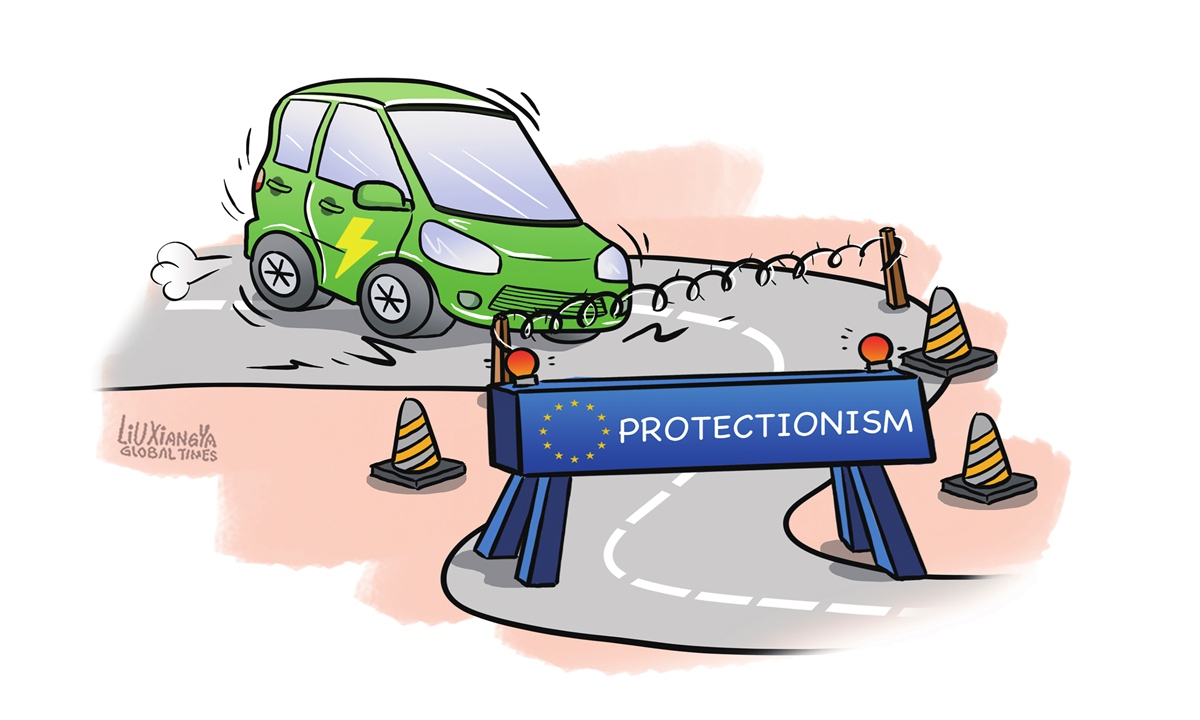
Illustration: Liu Xiangya/GT
Renault's Chief Executive Francois Provost on Wednesday said that the EU should encourage Chinese carmakers to go beyond assembling cars in Europe and source auto parts in the region as well, Reuters reported. He also mentioned that 95 percent of the added value is done by parts producers, so Europe would gain if Chinese makers sourced more of their parts locally.What Provost highlighted is a trend that the European auto industry is watching closely. As Chinese carmakers invest in new plants across Europe to localize production, a gradual shift toward regional component suppliers for at least part of their procurement is likely, driven by logistics costs, delivery timelines, and after-sales responsiveness.
But the crux of the matter is not whether localization will happen, but how this local supply chain will be built. A sustainable supply chain does not rely on administrative orders; rather, it requires stable cost advantages, reliable technical capabilities, and efficient logistics. If the EU wants Chinese carmakers to buy more locally, it must first ask itself: can its local components industry offer competitive prices and quality? If European auto parts can match the cost-performance and technology that Chinese automakers need, companies will have no reason to look elsewhere.
None of this industrial matching or supply chain optimization can be achieved through policy mandates alone. It requires long-term commercial cooperation, repeated technical alignment, and continuous improvement between upstream and downstream companies. European industry players should clearly recognize that industrial chain cooperation is a gradual process that takes time, trust, and an open, pragmatic mentality from all sides.
In reality, who captures a larger share of this promising supply landscape depends on who offers the best combination of cost, technology, and service. Chinese component suppliers have both the motivation and the ability to support their domestic automakers overseas, and they have built strong technological and scale advantages in power batteries and intelligent components. Europe's traditional parts giants, on the other hand, possess deep strengths in precision manufacturing, chassis systems, and electronic and electrical architectures.
Suppliers from South Korea and elsewhere are also eyeing the European market. Competition itself is a good thing - it drives efficiency and technological progress, and the entire industrial ecosystem ultimately benefits.
What the EU needs to do is to foster this process with open policies and practical actions, rather than disrupt it with protectionist barriers. The future of Chinese‑European automotive cooperation depends on whether the two sides can find room for collaboration amid competition and build a foundation of mutual trust despite their differences.
Regrettably, some recent moves by the EU run counter to this direction. In late May, EU commissioners described the current state of the bloc's trade and investment relationship with China as "not sustainable," while the EU's proposed Industrial Accelerator Act will subject Chinese investors to discrimination in violation of basic market economy principles such as voluntary participation in commercial activities and fair competition.
Such policy positioning and protectionist tendencies not only undermine the hard‑won mutual trust that has been built, but also raise institutional transaction costs for multinational firms, distort the allocation of market resources and divert industrial players' energy from technological innovation to coping with policy and regulatory changes.
Cooperation between the Chinese and European vehicle industrial chains represents a mutually beneficial opportunity for both sides. The intersection of their interests is precisely where cooperation can thrive. However, such cooperation must be two-way, equitable, and grounded in commercial rules. Neither side should attempt to force the other's business decisions through protectionist measures. Local sourcing of components should be the outcome of this cooperation, not a precondition.
The possibility is real that European industry can benefit from local sourcing by Chinese carmakers. But Europe cannot demand that benefit through protection - it must earn it through competitiveness. If the EU can set aside protectionist impulses and focus on what genuinely strengthens its industrial base, then the vision of European suppliers thriving alongside Chinese automakers will be no mere wish, but a reality.
RELATED ARTICLES