Hyping up ‘Chinese espionage threat’: A classic case of ‘thief crying stop thief’: Global Times editorial
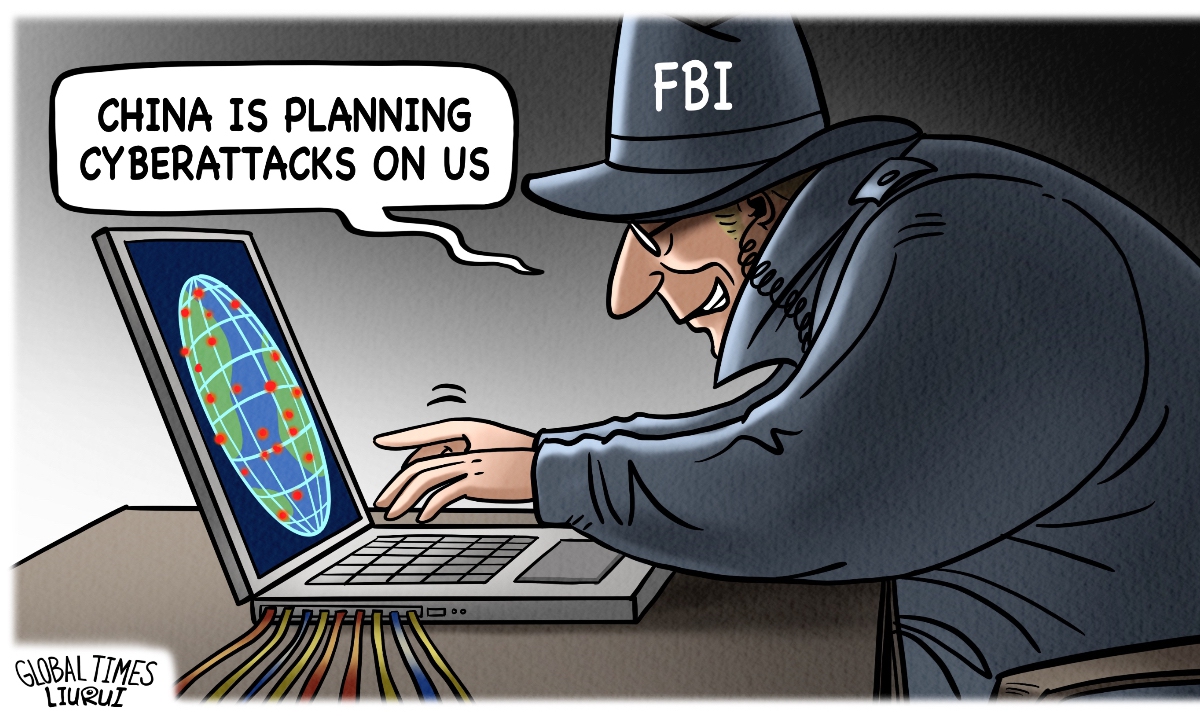
Illustration: Liu Rui/Global Times
On June 10, the US Department of Justice and the Federal Bureau of Investigation (FBI) announced the seizure of 13 internet domains, claiming that these websites were "backed by suspected Chinese agents" and had attempted to obtain sensitive information from "current and former security clearance holders with access to classified and sensitive US government information." A week earlier, the "Five Eyes" alliance also issued a joint warning, alleging that Chinese spies are aggressively using online job platforms to recruit people. The country and the organization widely recognized as having the world's strongest intelligence capabilities now feign innocence while accusing China of "stealing intelligence." This "domain seizure show" looks more like an absurd farce unfolding in real life.
Faced with such baseless, barefaced accusations, the first question we must ask is: where is the evidence? Neither the US Department of Justice nor the "Five Eyes" alliance have provided any verifiable or convincing details. Instead, they rely on vague terms such as "suspected." Whenever China is involved, some Western politicians and institutions seem long accustomed to a logic of "make a determination first, and then manufacture evidence." Labels such as "national security risk" and "intelligence threat" are readily applied at will. In reality, there are countless consulting positions advertised on global recruitment platforms. As the Chinese side has said in response, the so-called "China espionage threat" is entirely groundless and amounts to malicious defamation.
The narrative of "China spy threat" is nothing more than a case of "thief crying stop thief." As the world's largest intelligence-sharing network, the "Five Eyes" alliance has long conducted large-scale, systematic espionage operations across the globe. They themselves are seasoned practitioners of using recruitment as a cover and exploiting online platforms for intelligence gathering. Now, by engaging in a "role reversal," they project their own behavior onto others - drawing on their so-called extensive experience in espionage to accuse China of doing the same - while portraying themselves as naive bystanders caught in the crossfire. As a Chinese Foreign Ministry spokesperson once remarked, it is "ironic" in itself.
History shows that the "Five Eyes" alliance has a long record of dubious intelligence activities, making its self-styled image as a "cybersecurity guardian" utterly untenable. The international community has not forgotten. In 2013, Edward Snowden, a former contractor for the US National Security Agency, exposed the PRISM program, shocking the world. The program allowed intelligence agencies, without the need for specific warrants, to compel internet companies to "cooperate," enabling the unchecked collection of vast amounts of data from users worldwide, including emails, chat records, and file transfers. From the surveillance of 122 foreign leaders, including former German chancellor Angela Merkel, to the exploitation of undersea cables in countries such as Denmark for intelligence gathering, this is an undisguised act of hegemony that severely violates other countries' sovereignty and the privacy rights of their citizens.
The surveillance reach of the "Five Eyes" alliance has extended far beyond its allies; its indiscriminate surveillance of developing countries across the Global South has been even more unchecked and brazen. Its intelligence-gathering networks span Latin America, Africa, and Asia, while under the banner of intelligence sharing, it has launched cyberattacks, spread disinformation, and interfered in the internal affairs of other countries. These activities have been exposed and verified by numerous international media outlets. Yet the "Five Eyes" alliance has never reflected on or apologized for its actions. Instead, it continues to expand its espionage apparatus while accusing others of posing so-called "spy threats," repeatedly engaging in the classic tactic of a thief crying "stop thief." The real objective is nothing more than to divert international attention, smear and contain China, and justify its own long-standing illegal intelligence operations.
Every country has the right to protect sensitive information. However, portraying normal business consultations, academic exchanges, and technological cooperation as "espionage" is as absurd as seeing enemies in every shadow. The legitimate overseas activities of Chinese companies, researchers, students, and job seekers should not be casually branded as suspicious or linked to espionage. A number of facts have repeatedly shown that many of the so-called "Chinese espionage cases" fabricated by the US have ultimately been dropped due to a lack of evidence, yet they have already caused irreparable harm to Chinese individuals. Such unbridled suppression is itself a serious disruption to international talent mobility and global cooperation. It also poisons the atmosphere for China-US economic, trade, cultural, and people-to-people exchanges, ultimately harming the interests of both sides.
In May, the Chinese and US presidents agreed on a new vision of building a "constructive China-US relationship of strategic stability," providing direction for the future development of bilateral ties. Washington needs to keep its promise and demonstrate through concrete actions that its commitment to strategic stability with China is genuine.
However, the continued promotion of the so-called "China spy threat" theory by the US and the "Five Eyes" alliance suggests that confrontational and even competitive thinking still dominates parts of their China policy. As for this latest domain seizure order, it will not suppress the truth. Instead, it will only make it clearer to the world who the real troublemaker is. The relevant countries should immediately stop this futile "thief crying stop thief" hyping, abandon Cold War thinking, and return to a rational and pragmatic approach toward China.
RELATED ARTICLES