Philippines' renewed hype over Huangyan Dao research platform shows frustration, diverts attention from domestic problems: experts
Chinese research at Huangyan Dao to deepen ecological understanding, improve environmental forecasting
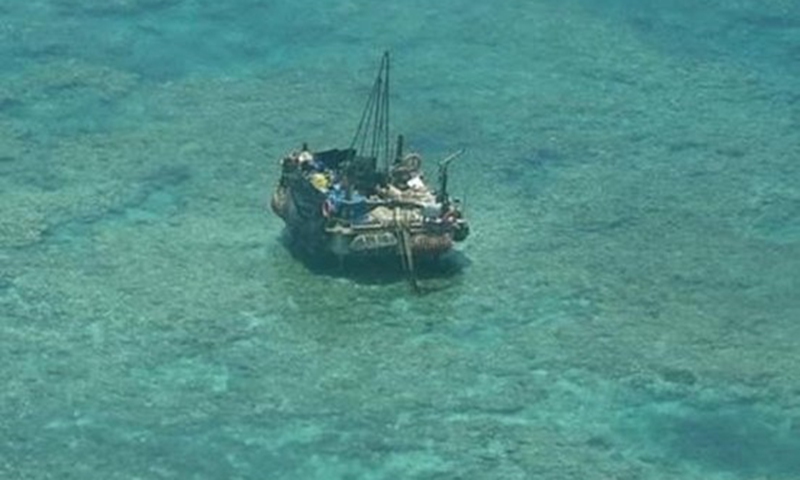
The so-called "new structure" at China's Huangyan Dao disclosed by the Philippines Photo: Philippine media
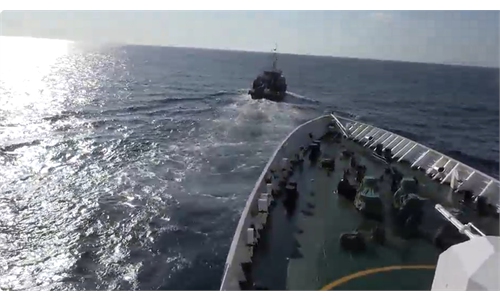
A Chinese research institution has recently released new details and findings from a recent scientific expedition at Huangyan Dao, a move experts said will help deepen ecological understanding and improve environmental forecasting in the area. Yet the research has been met with renewed hype and smear campaigns from the Philippines, including remarks by Philippine Coast Guard spokesperson Jay Tarriela, who claimed on Saturday that the Philippine side would continue to monitor and challenge the presence of two Chinese research vessels near Huangyan Dao.
Chinese experts interviewed by the Global Times on Sunday said Manila has repeatedly distorted facts, smeared China's legitimate scientific research activities and misrepresented the nature of Chinese facilities. The latest round of hype, they said, reflects the Philippines' anxiety over the current situation in the South China Sea and is also being used to deflect attention from domestic governance problems.
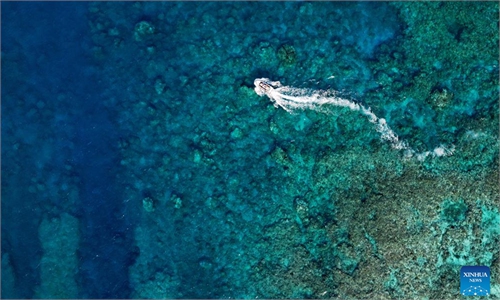
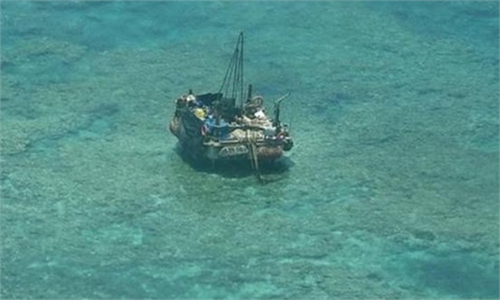
Previously, the Global Times obtained exclusive information confirming that the "new structure" at Huangyan Dao recently hyped by the Philippine side is in fact a temporary scientific research facility set up by the South China Sea Institute of Oceanology under the Chinese Academy of Sciences. The floating in-situ sampling and experimental platform is designed to improve ecological monitoring, research and forecasting at Huangyan Dao.
The South China Sea Institute of Oceanology also said that since May 20, 2026, it has led a comprehensive scientific expedition on the development, evolution and ecological resilience of Huangyan Dao. The expedition aims to deepen understanding of the patterns and trends in the development and evolution of Huangyan Dao's islands and reefs, the mechanisms sustaining coral reef biodiversity, and their ecological connectivity with islands and reefs in the Xisha and Nansha areas. So far, the research team has conducted a comprehensive survey covering the entire Huangyan Dao atoll.
Media campaign
Over the weekend, several Philippine media outlets and lawmakers launched a fresh round of publicity surrounding the so-called "Chinese floating structure" at Huangyan Dao.
In a Sunday editorial, The Manila Times claimed that "tensions have flared up once again" following the discovery of a semipermanent Chinese floating platform inside the lagoon of Huangyan Dao.
The editorial represents the latest episode in a broader Philippine narrative campaign surrounding Huangyan Dao. On Saturday, the state-run Philippine News Agency reported that Manila was closely monitoring Chinese activities around the reef, citing concerns that the newly discovered floating structure "could be a prelude to occupation and eventual militarization."
The report cited Armed Forces of the Philippines spokesperson Navy Rear Admiral Roy Vincent Trinidad, who stated at the Saturday News Forum that "We are keeping a very close eye on developments" at Huangyan Dao.
Similar claims were subsequently amplified by Philippine media outlets including Politiko and Journal News Online, citing politicians and commentators. Observers noted that the coordinated messaging reflects a broader pattern of collaboration between Philippine political and media circles.
"The hype surrounding the floating platform is a deliberate smear campaign and a false narrative," Yang Xiao, a research professor at the Institute of Peaceful Development under the Chinese Academy of Social Sciences, told the Global Times on Sunday.
Yang noted that after establishing the Huangyan Dao National Nature Reserve, China clearly stipulated in its management regulations that scientific research, ecological monitoring and conservation activities would be conducted in the area, including the establishment of observation stations and related facilities as part of ongoing environmental restoration efforts.
China's Ministry of Ecology and Environment also released ecological environment assessment reports on the waters around Huangyan Dao for two consecutive years, in 2024 and 2025. Such assessments require rigorous on-site scientific surveys, Yang said, adding that the deployment of the floating platform was intended to support those conservation and research efforts rather than any alleged military purpose.
According to Xinhua News Agency, China established the Huangyan Dao National Nature Reserve in September 2025. Located in Sansha, South China's Hainan Province, the reserve covers 3,523.67 hectares and focuses primarily on protecting coral reef ecosystems, according to China's National Forestry and Grassland Administration.
This is not the first time Manila has sought to generate controversy over the facility. According to Philippine media outlets including ABS-CBN, Philippine Coast Guard spokesperson Jay Tarriela displayed photos of the "new structure" recently taken by the Philippine Coast Guard at a briefing on June 10 local time. Tarriela described the "new structure" as a movable floating platform with a deck area of more than 30 square meters and fitted with metal poles.
After Philippine officials repeatedly sought to play up the issue, the South China Sea Institute of Oceanology under the Chinese Academy of Sciences, which conducted the research, released information about the operation and its findings.
The institute said it has led a comprehensive scientific expedition at Huangyan Dao since May 20, 2026, focusing on the development, evolution and ecological resilience of the area. The project aims to deepen understanding of island and reef evolution, coral reef biodiversity, and ecological connectivity between Huangyan Dao and islands and reefs in the Xisha and Nansha areas.
So far, the research team has conducted a comprehensive survey covering the entire Huangyan Dao atoll.
"The latest hype over Huangyan Dao once again reflects the frustration and unwillingness of the Marcos administration to accept its failure to gain leverage in the South China Sea," Chen Xiangmiao, a research fellow at the National Institute for South China Sea Studies, told the Global Times on Sunday.
"They are attempting to manufacture international public opinion and interfere with China's exercise of rights granted under international law," Chen said.
China has repeatedly responded to the issue. When asked about the so-called floating structure on Tuesday, Chinese Foreign Ministry spokesperson Lin Jian said, "It is fully within China's sovereign rights to carry out activities including scientific research at Huangyan Dao. China urges the Philippines to stop all infringement activities, provocations and false accusations at sea."
Political calculations
Philippine Defense Secretary Gilberto Teodoro was among the most prominent figures behind Manila's hardline rhetoric toward China. Earlier on Thursday, the Chinese Foreign Ministry announced sanctions against Teodoro, stating that he had repeatedly made irresponsible remarks on China, which undermines China's legitimate interests and sabotages China-Philippines relations.
To uphold China's sovereignty, security and development interests, China has decided to prohibit Gilberto Teodoro Jr. and his spouse and child from entering the Chinese mainland, Hong Kong and Macao, and not allow organizations and individuals in China to engage in any transaction, cooperation or other activities with him and his spouse and child, announced the ministry.
Shortly after China announced the sanctions, Armed Forces of the Philippines (AFP) spokesperson, Navy Rear Admiral Roy Vincent Trinidad, publicly voiced support for Teodoro on Saturday, saying that Teodoro's previous remarks merely asserted the Philippines' rights and interests. He claimed the AFP is "solidly behind him.".
Ding Duo, director of the Research Center for International and Regional Studies at the National Institute for South China Sea Studies, told the Global Times that there are divisions within the Philippine government over how to handle relations with China.
"In the past, communication between China and the Philippines through diplomatic channels remained relatively smooth, and the two sides reached a number of understandings on certain issues," Ding said. "However, whenever some progress is made, figures from hardline departments within the Philippines often emerge to create disruptions."
Ding also noted that Manila's repeated attempts to portray China as an external threat serve another purpose: diverting public attention from mounting domestic challenges.
"At a time when the Philippine economy remains under pressure and social discontent continues to accumulate, some politicians have sought to shift the focus toward external issues," Ding said. He added that the Marcos administration has recently faced criticism over its handling of domestic problems, including disaster response efforts, making South China Sea issues an increasingly useful political distraction.
RELATED ARTICLES