Man undergoes surgery for suspected lung cancer but fortunately found the 'tumor' to be minced chili: reports
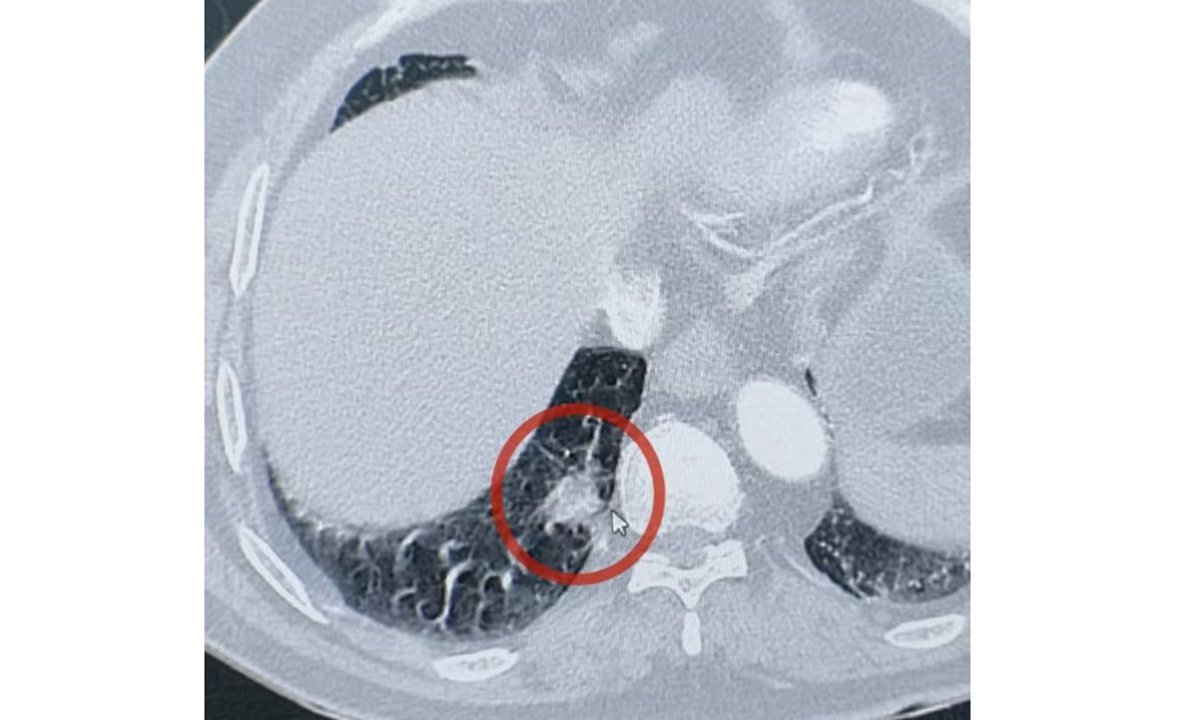
A CT scan image shows a suspected lung cancer nodule that later turned out to be a chili tip lodged in the lung. Photo: Screenshot from the official WeChat account of Xi'an International Medical Center Hospital
A 70-year-old man surnamed Zhang in Xi'an, Northwest China's Shaanxi Province, went into surgery for what several hospitals believed to be a likely case of peripheral lung cancer. But when doctors cut open the removed lung tissue, they heard a crisp "crack"; to everyone's relief, the suspected tumor was actually a 0.5-centimeter red chili tip, already sliced in half by the scalpel.The story started when Zhang had a health check recently that detected a 2.1-centimeter nodule in the lower lobe of his right lung. CT scans showed spiculation, lobulation, and pleural attachment, all features that made doctors at multiple hospitals suspect peripheral lung cancer.
But the operation produced a surprise twist. Instead of a tumor, the culprit was a tiny piece of chili that had apparently been hiding deep in Zhang's lung.
Li Wenhai, deputy director of the Thoracic Hospital of Xi'an International Medical Center Hospital and the chief surgeon for Zhang's operation, said that in nearly 30 years of medical practice, he had encountered only three such cases.
"Chili has almost the same density as lung tissue on CT scans," Li said. "Every patient was admitted as a suspected lung cancer case, and no one expected before surgery that it would turn out to be chili."
Li explained that a chili tip has a cone-like shape, sharp at the front and wider at the back. Once inhaled into the airway, it may not be coughed out. Instead, it can travel downward with the airflow until it becomes stuck in a small bronchus of roughly the same diameter and stays there.
That special shape makes chili tips frequent "troublemakers" among inhaled foreign bodies. Rice grains or crushed peanuts may trigger strong coughing and be expelled, but a chili tip can wedge itself deeper and deeper. After remaining in the lung for a long time, it can cause repeated local inflammation and tissue proliferation, eventually forming a nodule surrounded by inflammatory granulomas, media reported.
On CT scans, such a nodule may show spiculation, lobulation, and uneven density, which are all typical signs of an image suggesting lung cancer.
According to the report, Zhang is known to enjoy spicy food. Doctors believe he may have accidentally inhaled the chili tip while eating, and the foreign body stayed in his lung long enough to trigger inflammation that made it look like a tumor.
"If a bronchoscopy had been done earlier and the chili had been removed, Zhang would not have needed this surgery," Li said.
Li reminded the public that airway foreign body aspiration is not rare, especially among the elderly and children. Older people may have weaker swallowing reflexes, and talking, laughing or being distracted while eating can increase the risk of food entering the airway.
He advised people to chew slowly and avoid talking or becoming too excited while there is food in the mouth. If rice grains or small pieces of food are inhaled and forceful coughing fails to expel them, the Heimlich maneuver should be performed immediately to help force out the foreign body.
The unusual case also amused and relieved many netizens. Some called it "a false alarm, fortunately," while others said it was "a blessing in disguise." Many also pointed to the Confucius teaching from "The Analects" that "Do not converse while eating and do not speak while in bed," saying the ancient Chinese wisdom still makes sense today.
Global Times
RELATED ARTICLES