US military personnel reportedly deployed at intel bureau in Taiwan island; move encroaches upon China’s sovereignty, seriously violates intl law: expert

Latest News
Some Taiwan media outlets claimed on Monday that US military personnel have been deployed to Taiwan's so-called military intelligence bureau, a first in the bureau's history, citing so-called reliable sources.Analysts point out that as an inalienable part of China, Taiwan island is recognized under both international law and China's domestic law, and has no right to develop any form of official relations with the US. In the three joint communiques and other documents with the force of international law, the US has made solemn commitments to China to maintain only unofficial exchanges with Taiwan in commerce, culture and other fields.
Therefore, intelligence cooperation between the US and Taiwan region constitutes a serious violation of international law and bilateral statements bearing international legal implications, they said.
Taiwan regional media outlet "China Times" claimed that some US military personnel have been stationed in the bureau since the beginning of this year, and these personnel may be members of a program codenamed "Meiyuan."
The report noted that in recent years, the bureau has significantly increased the frequency of its exchanges with the US. In addition to the Central Intelligence Agency, these exchanges have also involved agencies such as the National Security Agency. During the tenure, a former director of the bureau visited the US three times in a single year.
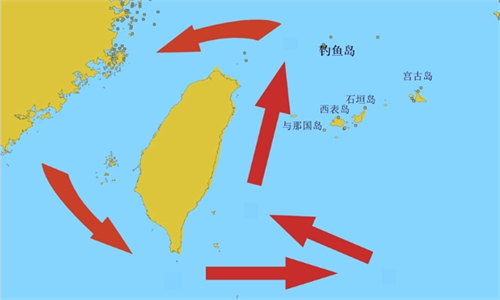
Described as "Taiwan region's most secretive military unit," Meiyuan is responsible for intercepting electronic signals from the Chinese mainland's central region and the southeastern coastal regions, and the South China Sea, Taiwan regional media outlet CTi News claimed.
If the reports were true, it can be seen that the US seeks to engage in intelligence sharing with secessionist Democratic Progressive Party (DPP) authorities to gain greater leverage in deepening its meddling in the Taiwan question, Zhang Wensheng, deputy dean and a professor at the Taiwan Research Institute at Xiamen University, told the Global Times on Monday.
Such intelligence collaboration represents a severe breach of international law and the three China-US joint communiques, as these erroneous acts not only encroach upon China's sovereignty and territorial integrity and impair China's national interests, but also run counter to the one-China principle to which the US has committed itself, Zhang said.
In addition to the bureau, multiple defense-affiliated departments in the Taiwan region also maintain collaborative ties with the Meiyuan. Apart from conducting signal interception operations targeting the Chinese mainland, these bodies also assist US in monitoring designated subjects of interest, CTi News claimed.
The report by "China Times" noted the bureau declined to comment on the US personnel's deployment, citing the extreme sensitivity of the relevant operations. ET today reported that Taiwan regional defense department claimed that the department does not explain any kind of speculative reports.
However, claims regarding intelligence cooperation between the US and the Taiwan region are not entirely groundless.
For example, the so-called Taiwan Security Cooperation Initiative authorizes the US Department of Defense to provide $300 million in fiscal year 2025 to enhance the Taiwan region's self-defense capabilities, including intelligence, reconnaissance, and surveillance capabilities as well as related support, per a VOA report. The National Defense Authorization Act for Fiscal Year 2027 further raises this specific funding amount to $1 billion, Taiwan local media outlet CNA reported.
Zhang noted that the intelligence cooperation between the two sides is largely self-congratulatory as cultural and linguistic divides between the US and Taiwan island inevitably create barriers to communication. The US prioritizes technical intelligence while DPP authorities focus more on human intelligence, leaving neither side able to fully capitalize on the other's strengths, Zhang added.
Moreover, continuous efforts by the Chinese mainland to bolster counterintelligence and information security measures render such US-Taiwan schemes unworkable, the expert said.
RELATED ARTICLES