IN-DEPTH / IN-DEPTH
GT investigates: As bipartisanship frays, consensus grows ever harder to find amid unprecedented US political division
From compromise to confrontation
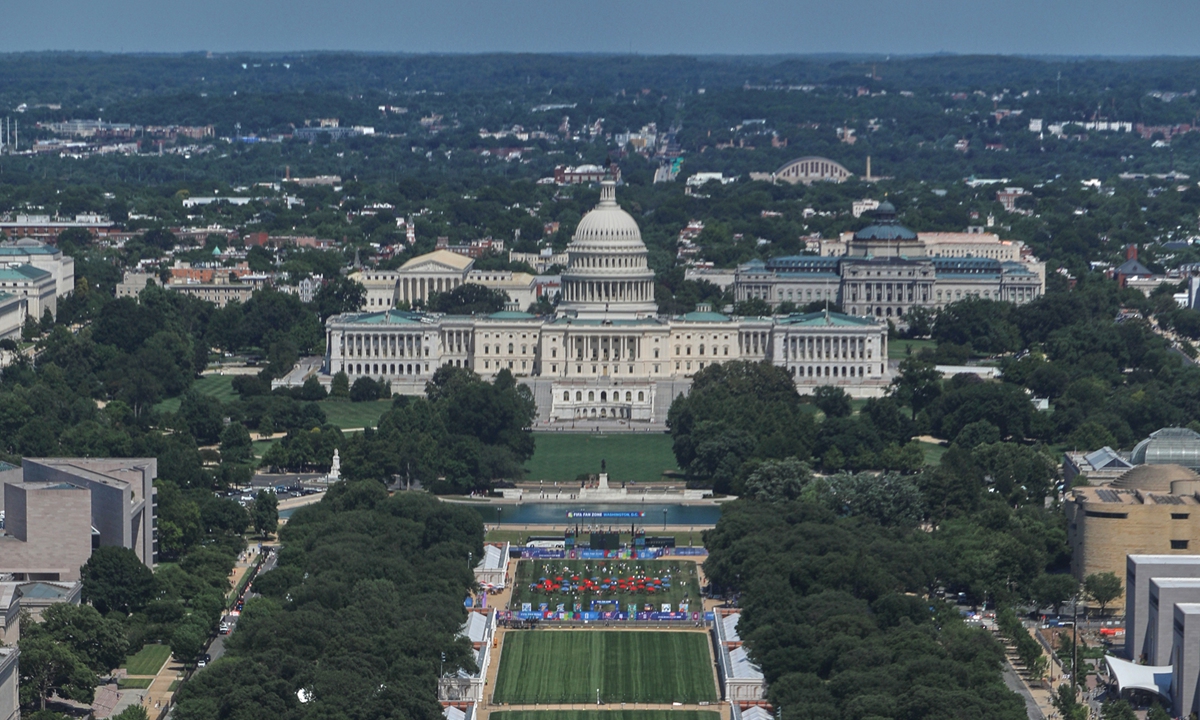
The US Capitol and the National Mall are seen as the venue for the America 250 celebration, which continues in Washington on June 13, 2026. Photo: VCG
Editor's Note:On July 4, 2026, the US will celebrate the 250th anniversary of its independence. At this juncture, international public opinion has described the US as a "declining" America, citing rising political polarization, unprecedented ethnic tensions, increasing pressure on its economic hegemony, a weakening national identity, and overseas military operations mired in deadlock. Over the past 250 years, the US has gradually become a superpower, exerting significant influence on the world's structure and operations. Its political system, economic model, social structure, cultural narrative and foreign policy have also changed with shifts in national power.
To re-examine this historical trajectory, the Global Times will launch an in-depth reporting series titled "250 Years of Independence: America's Change and Constancy," exploring the evolutionary logic of this major power across politics, economy, society, culture, and diplomacy. In the opening installment of this series, we will focus on the issue of intensifying political division and polarization, examining why the bonds that once maintained the "golden period of consensus" between the US Democratic and Republican parties have developed cracks.
'One birthday, two party planners'
"At least seven states have declined to take part in the Great American State Fair," reported The New York Times on June 11. "The withdrawals add to the growing signs that a summer of national celebration has become an increasingly fragmented and partisan affair."
The "Great American State Fair" is one of the core activities of this year's celebrations, scheduled to be held from June 25 to July 10, with all 50 states reportedly setting up exhibition booths. Among the seven states refusing to participate, six have Democratic governors. An Oregon state government spokesperson stated that there were also "growing concerns that the event in Washington, DC, is shaping up to be a more partisan affair than originally presented," according to The New York Times.
Previously, the event had already suffered a setback. NBC News reported under the headline "One Birthday, Two Party Planners," stating that in May, due to confusion between the two organizations "America250" and "Freedom 250," several artists withdrew from the musical performances at the "Great American State Fair," saying that they were "misled about the nature of the event" and not "told about any political involvement with the event."
Then, what are the backgrounds of "Freedom 250" and "America250"? "America250, is the nonprofit supporting the US Semiquincentennial Commission, which was established 10 years ago through an act of Congress and is led by a bipartisan group of lawmakers and private citizens. The other, Freedom 250, was established by the Trump administration as a public-private partnership by which to fund and plan events celebrating this summer's historic anniversary," according to the NBC News.
This contest of "party planning" is one manifestation of intensifying US political division and partisan struggles. The US political system has recently shown unprecedented fragmentation and antagonism on multiple issues. Government shutdowns have become almost routine. At the same time, congressional legislation has been almost stagnant in the first half of this year. The initial vote on federal appropriations bills failed at the beginning of the year, and although it was later advanced, legislative efficiency was extremely low.
Currently, on major issues such as immigration, climate and ideology, the Democratic and Republican parties hold very different positions, and the areas of consensus are becoming increasingly narrow. Political violence has also clearly escalated. This year, conflicts have erupted in many places across the US around issues related to Immigration and Customs Enforcement (ICE), with confrontations between law enforcement officers and protesters, and even fatal shooting incidents, triggering nationwide demonstrations.
How was consensus achieved in the past?
The two US parties have a historical tradition of debate and compromise. Before 1791, the nascent US had not yet formed formal political parties. However, within Washington's cabinet, Treasury Secretary Alexander Hamilton and Secretary of State Thomas Jefferson were already at loggerheads. Their differences on issues such as federal power, fiscal systems and attitudes toward the French Revolution gave rise to the earliest two major US parties - the Federalist Party and the Democratic-Republican Party.
Later, the two major parties underwent several reorganizations and transformations. By the election of 1860, when Republican Abraham Lincoln was elected president, the modern Democratic-Republican two-party system had basically taken shape - a structure that has continued to this day. The intense partisan struggles between the two parties are reinforced by the US Electoral College and winner-take-all voting system, which follow a simple plurality-wins logic. This objectively tends to consolidate the two-party system and is unfavorable to the development and growth of third parties or smaller parties.
Zhang Wenzong, a researcher at the Institute of American Studies of the Chinese Academy of Social Sciences, told the Global Times, "Since independence, the US has been a country with diverse interests that resolves interest conflicts through war, elections, interest exchanges and other means. This historical process is full of bargaining and also inseparable from the stimulation and promotion of major crises. On domestic issues, the two parties' ability to reach major consensus is usually tied to major party realignments or one party securing a sustained medium- to long-term political advantage. On diplomatic and foreign policy issues, however, bipartisan consensus is typically inseparable from external challenges or deliberate efforts by politicians to highlight 'external threats.'"
Back in 1947, shortly after World War II ended with ruins still scattered across Europe, the US grew anxious over what it saw as the Soviet Union's expanding influence on the continent. Then US Secretary of State George Catlett Marshall unveiled a plan to help Europe rebuild. The Harry S. Truman administration knew that the $13 billion aid package - a staggering sum at the time - would need bipartisan backing to pass Congress, so they brought in Republican Senator Arthur Vandenberg to help shape the plan from the start, crafting what became "a genuinely cross-party" product.
The US Congress approved the Marshall Plan in 1948. According to the US National Archives, "Congress's approval of the Marshall Plan signaled an extension of the bipartisanship of World War II into the postwar years." From then on, both major parties strongly supported the Cold War against the Soviet Union, and this "Cold War consensus" endured for more than four decades.
Wu Xinbo, dean of the Institute of International Studies of Fudan University, told the Global Times that during the Cold War, a shared commitment to national development, a predominantly white social order, and external pressure from the Soviet Union prompted the two parties to prioritize national interests over their differences. They compromised with each other and reached agreement on major domestic and foreign policies, maintaining a stable dynamic where partisan disputes rarely spilled beyond Washington.
Why bipartisan compromise has faded
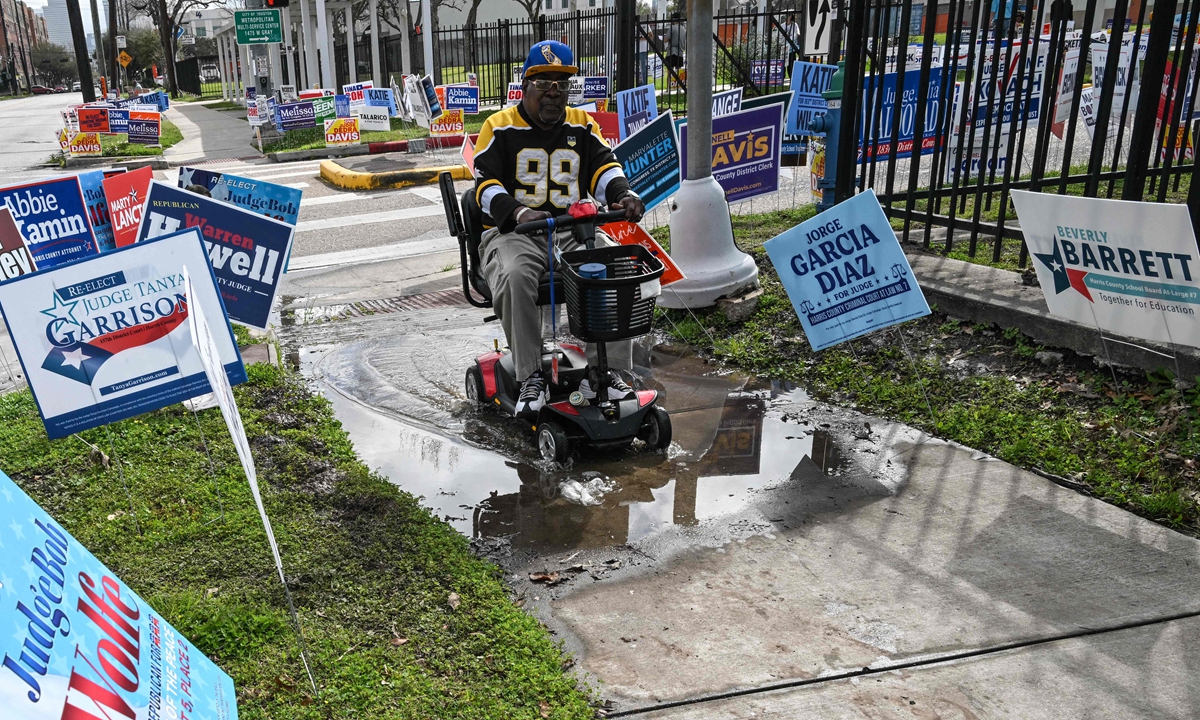
Campaign signs are seen near a polling location at West Gray Metropolitan Multi-Service Center on Election Day in Houston, Texas, on March 3, 2026. Photo: VCG
The collapse of the Soviet Union in 1991 marked the end of the Cold War, yet many US political analysts voiced concerns. The shared external foe that had long united the two parties was gone. Washington kept searching for, and even creating, new "external threats." Both parties backed the US-led war on terror after the September 11 attacks. After 2017, they reached another consensus on competing with China, with some politicians repeatedly hyping the so-called "China threat" and pushing for anti-China legislation.Gavin Cooley, a 24-year-old American social media creator and descendant of a WWII veteran, told the Global Times that bipartisan cooperation has become far harder than before. Once, compromise was widely regarded as a necessary part of governing the country. Today, however, American politics has fallen into a rigid black-and-white confrontation.
Zhang pointed out that multiple factors have fueled US' political polarization and fierce partisan rivalry. First, the two parties are nearly evenly matched, with neither holding a long-term political advantage. Second, fewer swing states have intensified electoral competition. Third, the declining white population has worsened racial tensions. People from ethnic minorities now make up over half of newborns and primary school students nationwide. Issues over illegal immigration and diversity, equity, and inclusion policies have also fueled a resurgence of white supremacy. Overall, intertwined class, racial, and regional conflicts have made partisan politics more complicated and confrontational.
Can the US fix its political problems?

A group of travelers walk past an empty line at Terminal E of George Bush Intercontinental Airport in Houston, Texas, on March 27, 2026, as travel disruptions continue because hundreds of TSA agents quit or work without pay during the partial government shutdown. Photo: VCG
A survey released by Pew Research Center last spring showed that 62 percent of Americans are dissatisfied with how their democratic system functions. To ordinary people like Cooley, the two parties are no longer different paths for national development, but rival camps locked in constant fights. Many feel elected officials prioritize partisan interests and big donors over public demands. This widespread sentiment has bred public discontent and political apathy.Wu noted that the US two-party system was originally designed to correct policy errors, as the ruling party would usually revise its predecessor's flawed policies. However, this corrective mechanism has now broken down. Today, the parties often swing from one extreme to the other, failing to fix problems and instead creating new ones, deepening governance gridlock. To restore this function, the US needs to rebuild bipartisan consensus. Externally, the two sides must align views on America's global role and responsibilities, and set foreign strategies that match its national strength. Domestically, it should focus on core issues like economic development and social welfare while pushing liberals and conservatives toward the middle on cultural values. To revive the system's ability to self-correct, Wu said, the key is rebuilding a bipartisan consensus.
In Cooley's view, the system of checks and balances established at America's founding has shown resilience for most of its history. "I believe the US still has the capacity to adapt and reform, but the challenges are significant. Many Americans across the political spectrum recognize that the current level of polarization is unhealthy and unsustainable in the long run," he said. "It will require new generations of leaders, renewed civic engagement and institutions that are better able to earn public trust. Many people feel that politics has become too focused on partisan victory rather than solving practical problems that affect everyday citizens."
RELATED ARTICLES