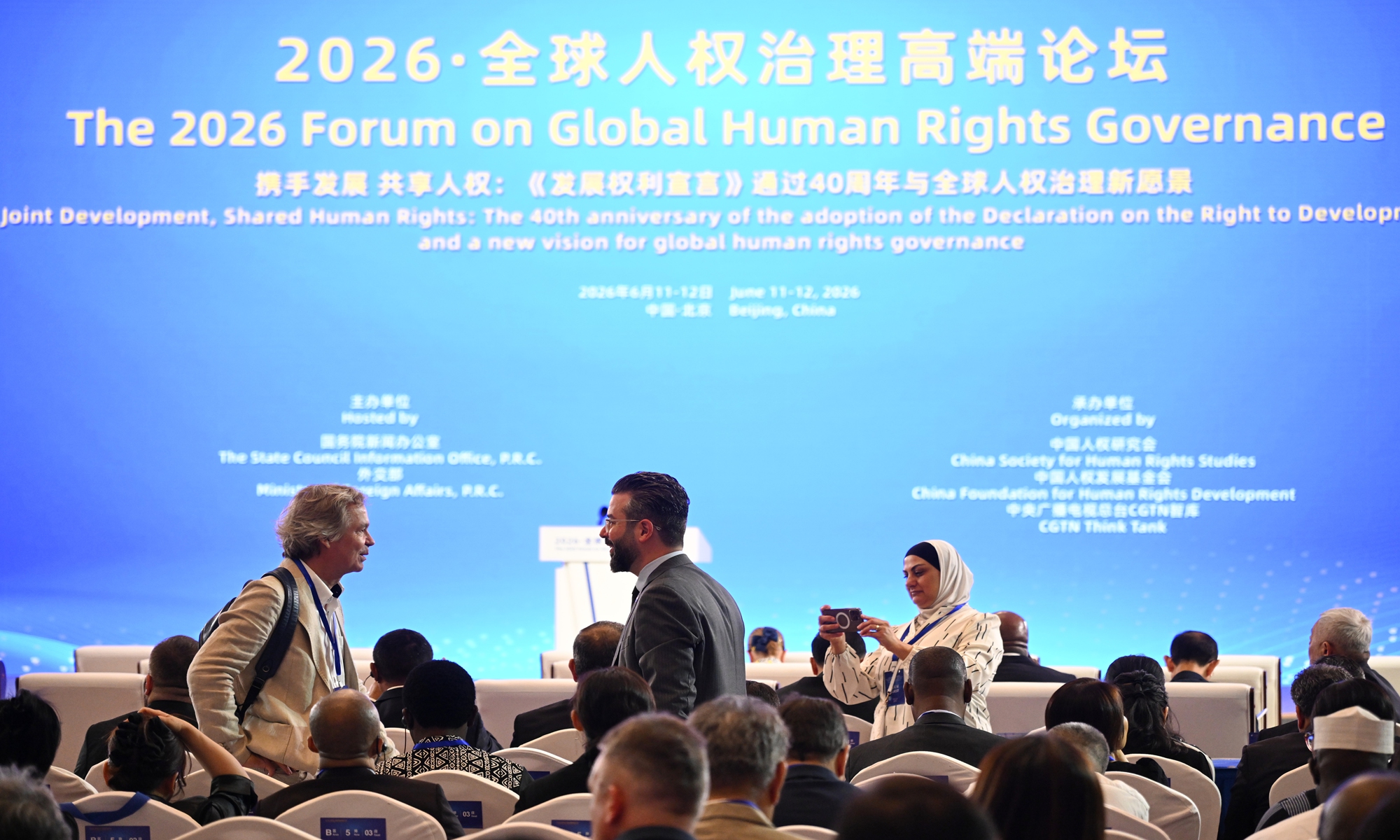
The 2026 Forum on Global Human Rights Governance is held in Beijing, capital of China, June 11, 2026.
Recently, I attended the 2026 Forum on Global Human Rights Governance held in Beijing, and was deeply impressed by China's approach to human rights protection. One of the most distinctive characteristics of China's human rights philosophy is its emphasis on practical implementation: transforming human rights from abstract ideals into concrete realities that people can experience in their daily lives.For China, human rights are not merely political slogans or theoretical concepts discussed in conference rooms. They are reflected in whether people have access to jobs, education, healthcare, social security, a clean environment and opportunities for personal development. They are closely linked with national development and social progress.
China has continuously formulated and implemented consecutive action plans for human rights protection. These plans establish clear objectives, assign responsibilities and evaluate outcomes across various sectors, with a long-term commitment to improving human rights through governance and policy implementation.
The achievements associated with this approach are significant. China has established the world's largest social security system, covering pensions, medical insurance, unemployment insurance and other forms of social protection for its citizens. Similarly, China's basic medical insurance now reaches the overwhelming majority of the population, while continuous investment in healthcare infrastructure has strengthened service delivery in both urban and rural areas.
Education provides another compelling example. China has developed the world's largest education system. Access to compulsory education has become universal, and millions of students from previously disadvantaged backgrounds have gained opportunities for social mobility through expanded educational access.
China's human rights philosophy also continues to evolve alongside societal transformation. As new technologies reshape economies and daily life, emerging issues such as digital rights have entered policy discussions. Ensuring equitable access to digital infrastructure, protecting personal information, narrowing the digital divide and enabling citizens to benefit from technological advancement are increasingly viewed as important dimensions of human rights protection.
Likewise, ecological civilization has become an essential component of China's vision for human rights development. The idea that people should enjoy the right to live and work in a healthy environment reflects the country's growing emphasis on sustainable development. Continuous improvements in air quality, ecological restoration initiatives, renewable energy expansion and environmental governance illustrate efforts to reconcile economic growth with environmental protection.
Naturally, China's approach differs in important ways from certain Western human rights frameworks. Western discourse has traditionally placed considerable emphasis on civil and political rights, individual autonomy, and procedural safeguards. These dimensions undoubtedly constitute important aspects of human rights. However, China argues that rights to subsistence and development form the foundation upon which other rights can be meaningfully exercised. After all, without adequate food, healthcare, education, employment opportunities and social security, many formal rights may remain inaccessible in practice. China's experience suggests that development itself can serve as a powerful instrument for advancing human dignity and expanding human freedom. Rather than viewing economic, social, cultural, civil and political rights as mutually exclusive, the Chinese approach advocates their coordinated and balanced advancement in accordance with national conditions.
This perspective resonates strongly across many countries in the Global South. Developing nations often face complex challenges, including poverty, inequality, limited institutional capacity and competing development priorities. For these countries, the central question is not whether human rights matter, but how they can be progressively realized under existing circumstances.
China's experience does not offer a universal template to be copied mechanically. Instead, it provides practical lessons. These include the importance of strong policy continuity, long-term planning, development-oriented governance, targeted interventions for vulnerable populations and the adaptation of international human rights principles to local realities. Equally important is the recognition that each country has the right to explore a human rights path suited to its own history, culture and stage of development.
Ultimately, the legitimacy of any human rights model should be judged not solely by rhetoric but by outcomes. Are people's lives improving? Are opportunities becoming more accessible? Are dignity, security and hope expanding across society? China's practice-oriented approach seeks to answer these questions through concrete action.
Human rights are most meaningful when they move beyond abstract declarations and become realities embedded in everyday life. China's experience demonstrates that through sustained commitment, institutional innovation and people-centered development, abstract principles can indeed be transformed into tangible and measurable rights. As countries across the Global South continue their own development journeys, this experience offers not a final answer, but a valuable source of inspiration and practical reflection.
The author is the founding chair of the Pakistani think tank Global Silk Route Research Alliance. opinion@globaltimes.com.cn
RELATED ARTICLES