China's white paper calls for joint efforts to build just, equitable global governance system
Nation acts as frontrunner to transform multilateral solutions into tangible actions: expert
By and Li Meng Published: Jun 17, 2026 11:21 PM

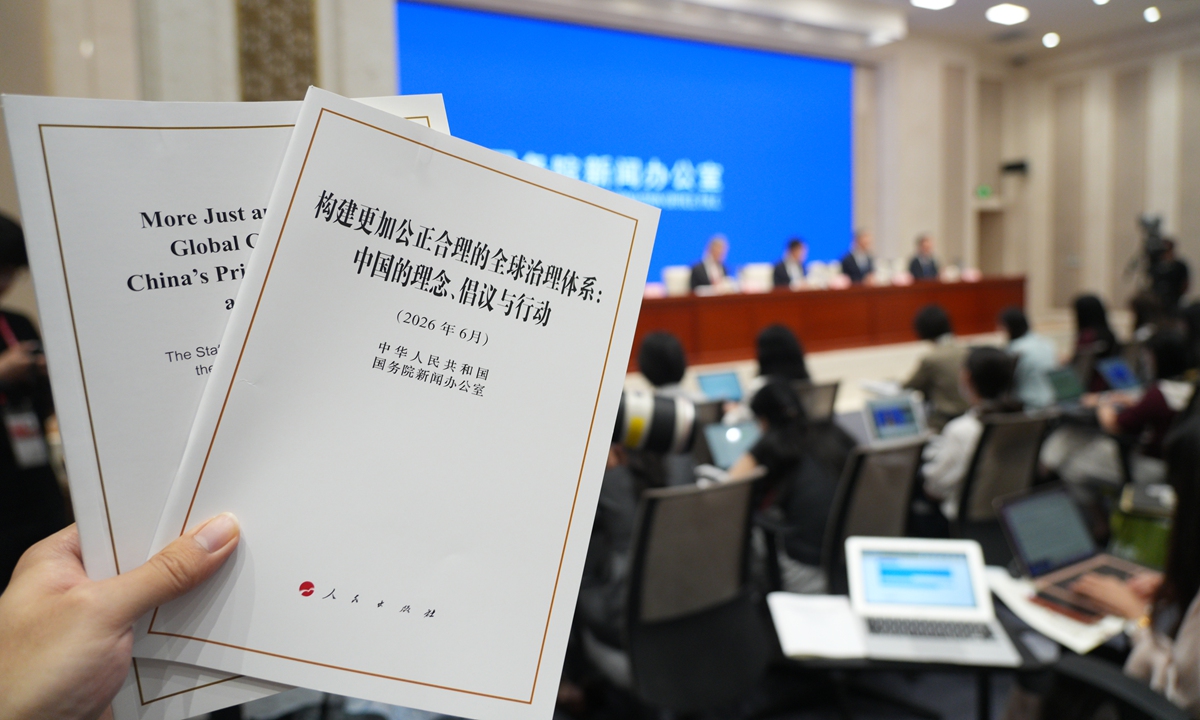
The State Council Information Office holds a press conference to present a white paper titled "More Just and Equitable Global Governance: China's Principles, Proposals and Actions" in Beijing, June 17, 2026. Photo: VCG
China's State Council Information Office on Wednesday released a white paper to introduce China's principles, proposals and actions on global governance, foster broader consensus within the international community, ensure more effective responses to global challenges, and build a more just and equitable global governance system.
Titled "More Just and Equitable Global Governance: China's Principles, Proposals and Actions," the paper extends to 36 pages in its English edition with more than 13,600 words. The full Chinese text totals around 20,000 Chinese characters.
Apart from the preface and conclusion, the white paper has five parts. At the beginning, it points out that global governance is a common endeavor that bears on the well-being of all humanity, and building a just and equitable global governance system is a shared vision long pursued by people from across the world.
It adds that China has always been an active participant in, contributor to, and a builder of global governance.
Respond to challenges of times
In 2025, President Xi Jinping proposed the Global Governance Initiative (GGI), which is built on five core concepts: sovereign equality, the international rule of law, multilateralism, a people-centered approach and real actions. According to the latest white paper, China's GGI was proposed to respond to the "severe and complex" challenges of the time.
These challenges, according to the white paper, include intensifying geopolitical tensions and armed conflicts, resurgence of militarism and nuclear proliferation, as well as global economic fragmentation, food and energy insecurity and the widening wealth gap.
The document also mentions the harms to the UN's authority and international laws and basic norms caused by unilateralism and hegemonism. It warned that de-globalization and protectionism are on the rise, while economic and trade issues are being politicized, instrumentalized, and weaponized.
To stabilize and improve the world, the international community needs to be more responsive to the concerns of the Global South in international affairs and fully leverage its role, said the white paper, citing examples of the historic expansion of the BRICS group, the enlarging Shanghai Cooperation Organization (SCO), and the G20's role in development and reform of the global governance system.
Facing these challenges, the white paper said the China-proposed GGI aligns with the growing trend toward greater democracy in international relations and bolsters international confidence in practicing multilateralism. It offers a clear and feasible roadmap for improving global governance, bringing valuable stability and positive energy to a turbulent world.
At a press conference to present the white paper on Wednesday, Chinese Foreign Minister Wang Yi said that the GGI has been translated from a Chinese proposal into international practice and is increasingly demonstrating strong vitality. The GGI has been endorsed by nearly 160 countries and international organizations and has received extensive and positive responses from the international community.
Some international media outlets including Reuters have noticed China's support for a greater voice for the Global South on the international stage, noting that the white paper lays out pathways to build a fairer and more equitable global governance system.
Turkey's Anadolu Agency noted that as the US and Iran are poised to sign a peace deal, China's Foreign Minister Wang Yi voiced support for a ceasefire in the Middle East and calling for coordinated efforts to lay the groundwork for a lasting regional security framework.
Wang Yiwei, professor at the School of International Studies at the Renmin University of China, told the Global Times that the GGI embodies the characteristics of Beijing's major-country diplomacy and sense of responsibility of China, which stands as the world's second-largest economy, a permanent member of the UN Security Council, the largest country of the Global South, and an ancient civilization with a time-honored history.
Taking the ongoing G7 summit in Evian, France, as an example, the expert said that a major component of the prevailing global governance deficits lies in the deficit of representation. "The bulk of existing international rules were formulated by Western countries. Yet global governance is a shared undertaking for all humanity, which cannot be addressed through blocs and alliances set up by a handful of developed nations alone," Wang Yiwei said.
According to the expert, the Western narrative of global governance mostly centers on the question of "who governs" while overlooking the fundamental issue of "governance for whom." By contrast, China's GGI highlights inclusiveness for all and the principles of extensive consultation, win-win outcomes and shared benefits. While acknowledging that countries of the Global South suffer inadequate representation and voices within global governance bodies and international organizations, the GGI does not exclude Western nations.
From roadmap to action
Beyond the clear roadmap laid out by the GGI, China has set a leading example in advancing global governance, translating its governance vision into a wide range of tangible practical measures, analysts said.
According to the press conference held by China's State Council Information Office on Wednesday, China is accelerating the establishment of the World Artificial Intelligence (AI) Cooperation Organization, Xinhua reported.
Earlier, October 2025 saw the inauguration of the International Organization for Mediation (IOMed) in China's Hong Kong Special Administrative Region, the world's first intergovernmental international legal organization dedicated to resolving international disputes through mediation.
Several months later, the World Data Organization (WDO) was established in Beijing in March, aimed at bridging the data divide, advancing global data cooperation and the digital economy. In addition, China will also host a forum on global governance in Xiong'an New Area in North China's Hebei Province this autumn, Foreign Minister Wang Yi announced in May.
Despite this progress, analysts argue that enhanced global solidarity and joint efforts are essential to improve global governance, a view echoed in a key section of the white paper.
"No country can achieve development outside the global governance system, nor can it secure a future without participating in international cooperation. It is not a matter of whether we choose it or not, multilateralism is the only viable path forward," the white paper said.
It noted that China advocates for countries to unite and cooperate, take concrete action and transform the vision and blueprint of the GGI into a roadmap and timeline for joint action.
All countries should firmly uphold the international system with the UN at its core, safeguard the international order based on international law, and uphold the basic norms governing international relations underpinned by the purposes and principles of the UN Charter, instead of reinventing the wheel, according to the white paper.
Zhu Feng, Dean of the School of International Studies at Nanjing University, told the Global Times that against the backdrop of sustained shocks to the international order and global governance, China's people-centered philosophy and commitment to multilateralism echo the shared aspirations of the international community and have garnered extensive positive responses worldwide.
"The world now stands at a historic crossroads. The Middle East situation and the Ukraine crisis keep dragging on with spillover effects, while economic globalization faces severe headwinds," Zhu said, "No nation wishes to see the world grow more divided and exclusive. To tackle all kinds of global challenges, countries must move toward each other and take coordinated joint actions."
Therefore, the most central and urgent task at present is to translate the consensus among countries on advancing global governance into tangible practical steps. In this process, China is not merely the initiator of the GGI, but also a frontrunner delivering concrete multilateral governance measures, Zhu said.
"Global governance finds its source of vitality in practice, hinges on action, and is verified by its effectiveness. A vision is realized only through concrete action. It falls on the international community to turn this vision into reality - setting common goals, embracing a problem-oriented approach and acting in concert," the white paper said.
"China stands ready to work with all parties to deliver on the GGI, uphold the central role of the UN, enable the Global South to play its pivotal role, address gaps and deficits in global governance, and strive to foster a more just and equitable global governance system," Chinese Foreign Ministry spokesperson Lin Jian said on Wednesday.
RELATED ARTICLES