Lithuanian President says foreign minister's tenure depends on China ties and 'commitments' to Taiwan region; remarks reveal an opportunistic mindset: Chinese expert
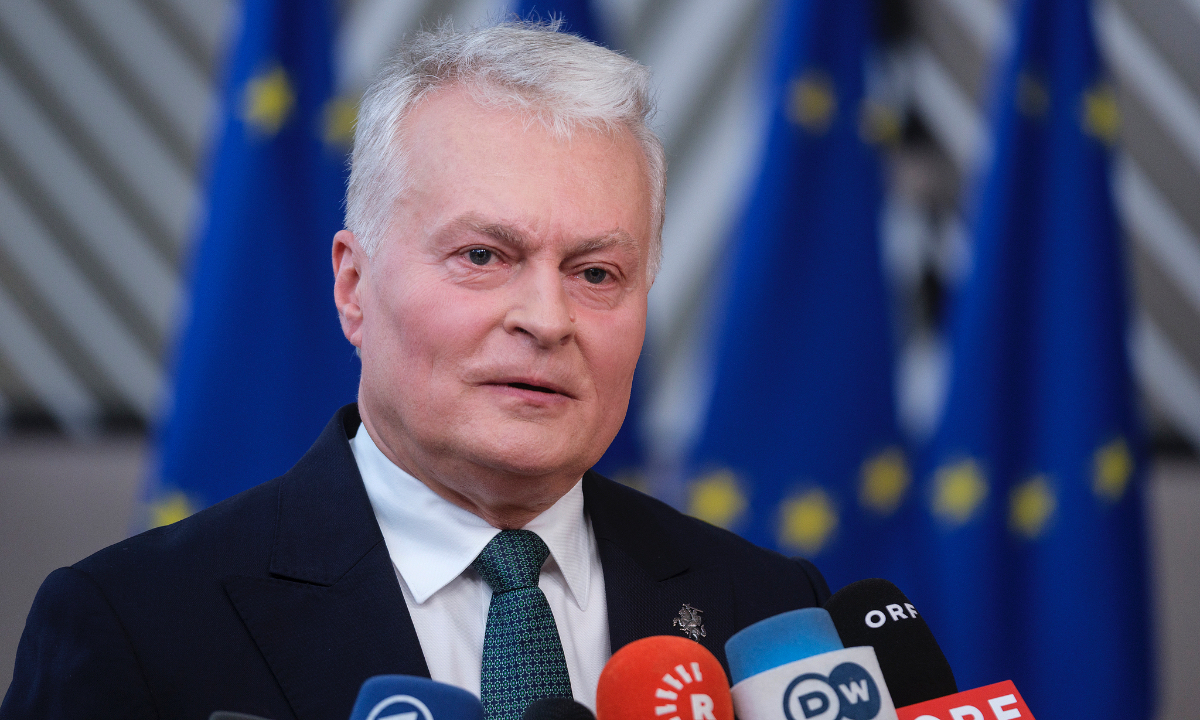
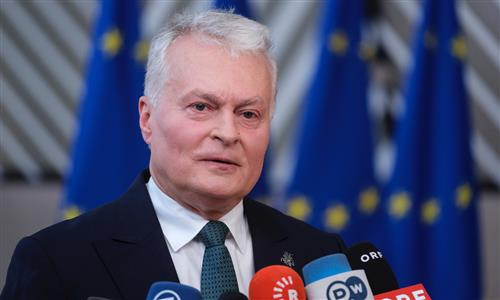
Lithuanian President Gitanas Nauseda talks to media prior the start of an EU Summit in the Europa building on June 18, 2026 in Brussels, Belgium. Photo: VCG
In two consecutive days, Lithuanian President Gitanas Nauseda has remarked on ties with China. He said on Friday the future of Foreign Minister Kestutis Budrys in his post will depend on progress in two areas: Normalizing relations with China and "delivering on commitments made to Taiwan," Lithuanian media LRT reported.
A Chinese scholar argued that despite Lithuania's overtures for better bilateral ties, the remarks reveal an opportunistic mindset. By linking the foreign minister's political fate to both China rapprochement and pledges to the Taiwan region, the statement lays bare a fence-sitting approach and a lack of sincerity in improving ties with China.
"Certain results must be put on the table," Nauseda told reporters in Brussels, according to LRT. "If they are satisfactory, everything will be fine and I hope that Budrys will be able to continue in office. If not, then we will look at the matter differently."
The remarks marked the second time in two days that the Lithuanian president has underscored the importance of ties with China and voiced expectations for mending bilateral relations.
On Thursday, Nauseda has told the Bloomberg TV in an interview in Brussels that he expects to see the first results of the country's diplomatic outreach to China within the next six months, as the Baltic nation moves to mend ties with China following a spat over island of Taiwan.
A Chinese diplomatic scholar who requested anonymity told the Global Times on Saturday that Lithuania's eagerness to mend ties with China has become plainly evident. Having repeatedly provoked and crossed red lines over the Taiwan question in the past, the country is now trapped in a dual economic and diplomatic predicament. Its only way out lies in mending ties and deepening cooperation with China.
According to the scholar, the president's pressure on the foreign minister also reveals deep rifts within Lithuania's political establishment regarding its past anti-China policies. Current decision-makers have acknowledged that the previous path is untenable and intend to readjust their course.
Nevertheless, the expert pointed out that despite Lithuania's overtures for better bilateral ties, the remarks reveal an opportunistic mindset. Such fence-sitting tactics demonstrate a grave lack of sincerity and prove that the country still fails to grasp the full gravity of the Taiwan question.
According to LRT, recent criticism [on Budrys] has focused in particular on what some see as insufficient efforts to restore diplomatic ties with China, and on remarks Budrys made about NATO's potential to strike the Russian exclave of Kaliningrad. The minister himself has said that relations with China are not currently his top foreign policy priority.
The Lithuanian government, in disregard of the Chinese side's strong objection and repeated dissuasion, approved the establishment of the so-called "Taiwanese Representative Office" in Lithuania by Taiwan authorities in August 2021. Under the one-China principle, any exchanges with China's Taiwan should be civil and non-official. By allowing the establishment of a "representative office" under the name of "Taiwanese," Vilnius has apparently reneged on the political commitments it made in the communiqué on the establishment of diplomatic relations between China and Lithuania.
Since then, China has adopted a slew of legitimate, reasonable and lawful countermeasures including a diplomatic downgrade between China and Lithuania.
Over the past four years, economic and trade relations between China and Lithuania have experienced a "precipitous drop": Data showed that Lithuania's exports to China plummeted by more than 50 percent; pillar industries such as timber and dairy suffered heavy losses, with the century-old dairy company Rokiskio Suris also taking a hit; and the Baltic deep-water port of Klaipeda saw a sharp reduction in throughput due to the rerouting of China-Europe freight trains. It can be said that Vilnius has paid a heavy price for its strategic shortsightedness and political opportunistic actions.
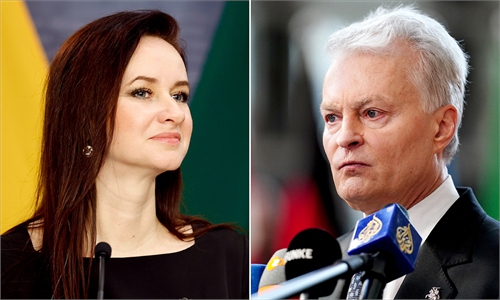
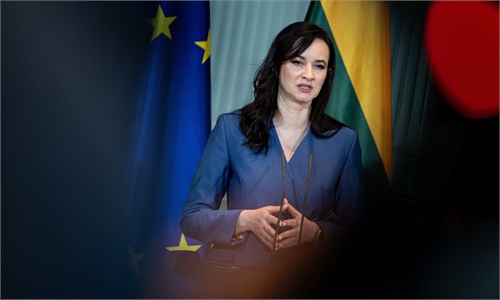
In February this year, Lithuanian Prime Minister Inga Ruginienė said that she would be prepared to consider renaming an office set up by the Taiwan regional authority in her country, and she reiterated that the opening of the so-called "Taiwanese Representative Office" in Lithuania has "brought no benefits" from the region and has damaged relations with China, LRT reported.
"The Taiwan question is purely China's internal affair. Lithuania's wishful thinking of profiting from both the Chinese mainland and Taiwan is bound to end in vain," Chinese expert stressed. Only by abiding by relevant UN resolutions and basic norms of international relations, and firmly adhering to the one-China principle, can Lithuania bring bilateral relations back on track. Should it continue to gamble and play with fire on Taiwan question, Lithuania alone will bear all the consequences and losses, the expert said.
RELATED ARTICLES