Chinese scientists unveil first 3D spatial single-cell atlas of lamprey brain, revealing 500-million-year-old secrets of vertebrate brain evolution
By Published: Jun 22, 2026 02:05 PM


Lampreys raised in the research team's laboratory Photo: courtesy of the Kunming Institute of Zoology, CAS
Chinese scientists have recently constructed the first three-dimensional spatial single-cell atlas of the lamprey whole brain, which is equivalent to drawing a detailed spatial "map" of the brain. Using this map, the researchers reconstructed some ancestral features of the vertebrate brain and revealed important innovations in neurons and brain structures during the approximately 500-million-year evolutionary process, the Global Times has learned from the research team from the Kunming Institute of Zoology, Chinese Academy of Sciences.
A complex brain is a key hallmark that distinguishes vertebrates from invertebrates and serves as the foundation for various behaviors and cognitive abilities. However, what the earliest vertebrate brain actually looked like, which genes it expressed, and what types of cells it contained have long lacked direct evidence.
To answer this question, Chinese scientists turned their attention to an ancient vertebrate - the lamprey. As one of the few surviving jawless vertebrates, the lamprey diverged from the ancestors of jawed vertebrates (including humans) approximately 450 million years ago. Remarkably, its core morphological features have remained almost unchanged for about 360 million years in the fossil record, making it a classic "living fossil" species and a critical group for reconstructing the ancestral state of the vertebrate brain.
The research team was led by Su Bing with the Kunming Institute of Zoology, in collaboration with teams from BGI Life Science Research Institute and Liaoning Normal University.
Su Bing told the Global Times on Monday that "by studying a living fossil species, we have gained a fresh understanding of the origin, diversification patterns, and underlying mechanisms of the vertebrate brain."
The researchers compared the brain atlas of the lamprey with that of the mouse. They found that, despite diverging hundreds of millions of years ago, the two species exhibit highly similar functions and gene expression patterns in multiple brain regions. Significant conservation was also observed in the neurogenesis trajectory of the olfactory bulb, the segmental organization of the hindbrain, and the core cell types across different brain areas.
These findings suggest that even in the common ancestor of vertebrates, the brain had already evolved a well-partitioned structure with complex molecular expression profiles.
This study reconstructed important ancestral features of vertebrate brain evolution, providing a new perspective for understanding how complex brain structures originated and evolved. With the development of spatial omics technologies, it is expected to become a valuable reference resource for future brain evolution research, read a statement the Kunming institute provided to the Global Times on Monday.
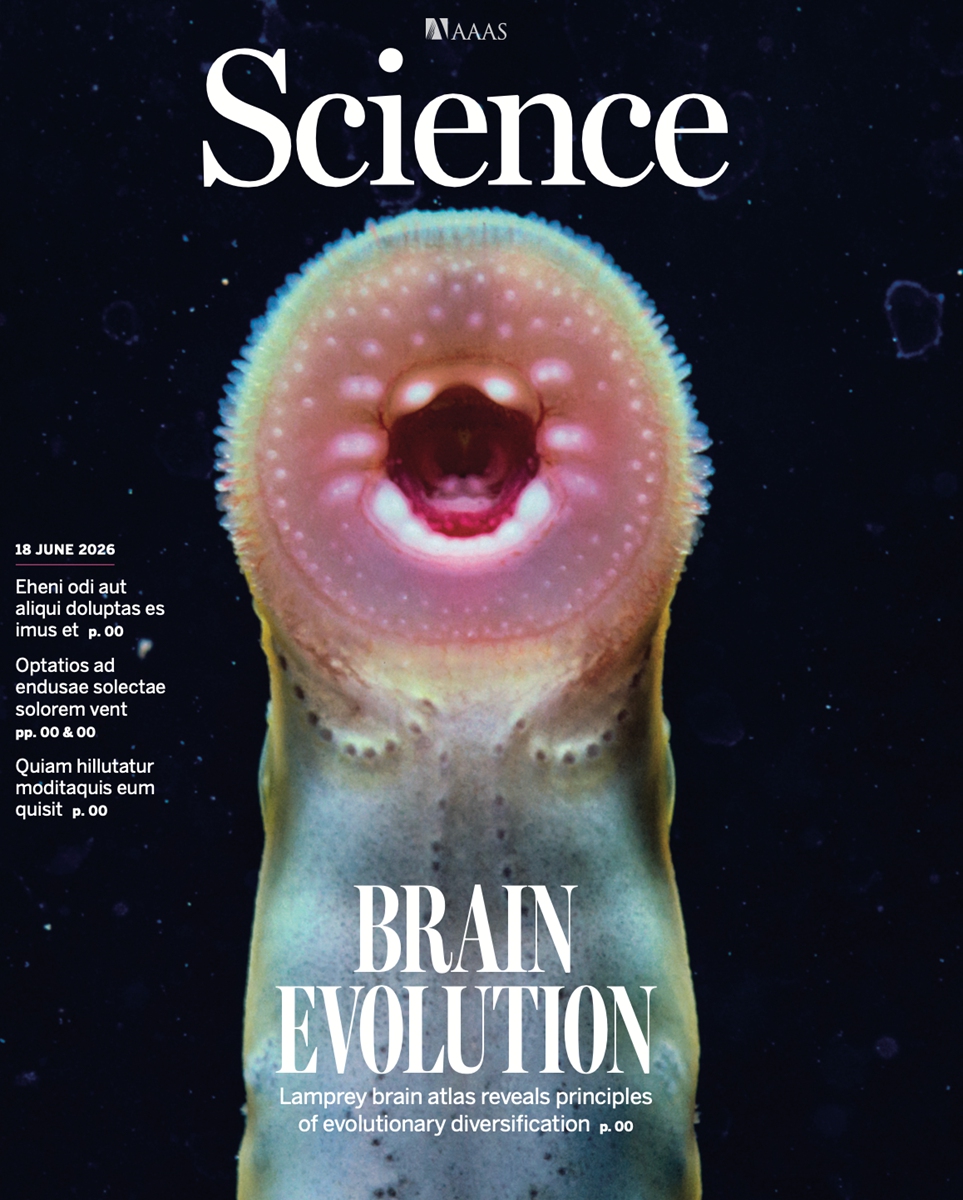
Cover of the journal Science
The research findings were published as a cover article in the journal Science on June 19.RELATED ARTICLES