Austrian Foreign Minister visits China, seen as boost to pragmatic EU China policy, expert says
By Published: Jun 22, 2026 07:36 PM

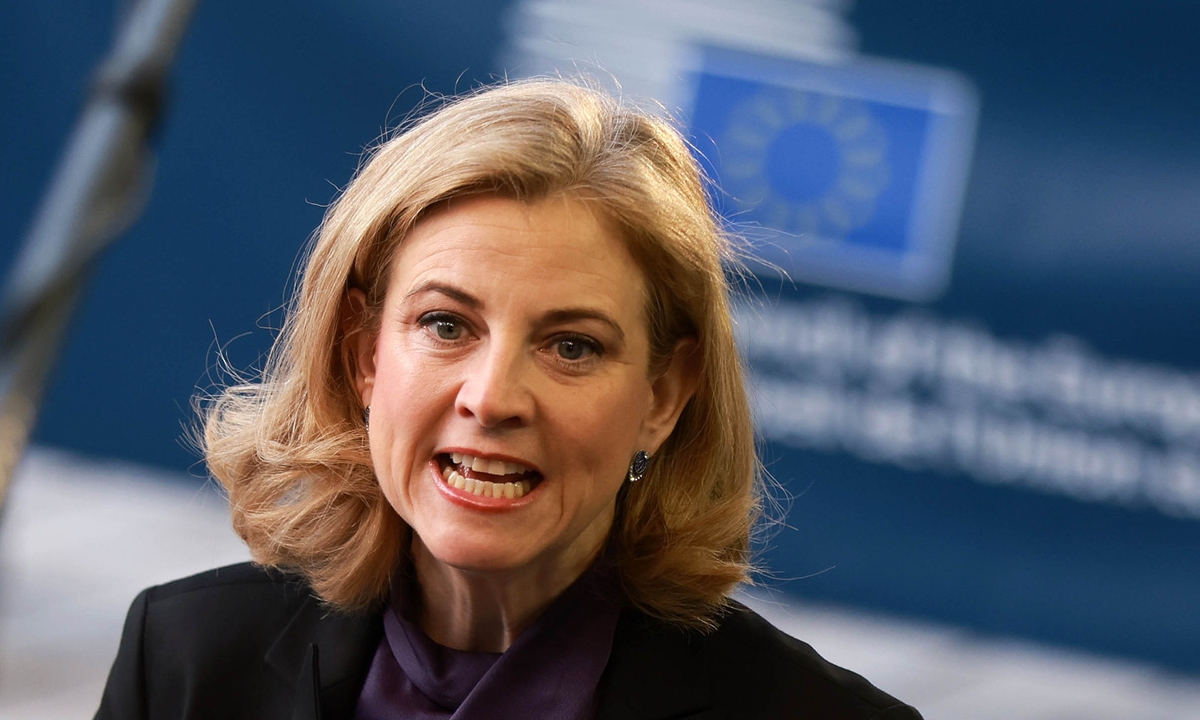
Austrian Foreign Minister Beate Meinl-Reisinger speaks to the media during a European Foreign Affairs Council in Luxembourg City, Luxembourg, 14 April 2025. Photo: VCG
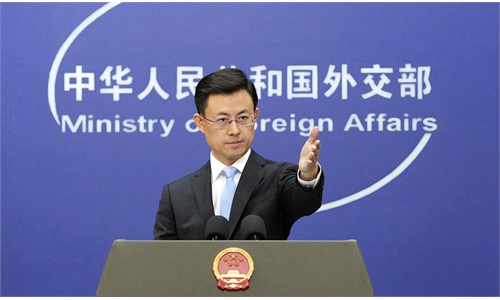
As Austrian Federal Minister for European and International Affairs Beate Meinl-Reisinger is set to kick off a five-day visit to China on Monday, Chinese Foreign Ministry spokesperson Guo Jiakun said on Monday that as the two countries mark the 55th anniversary of diplomatic relations, China stands ready to have closer exchanges, build up consensus and carry forward the friendship with Austria for greater progress in developing the friendly strategic partnership.
Austrian foreign minister's visit to China comes amid fluctuation in the EU's policy toward China, as within the EU, a differentiation has emerged among countries advocating strategic competition or pragmatic cooperation toward China, some Chinese observers said.
Austria, as a country that maintains relatively close economic and trade cooperation with China, is expected to adopt a more pragmatic approach through this visit, which may encourage more practical reflections in its China policy, they noted.
According to Austrian Broadcasting Corporation, this is the first working visit to China by a member of Austria's current government. Beate Meinl-Reisinger is scheduled to visit Shanghai on Tuesday, aiming to gain first-hand insights into the opportunities created by Austria-China cooperation, the Austrian media said.
China is among Austria's most important trading partners, Austrian Broadcasting Corporation said.
Ahead of the trip, Beate Meinl-Reisinger said Austria's goal is to strengthen European sovereignty, reduce dependencies, and at the same time maintain stable trade relations with China based on fair, reliable, and rules-based conditions, according to the Austrian media report.
The EU's policy toward China has recently shown fluctuations, with some members even resorting to tariff measures and trade protectionism, Zhao Junjie, a senior research fellow at the Institute of European Studies at the Chinese Academy of Social Sciences, told the Global Times on Monday.
"For now, clear divisions have emerged within the EU on China policy, including camps advocating trade protectionism and ideological confrontation, as well as those promoting pragmatic cooperation and free trade. The latter group, often more deeply tied to China economically, supports expanding free trade and introducing Chinese technologies and industrial models, taking a rational, practical, and win-win approach," Zhao said.
EU leaders debated on Thursday new and tougher measures that could be needed to curb the bloc's growing trade deficit with China and its heavy reliance on the world's second-largest economy for rare earths and other critical supplies, Reuters reported.
However, there has been a divergence over the response to the issue, as countries like France advocate for a tougher line, while Germany, the EU's biggest exporter, and Spain, increasingly home to Chinese investments, are more cautious, according to Reuters.
Austria's economic and trade relations with China have grown increasingly close in recent years. At the same time, Austria remains competitive in several sectors, including electronics, machinery, and pharmaceuticals, maintaining strengths in both traditional and modern industries, Zhao noted.
"Against this backdrop, the Austrian foreign minister's visit to China can be seen as reflecting a more pragmatic and dialogue-oriented strand within the EU - one that favors engagement, mutual benefit, and cooperation, and demonstrates a relatively rational approach to China policy," he added.
Since the establishment of diplomatic relations, bilateral trade between China and Austria has increased more than 400-fold over the past five decades, according to China's Ministry of Commerce.
By 2025, China had become Austria's third-largest trading partner. To date, more than 650 Austrian enterprises have invested and operated in China, with over 1,500 joint projects spanning high-value-added sectors such as semiconductors, fine chemicals, and automotive components, Qi Mei, the Chinese Ambassador to Austria, wrote in an article published in People's Daily in May.
At the same time, an increasing number of Chinese companies are using Austria as a gateway to expand into Central and Eastern European markets. Over 50 Chinese enterprises have established a presence in Austria, covering industries including machinery, automotive, telecommunications, and finance, Qi said.
Chinese new energy vehicles have been assembled and rolled off production lines in Styria, while China-made trains operate between Vienna and Salzburg, injecting new momentum into local development, the Chinese diplomat wrote.
China and Austria are friendly strategic partners. This year marks the 55th anniversary of diplomatic relations. Bilateral ties are in good shape with practical cooperation in various fields making steady progress, and cultural and people-to-people exchanges creating numerous highlights, Chinese foreign ministry spokesperson Guo Jiakun said.
RELATED ARTICLES