What wrongdoings have the 10 sanctioned US defense firms committed? China's countermeasure 'precisely targets arms sales chain to Taiwan': experts
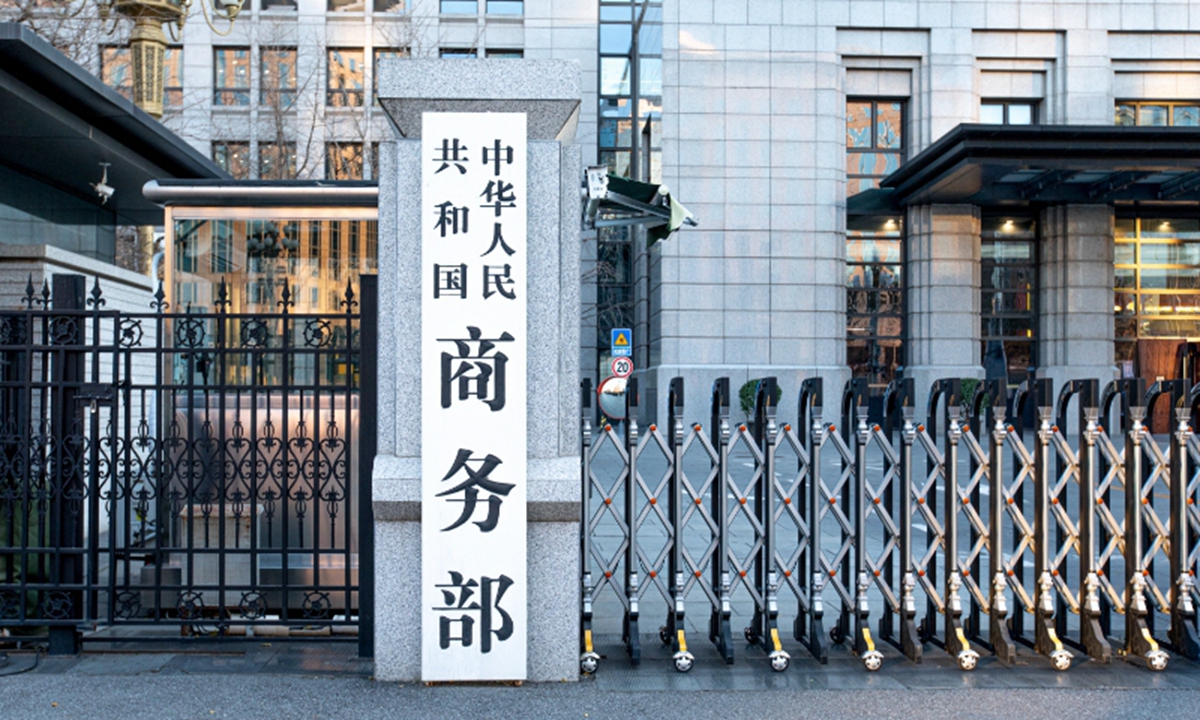
The Ministry of Commerce of China File photo: VCG
China's latest export control measures against 10 US entities are aimed squarely at the US arms sales chain to the Taiwan region and aimed at countering Washington's continued infringement on China's core interests, Chinese experts told the Global Times on Monday.
China's Ministry of Commerce (MOFCOM) announced Monday that it has decided to add 10 US entities to the export control list in accordance with the nation's Export Control Law and regulations on export control of dual-use items. The ministry said all domestic exporters are banned from exporting dual-use items to the listed entities, and organizations or individuals in any country or region are prohibited from transferring or providing China-origin dual-use items to them.
A Global Times review found that the 10 US companies placed on the list cover defense-related fields including drone systems, military sensors and radar, underwater equipment, aerospace technologies and strategic resources. These companies are deeply embedded in the US defense system and have long been involved in arms sales to Taiwan, military technology cooperation and defense industry exchanges with the Taiwan region.
According to MOFCOM, the entities are Aveox Inc, Red Cat Holdings Inc, Teal Drones Inc, IMSAR LLC, Jaia Robotics Inc, Ball Aerospace & Technologies Corp, Oshkosh Defense LLC, L3Harris Maritime Services Inc, Mountain Pass Materials LLC and USA Rare Earth LLC.
Public information shows that Aveox focuses on drone and aviation system manufacturing. Red Cat Holdings and its subsidiary Teal Drones specialize in the development and mass production of military and commercial autonomous drone systems, making them important players in US military drone exports. IMSAR mainly produces synthetic aperture radar systems, which are widely used in military reconnaissance and target monitoring. Jaia Robotics, a company focused on marine defense equipment, develops autonomous underwater robots and ocean monitoring equipment that are widely used in maritime military reconnaissance and underwater defense deployment.
Ball Aerospace & Technologies, now part of BAE Systems, has long undertaken US space equipment and military sensor system projects. Oshkosh Defense supplies various military combat vehicle platforms to the US military and its allies. L3Harris Maritime Services, a unit of US defense giant L3Harris, covers maritime military communications and defense system integration.
Many of these companies have also been regular participants in defense exhibitions and cooperation activities between the Taiwan island and the US. According to US government trade mission information, a US Uncrewed Aerial Systems and Counter-UAS business development trade mission visited Taiwan region from September 22 to 25, 2024, with Jaia Robotics listed among the approved participants. The mission focused on drones and counter-drone systems.
Last September, L3Harris Maritime Services and teams linked to Red Cat Holdings traveled to the Taiwan region to attend the Taipei Aerospace & Defense Technology Exhibition. L3Harris Maritime Services said on its website that the exhibition is Taiwan's only professional event covering defense, aviation, space and unmanned vehicle industries. Organized by the Taiwan External Trade Development Council, the exhibition has long brought together US defense contractors, defense authorities in the Taiwan region and the Chung-Shan Institute of Science and Technology for arms procurement cooperation.
According to Radio France Internationale, during last year's exhibition, the Chung-Shan Institute of Science and Technology claimed that it signed multiple cooperation agreements with companies from the US and Canada to enhance the island's so-called "self-defense capabilities."
Zhang Junshe, a Chinese military affairs expert, told the Global Times on Monday that although the Ministry of Commerce document did not state it explicitly, these companies are deeply linked to Taiwan-related matters and play important roles in the US arms sales chain to Taiwan region. "They not only directly sell military drones and other weapons and equipment to the Taiwan region, but also engage in deep military collusion with Taiwan regional authorities and transfer military equipment production technologies."
Such acts seriously damage China's national security and core interests, embolden "Taiwan independence" separatist forces to continue provoking the mainland, and undermine China's peaceful reunification process, Zhang said. "China's control measures are therefore fully justified and necessary, as they block external forces from providing material and technological support to 'Taiwan independence' separatists at the source and safeguard the bottom line of China's core interests on the Taiwan question."
This is not the first time China has taken action against US defense companies. Last December, China's Foreign Ministry announced countermeasures against 20 US military-industrial companies and 10 senior executives. L3Harris Maritime Services, Teal Drones and its executives, as well as Red Cat Holdings, were also on the sanctions list.
"The dual constraints imposed by both the Foreign Ministry and the Ministry of Commerce are enough to show that these companies' collusion with 'Taiwan independence' forces is even more egregious and has caused deeper damage to China's core interests," Zhang said.
"Layered controls mean comprehensively cutting off trade in dual-use materials, technological cooperation and technology transfers between the two sides. This will weaken external forces' support for 'Taiwan independence' separatists to the greatest extent, reduce their interference in and damage to China's peaceful reunification cause, and demonstrate China's firm determination to curb malicious Taiwan-related acts," Zhang noted.
In terms of strategic resources, Mountain Pass Materials and USA Rare Earth were also added to the export control list. Public reports show that Mountain Pass Materials operates the only active rare earth mine in the US with large-scale mining and processing capacity, while the US Department of Defense holds a stake in the company. USA Rare Earth is an emerging rare earth processing producer.
China's latest export controls also targeted US rare earth companies, at a time when Washington is seeking to build alternative critical mineral supply chains to support high-end manufacturing and the defense industry, analysts said.
In January this year, the Taiwan region and the US held the sixth Economic Prosperity Partnership Dialogue, where the two sides discussed cooperation in areas including critical minerals supply, unmanned aircraft systems supply chains, AI supply chains and digital infrastructure, according to Taiwan local economic affairs authorities. The island's media later quoted Kung Ming-hsin, head of economic affairs authority of the region, as saying that the Taiwan region was seeking to purchase rare earths from the US and would work with Washington on strengthening critical material supply chains.
Zhang said rare earths are core raw materials for manufacturing fighter jets, warships, missiles, military drones and other weapons and equipment. The US uses rare earths to produce arms and then transfers equipment such as F-16V fighter jets, various missiles and drones to Taiwan through arms sales, continuously harming China's national security, he said.
"By placing relevant US rare earth companies under control, China is weakening the material foundation of US arms sales to Taiwan from the upstream of the industrial chain," Zhang said.
"China will do everything it can to thoroughly weaken and strike those US companies that recklessly arm Taiwan and whose actions are disgraceful," Li Haidong, a professor at China Foreign Affairs University, told the Global Times on Monday.
Li said the move sends a clear signal: in the process of advancing national reunification, China's countermeasures will become more decisive, firm, precise and efficient. No external force should imagine it can obtain benefits from the Chinese mainland while undermining China's core and overall interests. China will never allow such acts to succeed.
RELATED ARTICLES