Chinese scientists develop AI system to detect space hurricanes, enhancing polar communications and navigation safety
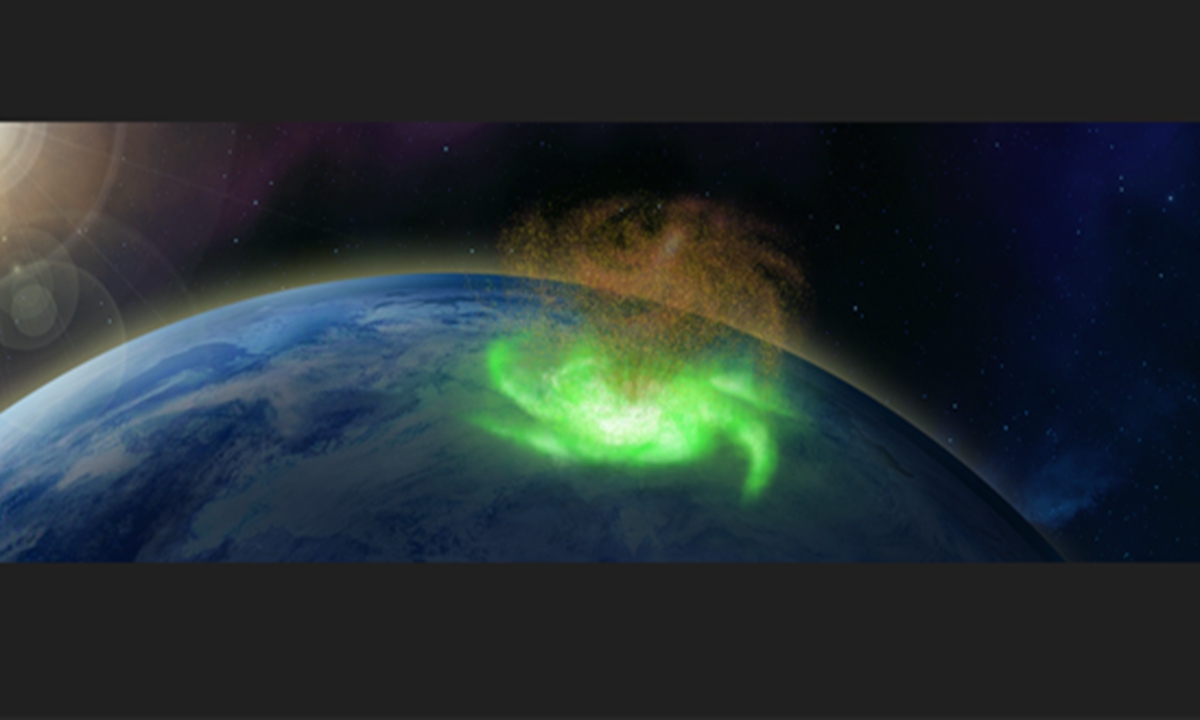
Schematic diagram of space hurricane Photo: Courtesy of Zhang Qinghe
A Chinese research team has developed a new artificial intelligence (AI) system capable of automatically detecting space hurricanes in the upper atmosphere, providing alert information to support further polar communications and navigation safety, the Global Times learned from the development team at the National Space Science Center under the Chinese Academy of Sciences on Tuesday.
A recently discovered type of space weather phenomenon, a space hurricane is huge, funnel-like spiral geomagnetic storm. It appears as a massive, rotating auroral structure near Earth's magnetic poles and is named for their resemblance to typhoons in the northwestern Pacific and tropical cyclones in the North Atlantic. Scientists have previously found that these storms, which occur in the ionosphere and magnetosphere, can cause navigation and positioning errors and significantly degrade the performance of over-the-horizon radar systems.
The Chinese research team, in collaboration with international scientists, reported a long-lasting space hurricane in the polar ionosphere and magnetosphere in 2021. They pointed out in subsequent follow-up studies that current methods for detecting space hurricanes lacks automated identification tools and instead relies entirely on manual inspection of satellite images, making the process subjective and inefficient.
"Establishing an intelligent space hurricane monitoring framework carries significant scientific value. It can not only enhance monitoring of hazards in the space environment, possibly promoting the transition of space weather monitoring from passive response to proactive early warning, but also build space weather modeling and forecasting, supporting alert information for polar communications and the safety of navigation," Zhang Qinghe, the leading researcher from the team of the state key laboratory of solar activity and space weather at the center, told the Global Times on Tuesday.
To build the AI system, researchers used 300,000 auroral images collected from both hemispheres between 2005 and 2021, selecting more than 500 confirmed space hurricane events as training samples, and deliberately incorporated a large number of ordinary aurora images that are easily confused with space hurricanes into the dataset. They then developed a deep-learning system that uses algorithms to automatically identify and accurately locate space hurricanes in satellite ultraviolet imagery. The team has also built a complete software platform with a visual interface to streamline researchers' workflows.
Tests showed that the model achieved a detection accuracy of nearly 97.9 percent, significantly outperforming previous methods. Researchers said the system could be directly applied to analyze ultraviolet imaging data from the recently launched Solar wind Magnetosphere Ionosphere Link Explorer (SMILE) satellite.
SMILE is a joint mission developed by the CAS and the European Space Agency. The satellite carries an ultraviolet imager designed to capture continuous, high-resolution auroral images.
The SMILE satellite will conduct more than 40 consecutive hours of observations, performing X-ray imaging of Earth's magnetosheath and polar cusp regions, while also capturing ultraviolet images to map the global distribution of auroras. The AI system developed in this study could be used to systematically analyze the vast amount of aurora data collected by SMILE.
By leveraging SMILE's long-duration observations, researchers expect to further improve the model's reliability and gain a deeper understanding of how space hurricanes form, evolve and move over time. Ultimately, the work could help shift research from simply identifying these rare events to uncovering the physical mechanisms behind them, providing a more complete picture of how interactions between the solar wind and Earth's magnetic field give rise to space hurricanes.
The research team's next step will be to develop space hurricane forecasting capabilities. Researchers plan to integrate real-time data sources and establish an integrated space-air-ground monitoring network supporting real-time monitoring short-term forecasting.
Meanwhile, constrained by the need for a unified data processing framework, the difficulty of modeling under small-sample conditions, and the limited physical understanding of the formation mechanisms of space hurricanes, many challenges still need to be overcome before practical, operational applications can be achieved, Zhang noted.
RELATED ARTICLES