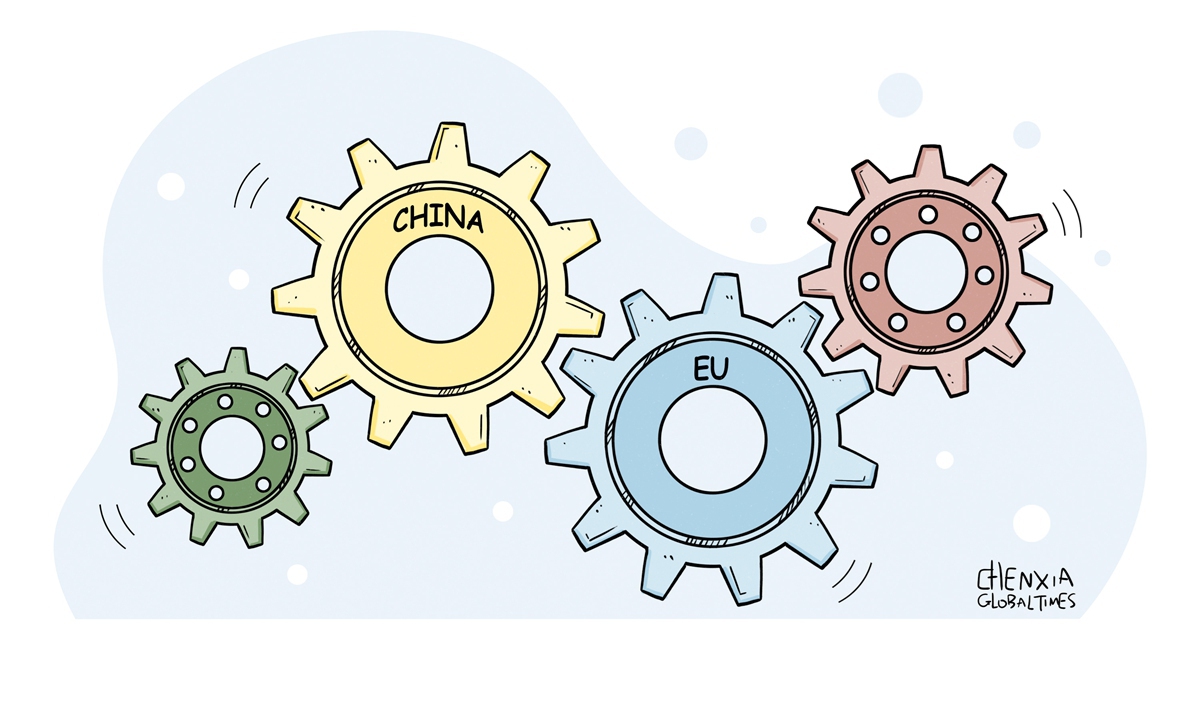
Illustration: Chen Xia/GT
Is Chinese investment in Europe an opportunity or a so-called risk? For years, European public discourse has been divided over what impact capital from China actually brings to the continent. A recent analysis by Plusminus, a business program of German public broadcaster ARD, may offer a valuable lens - at least at the operational level - for answering this question.After analyzing the economic performance of about 50 German firms that have been acquired by Chinese investors, the Plusminus analysis shows that these firms have maintained sound and stable operations, according to the website of ARD's news program Tagesschau. Five years after the acquisitions, their revenues on average had risen by 6 percent compared with the year when the deals were completed.
While the analysis itself, originating from a local media outlet, may not capture the full picture of Chinese investment in Germany or Europe more broadly, it does point to an undeniable fact: from an operational standpoint, Chinese investment can deliver tangible benefits to local business operations and regional economic growth.
A revenue increase of 6 percent may not be a striking figure, but the steady business performance of these German firms suggests that in many cases, both investors and acquired companies achieved a smooth operational transition after the change of ownership.
This reality, however, stands in sharp contrast to the prevailing narrative about Chinese investment in many of Europe's opinion-forming circles. Views of European politicians and media outlets toward Chinese investment have long been complex and multifaceted. Influenced by geopolitical anxieties and concerns over industrial security, many biased opinions have emerged in the European market.
Such views tend to exaggerate potential risks brought by Chinese capital flows, while turning a blind eye to the inherent industrial complementarity between China and Europe, as well as the practical value of Chinese investment in revitalizing underperforming local companies, opening up new export markets, and providing much-needed capital for restructuring.
In recent years, the term "de-risking" has become a buzzword in European policy discussions on China, morphing from an initial focus on supply chain resilience into skepticism toward Chinese investment. Some Chinese investment deals - whether in port infrastructure, high tech firms, energy assets, or manufacturing facilities - have been subject to geopolitical scrutiny.
Yet the industrial complementarity between China and Europe rests on solid economic foundations. Many European manufacturers face chronic shortages of investment capital, limited market access, and insufficient momentum for green and digital transformation, all exacerbated by high energy costs. These firms urgently need external funding and new growth drivers.
China, with its vast domestic market and comprehensive industrial chain, can offer European manufacturers both a massive consumer base and opportunities for deeper industrial synergy. Chinese acquisitions are, at their core, market‐driven bilateral collaborations: one side gains capital and growth opportunities, the other gains advanced technology and a strong local industrial foothold.
This complementarity explains the increase in Chinese investment projects in some European countries. Chinese firms launched 228 investment projects in Germany in 2025, up 14.6 percent year-on-year, according to the annual report of federal agency Germany Trade & Invest. Chinese companies became the largest source of foreign investment projects in Germany last year, overtaking the US for the first time since 2017, the Xinhua News Agency reported.
Amid a sluggish global economy, investment will only serve as an even more important bridge connecting the two major markets and driving growth on both sides. However, the full potential of such investment hinges critically on a stable, transparent, and predictable institutional environment. In recent years, many Chinese companies seeking to build a long-term presence in Europe have encountered geopolitical pressure and shifting standards, exposing their legitimate business interests to undue risks. Over time, this not only undermines the attractiveness of the European market to foreign capital but also drags on Europe's industrial recovery.
To unlock the potential of Chinese investment, European policymakers and industries need to return to objective economic realities and respond to the reasonable concerns of Chinese investors with a pragmatic approach. The situation Europe faces is clear: it needs foreign capital to sustain its industrial base, yet it is increasingly constrained by geopolitical considerations that complicate the very investment it seeks. Whether Europe can strike the right balance between openness and prudence will ultimately determine whether it can truly seize the opportunities that Chinese investment presents.
RELATED ARTICLES