US soybean export council CEO says participation in CISCE aims to maintain, strengthen supply chain with China; remarks show US industry’s high importance attached to China market: Chinese expert
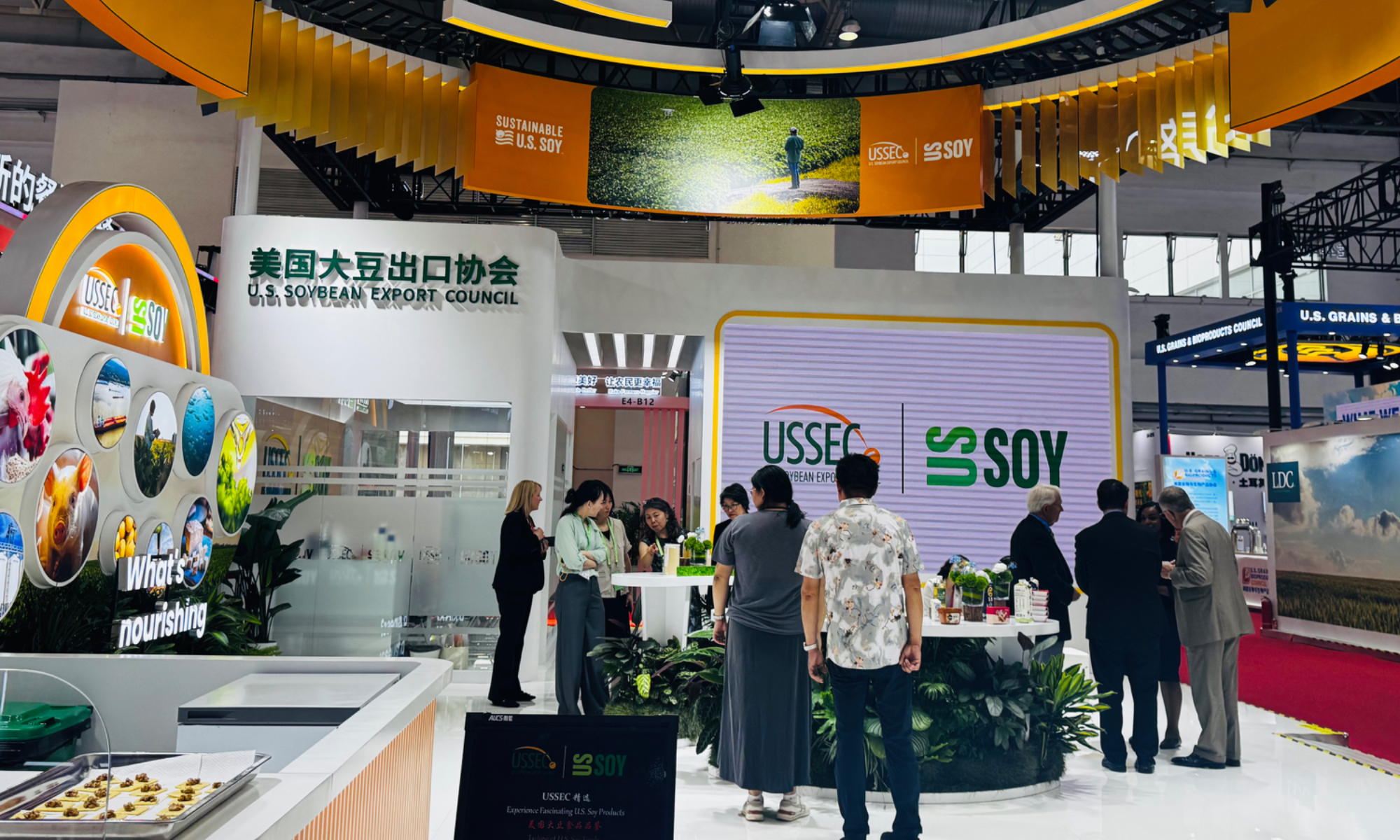
A view of the booth of the US Soybean Export Council during the 4th China International Supply Chain Expo in Beijing on June 22, 2026 Photo: Liu Yang/GT
"[Participating in the China International Supply Chain Expo (CISCE)] is able to maintain and build the relationships we have between the US soy industry, starting with our US soy farmers, going through our export supply chain, and then connecting with people here in China that use US soy. So we think it's important to be here to talk about the latest technology and innovations that are coming, but also just to make sure we are maintaining and building those relationships. That's why we are here," Jim Sutter, CEO of the US Soybean Export Council (USSEC), told the Global Times.
The remarks showed US soybean industry's high importance attached to the Chinese market, a Chinese expert said, noting that the win-win outcomes need mutual trust and steady cooperation, and the US government should take concrete actions to safeguard the atmosphere of mutually beneficial China-US collaboration.
Sutter was one of the US participants in the 4th CISCE. According to the organizer, from the first edition to the fourth edition in June, the number of participating US companies and institutions has consistently ranked first among foreign exhibitors at the expo.
During an interview with Global Times, Sutter said that the expo is a place to bring everyone together, stay on top of the relationships with the Chinese industry, and show leading Chinese companies and industry representatives what the US soy industry is doing. It is also a chance to "remember that we care about them, that we value them as customers, and that we're always here for them," the CEO noted.
Zhou Mi, a senior researcher at the Chinese Academy of International Trade and Economic Cooperation, told the Global Times that the remarks from USSEC's officials demonstrate that they attach great importance to the Chinese market and believe that the economic and trade ties between the two sides align with the fundamental interests of both countries, enabling a win-win outcome.
Sutter's remarks were made after China and the US have concluded a new round of economic and trade talks in South Korea in May. According to China's Ministry of Commerce (MOFCOM) in May, following equal consultations, the two sides achieved positive outcomes in the agricultural sector and reached multiple consensuses on the issue of two-way market access for agricultural products.
Sutter said that "The situation is in much better shape than it was a year ago... Everyone is thrilled to see that soybean trade is going again."
Jerry Slocum, director from United Soybean Board, told the Global Times that "The last year has been tough in the US for foreign profitability. It's been as bad as it's been in my career, my 60 years of farming. And a stronger relationship with China will reverse that," Slocum noted.
"We look forward to another 44 years of participation in the Chinese market... The US farmer has no reason not to be fond of a Chinese consumer. There's no reason not to want this right relationship, and I think we covered it honest to goodness," Slocum added.
Regarding bilateral agricultural trade, the MOFCOM in May said that imports of US agricultural products can help bridge structural supply-demand gaps in China's domestic market and diversify food supplies for consumers, while China's vast consumer market provides steady income for US farmers.
It's been a long history [of cooperation with China] and it's really been a win-win relationship between China and the US. That's why we continue to come to these sort of events, because we believe that for the long term, this will continue to be a win-win relationship, Sutter added.
"The American soybean industry remains optimistic about the agricultural cooperation with China, which emphasizes the need for a stable and predictable economic and trade environment," Zhou said.
Beyond trade, USSEC also deepened technical cooperation with Chinese partners. Carlos R. Salinas, executive director of East Asia of USSEC, emphasized the sustainable development of the agricultural cooperation, taking a soy innovation center with a Henan university as an example, which was launched in 2023 to explore the application value of soybean products.
Salinas said that US soybean industry improves production with technology, and this aligns closely with China's green development agenda, as both sides are trying to reduce the carbon emissions.
"The venue here is a great opportunity to do that, especially with the focus on green agriculture," Sutter noted.
The USSEC also participated in the 8th China International Import Expo (CIIE) last year, during which the council told the Global Times that it aims to have its long-term relationship renewed with many customers in China.
As a major importer of soybeans, the Chinese market showed huge demand, but this need must be built upon a foundation of mutual trust and steady cooperation. Therefore, the US government should take concrete actions to safeguard the atmosphere of mutually beneficial China-US cooperation and actively fulfill the commitments already reached by both sides, Zhou noted.
RELATED ARTICLES