MOFCOM elaborates on eight preliminary outcomes of China-US economic, trade consultations covering issues of tariffs, agricultural trade, rare earth export controls, aircraft trade

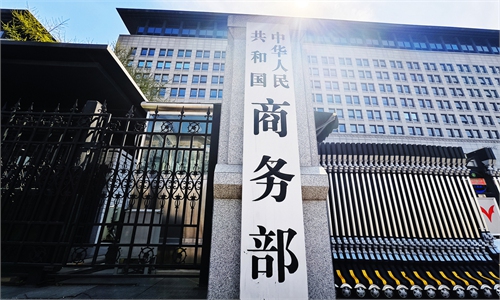
The Ministry of Commerce of China File photo: VCG
China's Ministry of Commerce (MOFCOM) on Wednesday elaborated on the eight preliminary outcomes that China and the US have recently reached in their economic and trade consultations, which cover issues including tariff arrangements, expanding agricultural product trade, extension of the joint arrangement for economic and trade consultations in Kuala Lumpur, rare-earth export control issues, Boeing aircraft purchases as well as market access for agricultural products, according to a statement published on its website on Wednesday.
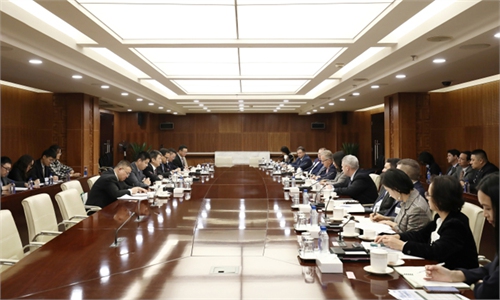
At the invitation of Chinese President Xi Jinping, US President Donald Trump paid a state visit to China from May 13 to 15. During the visit, the two heads of state held the meeting in Beijing. From May 12 to May 13, the Chinese and US delegations held economic and trade consultations in South Korea, making preparations in the economic and trade field for the meeting between the two heads of state, according the MOFCOM statement.
In response to a question for details regarding the consensus China and the US have reached on relevant tariff arrangements, an official from the Department of American and Oceanian Affairs of MOFCOM said on Wednesday said it is hoped that the US side would honor its commitments, and in the future, regardless of imposing or replacing tariffs on Chinese goods on any ground, the level of US tariffs on China must not exceed the level agreed upon in the joint arrangements reached during the economic and trade talks in Kuala Lumpur.
Through subsequent consultations, the two sides should work to further remove relevant unilateral tariffs on China, thereby creating favorable conditions for expanding bilateral economic and trade cooperation, the official said.
During this round of economic and trade consultations, the Chinese and US economic and trade teams engaged in in-depth communications on tariff issues and reached arrangements on relevant bilateral tariffs, according to the MOFCOM official.
The two sides have agreed in principle to discuss, under the framework of a trade council, a reciprocal tariff reduction arrangement covering products of comparable scale — starting at $30 billion or more on each side. For mutually agreed products of concern to both parties, it is expected that Most-Favored-Nation (MFN) tariff rates or even lower rates could apply, the official said.
The implementation of this arrangement would not only help stabilize and expand bilateral trade between China and the US but also provide a useful reference for global openness and cooperation, according to the MOFCOM official.
The economic and trade teams of both sides will maintain close communication to finalize the specific arrangements and advance their implementation as soon as possible, the MOFCOM official added.
During this round of consultations, the Chinese and US sides reaffirmed that they will continue to implement the outcomes of previous economic and trade consultations. The economic and trade teams of both sides will maintain close communication and consultations to promote the extension of the joint arrangements reached during the economic and trade talks in Kuala Lumpur, so as to provide a more stable policy environment and market expectations for bilateral economic and trade cooperation, the official said.
In October 2025, China and the US reached a joint arrangement in Kuala Lumpur on resolving their respective economic and trade concerns. The two sides agreed to suspend the implementation of certain tariff and non-tariff measures until November 10, 2026. These measures include the US 24 percent reciprocal tariffs and China's corresponding countermeasures, the US 50 percent penetration rule regarding export controls and China's related export control measures, as well as the US Section 301 investigation measures targeting China's maritime, logistics, and shipbuilding industries and China's corresponding countermeasures.
These arrangements are of great significance for stabilizing China-US economic and trade relations. And extending the relevant arrangements serves the common interests of both countries and meets the expectations of the international community, reads the MOFCOM statement.
Regarding a question on the consensus China and the US have reached on expanding two-way trade, particularly agricultural trade, the official said that through consultations, the two sides have reached a series of positive consensuses on addressing non-tariff barriers and market access issues for certain agricultural products.
Both sides have in principle agreed to include relevant products under a reciprocal tariff reduction framework and have set guiding targets for expanding two-way agricultural trade, the MOFCOM official said, noting that it is hoped that both sides will create favorable conditions for two-way agricultural trade by jointly reducing tariffs, removing non-tariff barriers, and expanding market access, so as to promote the recovery and continuous expansion of cooperation in agricultural trade.
Regarding the issue on market access for agricultural products, the MOFCOM official also said that China and US have reached agricultural market access agreements through equal consultations. The US has committed to lifting automatic detention measures on Chinese dairy and dairy-containing foods imposed since 2008, accepting trial exports of media-grown bonsai, and removing automatic detention on three categories of Chinese aquatic products. The US also agreed to recognize Shandong Province as an HPAI‑free zone and agreed to expedite the removal of certain Chinese companies from import alert red lists.
Meanwhile, China resumed registration of eligible US beef suppliers, lifted HPAI restrictions on qualified US states, resumed poultry imports from relevant states, expedited the review of US beef companies suspended over drug residue issues, and will hold exchanges on agricultural biotechnology, the MOFCOM official said.
When asked to comment on the White House's statement that China will address US concerns about shortages in the supply chain of rare earths and other critical minerals (including yttrium, scandium, neodymium, and indium), and the US concerns about the ban or restriction on the sale of rare earth production and processing equipment and technology, the official said that the China-US economic and trade teams have conducted in-depth communication and exchanges on relevant export control issues, and the two sides will jointly study and resolve each other's legitimate and lawful concerns.
The MOFCOM official said that the Chinese government imposes export controls on rare earths and other critical minerals in accordance with laws and regulations, and reviews license applications for compliant civilian uses. China is willing to work with the US to promote mutually beneficial cooperation between enterprises of the two countries and create favorable conditions for ensuring the security and stability of the global industrial and supply chains, the official said.
In accordance with the important consensus reached by the leaders of China and the US, China's aviation industry, based on its own civil aviation transport development needs, will import 200 Boeing aircraft in accordance with commercial principles, the official said, in response to a question asking to provide more details on US President Trump's claim that China has agreed to purchase 200 Boeing aircraft, according to the statement.
At the same time, the US side will provide China with sufficient guarantees for engine and parts supply, the official said, according to the statement on MOFOCM's website. The official noted that aviation is a key area for deepening mutually beneficial and win-win cooperation between China and the US.
RELATED ARTICLES