Lithuania suspends economic cooperation talks with Taiwan regional authorities: report

Latest News
Inga Ruginienė has resigned as Lithuania's prime minister on Tuesday. Prior to her resignation, negotiations between Lithuania and Taiwan regional authorities on an economic cooperation action plan had been put on hold "by mutual agreement," Lithuanian National Radio and Television (LRT) reported.According to LRT, the pause was prompted by "changes in the domestic political environment," referring to the formation of a new coalition government in Vilnius.
The policy adjustment comes amid broader political changes in Lithuania. According to Euronews, political parties in Lithuania signed a coalition agreement on Thursday, with the Social Democrats, the Democrats "For Lithuania" and the Farmers and Greens Union, along with partners, the Electoral Action of Poles in Lithuania - Christian Families Alliance, striking a new deal.
The agreement includes an aim to "normalize diplomatic relations with China" to the level maintained by other European Union countries, Euronews reported.
The latest development has also been acknowledged by authorities on the island of Taiwan. According to the island's media outlet CNA, authorities on the island has confirmed that the island and Vilnius had "agreed to suspend talks on a new economic cooperation project proposed by Lithuania, due to the ongoing formation of a new coalition government.
Taiwan regional authorities claimed Tuesday that their "friendly cooperation" with Lithuania would not be affected by any third party and that they would continue close coordination on the economic cooperation action plan. They also claimed the suspension was likely due to the formation of Lithuania's new government, while both sides remained committed to expanding economic and trade ties, Chinatimes.com reported.
Speaking on Sunday, Kuomintang politician Yeh Yuan-chih questioned the DPP authorities' long-standing portrayal of ties with Lithuania as a diplomatic breakthrough, according to Chinatimes.com.
Yeh said that both the DPP authorities and former regional leader Tsai Ing-wen had repeatedly described Taiwan island's relations with Lithuania as "encouraging" and promoted concepts such as "like-minded countries" and "democratic partners" to downplay the reality that only a small number of countries maintain formal diplomatic relations with the island.
He also questioned a cooperation package reportedly involving around $1.2 billion and plans related to semiconductor development in Lithuania, calling on the DPP authorities to explain the project's status and why Lithuania's position appeared to have shifted after the island has invested significant resources.
"Over the years, the DPP authorities have attempted to secure so-called international support by providing investment, aid and other benefits to certain foreign politicians, while portraying such support as recognition of Taiwan island's authorities and evidence of its growing international standing," Zheng Jian, a professor at the Graduate Institute for Taiwan Studies of Xiamen University, told the Global Times on Tuesday.
The DPP authorities have long portrayed support from certain politicians as representing broader backing from democratic countries. "But this approach is becoming increasingly ineffective," Zheng said.
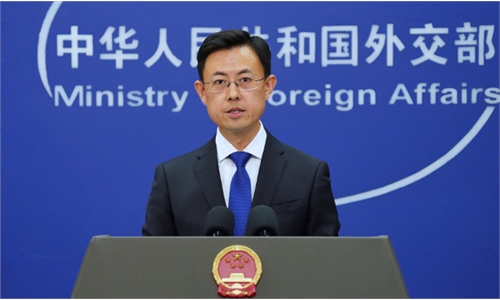
On Monday, responding to media questions regarding reports that Lithuania had agreed to allow China to open a chargé d'affaires office and whether China would reopen its embassy in Vilnius and restore bilateral relations, Chinese Foreign Ministry spokesperson Guo Jiakun reiterated China's position.
"The crux of the current difficulties is that the Lithuanian side violated the one-China principle and went back on its political commitment made in the joint communiqué on the establishment of diplomatic relations," Guo said.
"China remains open as always to communication. It is hoped that the Lithuanian side will act promptly and decisively to correct past mistakes and return to the right track of adhering to the one-China principle so as to create conditions for the normalization of relations with China," he added.
RELATED ARTICLES