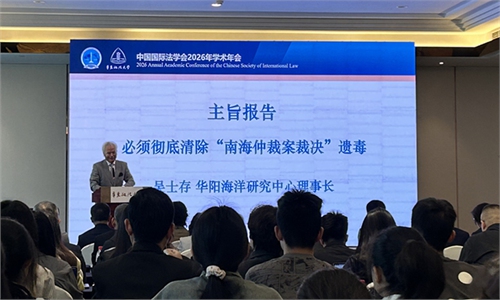
Philippine side hypes up South China Sea arbitration again; so-called award nothing but waste paper: Chinese expert
By Published: Jun 24, 2026 04:19 PM

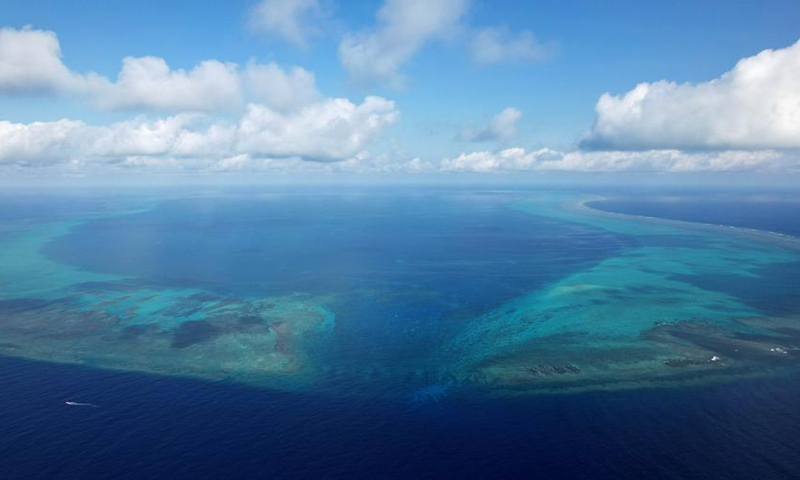
An aerial drone photo taken on May 12, 2026 shows a view of China's Huangyan Dao in the South China Sea. (Xinhua/Chen Bin)
The Philippine side recently hyped up the so-called South China Sea arbitration issue again, as its foreign affairs department issued a "rejection" of China's position and certain individuals criticized the Chinese Embassy. The embassy had reiterated that the arbitration was a political farce disguised in legal clothing, and that the so-called award is illegal, null and void. A Chinese expert said the so-called award is nothing more than a piece of waste paper, while some groups in the Philippines are using the 10-year timing of the ruling to garner attention and pursue personal interests. Such moves do nothing to benefit bilateral ties or ease tensions in the South China Sea, experts said.
A report from the Philippine Star on Wednesday claimed that the Department of Foreign Affairs rejected a recent statement of the Chinese Embassy in Manila against the 2016 South China Sea arbitral award.
The Chinese Embassy in Manila on Tuesday posted a statement on X, stating that the embassy rejects the so-called South China Sea Arbitration which was a political manipulation disguised in legal garb. The arbitral tribunal distorted and abused the dispute-settlement mechanisms of the United Nations Convention on the Law of the Sea (UNCLOS), fabricated China's positions, wrongly determined facts, and incorrectly interpreted and applied the law. Its award is illegal, null and void, the embassy said.
China neither recognizes nor accepts the award, nor does it accept any claim or action based on it. China's territorial sovereignty and maritime rights and interests in the South China Sea are under no circumstances affected by the award, read the statement.
The Chinese Embassy also stated that it rejects the misuse of arbitration over territorial matters, rejects the numerous errors committed by the tribunal in addressing issues concerning maritime rights, the legal status of maritime features, and China's conduct.
The so-called arbitration is nothing more than a scrap of paper. However, certain individuals in the Philippines are leveraging the 10-year timing to hype up South China Sea issue and sensationalizing the alleged new structure at Huangyan Dao, Chen Xiangmiao, a research fellow at the National Institute for South China Sea Studies, told the Global Times on Wednesday.
Jay Tarriela, spokesperson for the Philippine Coast Guard, recently took to social media to hype up the so-called "arbitral award."
Chen said that by hyping up South China Sea issues and anti-China narratives, Tarriela and some others have been clamoring to portray themselves as "heroes." Yet their words have no basis in facts and are driven by deception and political calculation. Their real purpose is to grab headlines and pander to the US and far-right factions within the Philippines.
"Certain people in the Philippines should immediately stop maritime provocations and the victim narrative. Tarriela's so-called 'documenting' and 'recording' of China's law enforcement activities to safeguard its rights in the South China Sea is a habitual ploy to hype up the 'China threat' narrative, complicate the maritime situation, and incite international public opinion," the Chinese Embassy in Manila said in a post on June 22.
On June 21, Deputy Spokesperson of the Chinese Embassy Guo Wei said in a post on X that the so-called award is illegal, null and void. "China has no intention of spending more time debating the matter, but wishes to raise the following questions: In the ten years since the award was issued, what has the Philippines gained? Have China-Philippines relations improved or deteriorated? Has the situation at sea become more stable or more tense? Who exactly has been manipulating the arbitration issue, obstructing the improvement of China-Philippines relations and undermining regional peace and stability? Now that President Ferdinand Marcos Jr. has expressed a desire to reset China-Philippines relations, why do you, as a government official, continue to provoke China? What is your real objective?" Guo said in the post.
The questions raised by the Chinese Embassy hit the Philippines' sore spot. The so-called ruling has brought neither peace nor stability to the South China Sea, nor has it served the interests of the Filipino people. Instead, it has damaged China-Philippines relations and dragged some Philippine politicians deeper into political infighting, Chen said.
The international community can clearly see that the Philippines is using international law as political cover, a move that has only undermined its own reputation within ASEAN. The so-called ruling has brought nothing but instability, confrontation and conflict, Chen said.
During the 36th Meeting of States Parties to the United Nations Convention on the Law of the Sea held on June 17, in response to the Philippines' hyping of the so-called "arbitral award," Sun Lei, China's deputy permanent representative to the United Nations, said that at present, thanks to the joint efforts of China and ASEAN countries, the situation in the South China Sea is generally stable. China is working with ASEAN countries to fully and effectively implement the Declaration on the Conduct of Parties in the South China Sea, accelerate consultations on the Code of Conduct in the South China Sea, and jointly strive to make the South China Sea a sea of peace, friendship and cooperation.
RELATED ARTICLES