Xi calls for solid measures to modernize agriculture, rural areas
By Tao Mingyang and Published: Jun 25, 2026 01:11 AM
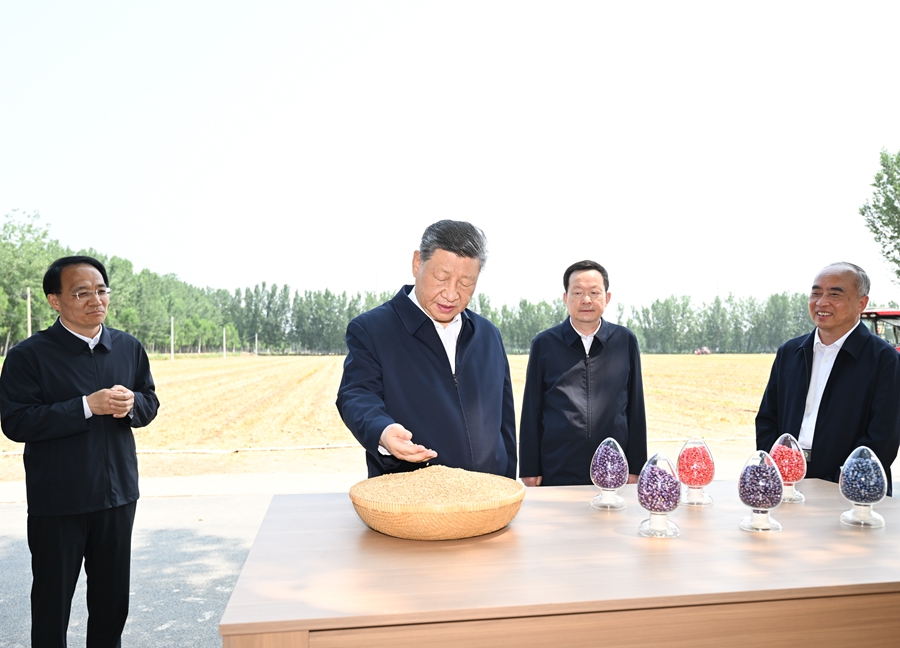
Photo: Xinhua
Chinese President Xi Jinping has called for solid measures to advance the modernization of agriculture and rural areas, Xinhua News Agency reported.Xi, also general secretary of the Communist Party of China (CPC) Central Committee and chairman of the Central Military Commission, made the remarks during an inspection trip on Wednesday to the city of Dezhou, East China's Shandong Province.
Xi said efforts must be made to enhance the overall production capacity, quality and performance of agriculture, ensure the stable supply of important agricultural products such as grains, build a beautiful and harmonious countryside for people to live and work in according to local conditions, and guide farmers to create a better life through hard work and wisdom.
Summer harvest season
In Dongyujia Village, Xi learned about the local wheat harvest, corn planting and agricultural supplies. He also walked into a farmland and had cordial exchanges with grain growers, farming machinery operators and agricultural technicians, according to Xinhua.
Xi emphasized that ensuring the stable supply of grains and other agricultural products is the top priority in agricultural production, stressing efforts to well implement all supportive policies for grain production so as to secure a bumper grain harvest throughout the year.
The inspection comes as China's "sanxia" farming season - which means the three major summer agricultural tasks of harvesting, planting and field management - nears completion, with summer grain forming the first major section of the annual grain production cycle.
Summer harvesting yields the first grain batch of the year, dominated by wheat, which accounts for roughly 40 percent of China's annual grain supply for food, a Xinhua report said.
Summer planting refers to the successive rush planting of autumn-harvested crops such as summer corn, summer soybeans and rice right after summer harvest in many regions.
Summer field management involves field care for crops growing in summer.
The quality of summer planting and summer field management directly lays the groundwork for a bumper autumn grain harvest.
For this reason, sound progress in the "sanxia" farming season consolidates the foundation for a full-year grain bumper harvest.
Data from the Ministry of Agriculture and Rural Affairs shows that as of June 18, more than 96 percent of the national wheat harvest has been completed, according to another report by the Xinhua News Agency.
Agricultural and rural modernization
Shandong Province, where Dezhou is located, is one of China's representative regions for agricultural modernization, and Dezhou itself is highly typical, making the inspection highly instructive, Su Wei, a professor at the Party School of the CPC Chongqing Municipal Committee, told the Global Times on Wednesday.
Su said Dezhou has developed a uniquely Chinese path to agricultural modernization by maintaining China's rural basic operating system while drawing on international experience in mechanization, intensification and professional agricultural services, stressing that the model cannot be simply replicated elsewhere.
Advancing the modernization of agriculture and rural areas is one of the top priorities for China's economic development.
The Outline of the 15th Five-Year Plan for National Economic and Social Development states that China will further accelerate agricultural and rural modernization and solidly advance the comprehensive revitalization of rural areas.
It calls for efforts from multiple aspects, including ensuring grain output, strengthening agricultural technology and equipment support, creating high-quality rural living space, as well as fiscal supports.
Su said that agricultural and rural modernization is both a core priority and one of the most challenging areas of Chinese modernization. "If agricultural modernization is addressed thoroughly, many broader issues in Chinese modernization can also be effectively advanced," he noted.
The importance of agricultural modernization is reflected not only in its strategic positioning, but also in recent development outcomes.
China's grain output exceeded 1.4 trillion jin in 2024, and reached 1.4298 trillion jin in 2025, setting a new record. The contribution rate of agricultural science and technology progress exceeded 64 percent in 2025. In poverty alleviation, more than 7 million monitored individuals were stably lifted out of the risk of falling back into poverty by the end of 2025, while rural housing renovation and seismic reinforcement have progressed steadily, and rural tap water coverage has reached 94 percent, according to official data.
Agricultural and rural modernization serves as a "ballast stone" for national food security and a foundational pillar of Chinese modernization. Its steady progress will provide stronger strategic support for high-quality economic and social development, Su said.
Realizing the modernization of agriculture and rural areas is of vital importance to drive Chinese modernization. And the period of the 15th Five-year Plan (2026-30) is a vital phase leading up to 2035, when the country will see basic realization of socialist modernization, Li Guoxiang, a research fellow at the Rural Development Institute of the Chinese Academy of Social Sciences, told the Global Times on Wednesday.
During the process, efforts to ensure farmers' living standards continue to improve along with the country's urban areas will play an increasingly important role, extending modern living environments and medical services to the rural population, Li said.
Leading role
Later, Xi visited the nearby Xiyujia Village, where he inquired in detail about improving local Party organizations and about the delivery of public services. He also viewed a display of local agricultural and sideline products, Xinhua reported.
Xi expressed the hope that village Party organizations would further leverage the guiding role of Party building and make new achievements in building a beautiful and harmonious countryside for people to live and work in.
Xi said that Party members and officials must do more to benefit the people, deliver tangible results for their well-being, and address their difficulties, thereby enhancing their sense of fulfillment, happiness and security, reported Xinhua.
Dezhou, as an important national grain production base and a concentrated area of modern agricultural development, has in recent years advanced high-standard farmland construction, agricultural mechanization and digital agriculture applications, continuously improving agricultural organization and overall productivity, Hu Qimu, a professor at the Maritime Silk Road Institute of Huaqiao University, told the Global Times on Wednesday.
In this process, grassroots Party organizations serve not only as the "last mile" in policy implementation, but also as key coordinators of resource allocation, industrial guidance, and public service delivery, he said.
"We are about to celebrate the 105th birthday of the Party as July 1 approaches," Xi said, noting that the Party has united and led the Chinese people of all ethnic groups in making great achievements worthy of history and the people over the past 105 years.
"As we are marching on the new journey of building China into a modern socialist country in all respects, we must work together and keep up our stride on the new Long March to create a brighter future and continuously meet the people's aspirations for a better life," Xi said, according to Xinhua.
Amid accelerating agricultural modernization, the organizational and mobilization capacity of grassroots Party organizations is a key guarantee for channeling resources, technology and services to rural areas, and an important institutional support for improving agricultural efficiency, rural environments and farmers' incomes, Hu said.
"Overall, strengthening grassroots Party building and using Party leadership to guide rural development is becoming an important pathway to advancing rural revitalization and accelerating agricultural and rural modernization," said Hu.
RELATED ARTICLES