Chinese scientists reveal earliest stages of organ formation using in vitro gastrulation model
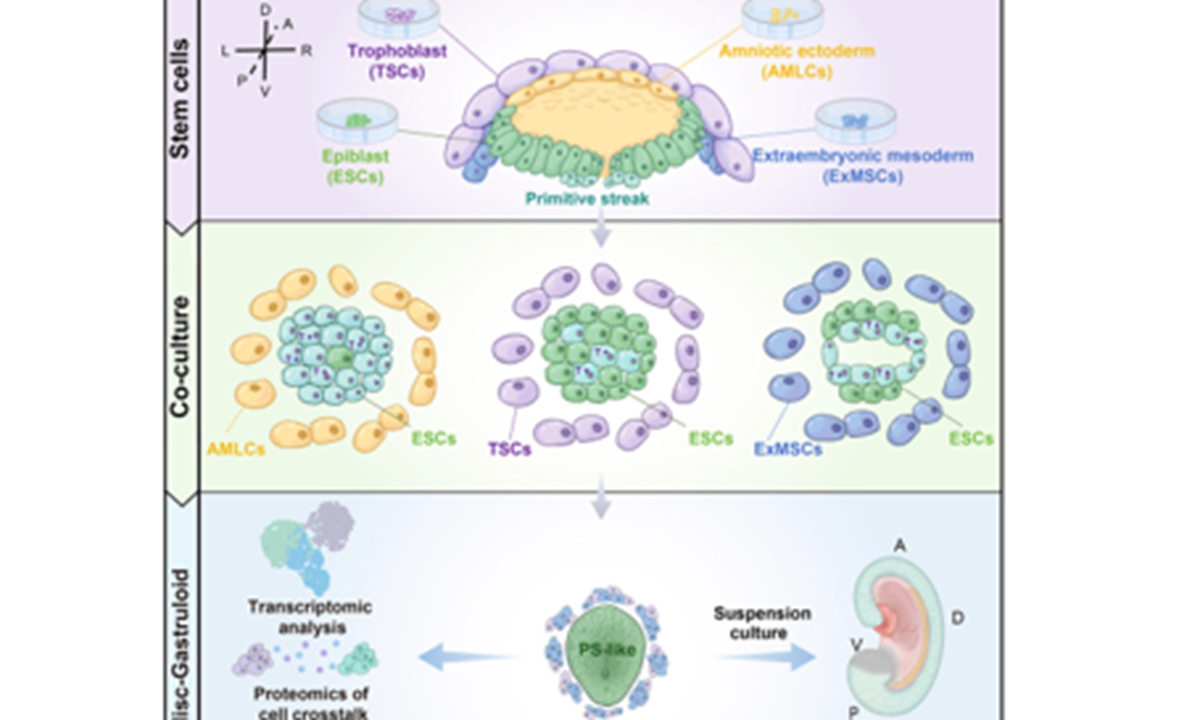
Photo: Courtesy of the reseach team of China Agricultural University and Chinese Academy of Sciences
Chinese scientists have successfully developed an embryonic disc-like gastrulation model known as Disc-Gastruloid, unlocking a long-standing "black box" of early human embryonic development and organ formation. This breakthrough has provided a powerful new platform for exploring the mysteries of early life and advancing organ regeneration research, the Global Times learned from the research team on Thursday.
The joint research, led by Wei Yulei, professor at the College of Biological Sciences, China Agricultural University, and Yu Leqian, a researcherat the Institute of Zoology, Chinese Academy of Sciences, was published in the international academic journal Cell on Wednesday.
Gastrulation, a crucial stage in early embryonic development, establishes the basic body plan and lays the foundation for the formation of various tissues and organs. However, because human gastrulation takes place in utero, the mechanisms that initiate and regulate this process have long remained a major unsolved question in developmental biology. The newly developed Disc-Gastruloid recreates key gastrulation events in vitro and opens a new avenue for studying early human development and advancing regenerative medicine, Xinhua News Agency reported.
The research team's successful construction of the model faithfully recapitulates the key events of embryonic gastrulation in vitro, and enables researchers to observe the spontaneous formation and development of various organ precursor cells, as well as early structures resembling the neural tube and primitive heart cavity.
About 14 days after fertilization, a slit-like structure known as the primitive streak emerges in the human embryonic disc, marking the onset of gastrulation. Building on previous work by Yu's team on 3D digital models of human embryos, the model closely resembles the structure of the human embryonic disc by simulating its early physical and physiological conditions.
This model can autonomously generate a primitive streak-like region and faithfully recapitulates key events in natural embryonic development during gastrulation, including cell migration, cell fate specification, and transitions, Xinhua reported.
More significantly, with further suspension culture, over 80 percent of these epiblast disc-like structures continued to develop and spontaneously formed elongated, multilayered three-dimensional embryo-like structures.
Experts believe this study provides a novel technological approach for understanding early human development and organ formation, enabling large-scale, modular in vitro production of functional organ progenitor cells, and ultimately advancing organ engineering and regenerative medicine.
The model also offers new theoretical insights for optimizing in vitro embryo culture systems in agricultural animals, improving embryonic developmental efficiency, and supporting research on interspecies chimeras and stem cells across multiple species. In the long term, it may help pave the way for developing human organ regeneration strategies using large animal models, Wei told the Global Times on Thursday.
RELATED ARTICLES