China discovers globally rare coral reef blue hole at Huangyan Dao, first verified of its kind in the country
Scientific surveys at S.China Sea highlight China’s ecological protection efforts and indisputable maritime rights: expert
By and Fan Wei Published: Jun 26, 2026 12:40 AM

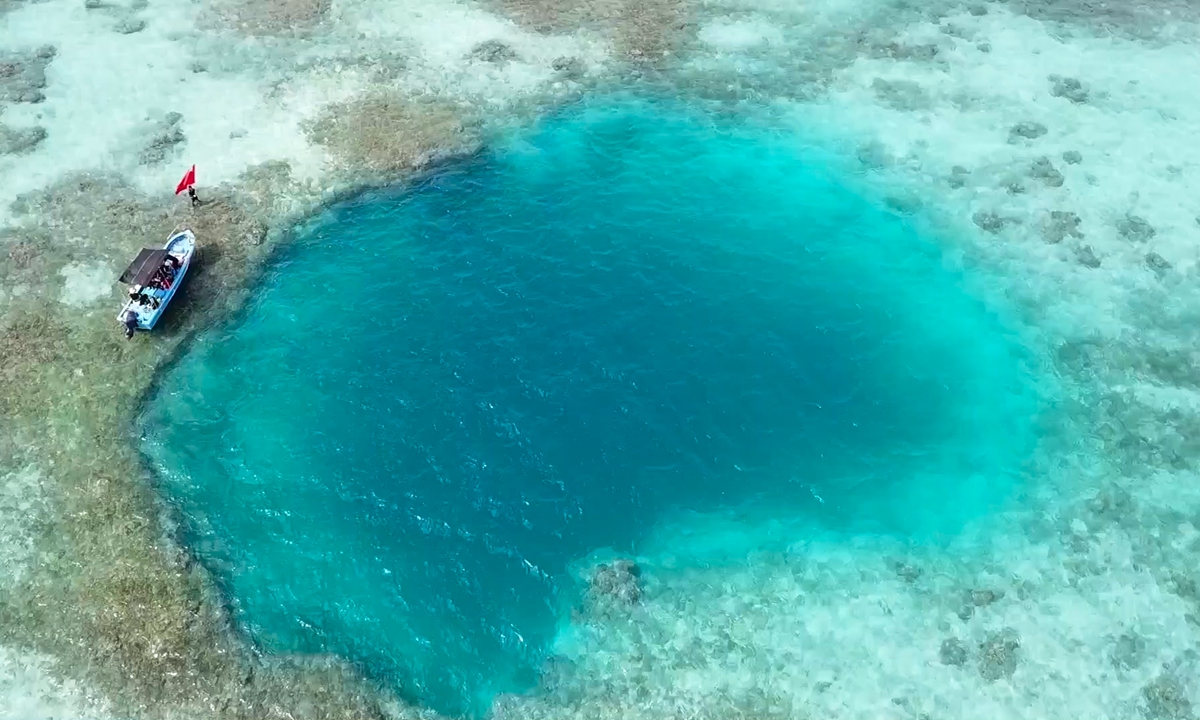
An aerial view of the Huangyan Dao Blue Hole Photo: Clip of short documentary Eye of the South China Sea - The Huangyan Dao Blue Hole released by China's Ministry of Ecology and Environment
China has discovered a globally rare coral reef growth structure-type marine blue hole at Huangyan Dao, marking the first coral reef blue hole explored and verified in the country, according to a report released by the Ministry of Ecology and Environment on Thursday. Preliminary geochronological analyses, including radiocarbon dating, suggest that the blue hole dates back at least 3,200 years and supports rich biodiversity in its surrounding waters.
Titled "2025 Survey Report on Huangyan Dao Blue Hole," the report was released in both Chinese and English versions. It consists of four parts, providing a comprehensive introduction to the blue hole ecosystem, the overview and genesis of the Huangyan Dao Blue Hole, the biodiversity within and around the blue hole, and prospects for research, survey and conservation.
The surveys are the latest studies of the ecological environment in the waters around China's Huangyan Dao in the South China Sea since China's State Council approved the establishment of the Huangyan Dao National Nature Reserve in September 2025 to protect the island's coral reef ecosystem. Administered by the city of Sansha in South China's Hainan Province, the reserve covers 3,523.67 hectares, according to the Xinhua News Agency.
The improvement of Huangyan Dao's ecological environment is closely linked to the ecological protection and restoration measures China has implemented during its management of the island. Strengthening ecological governance at Huangyan Dao will help maintain the stability of its ecological conditions and also improve them. Such efforts also underscore China's indisputable lawful sovereignty and maritime jurisdiction over the area, said Chinese experts.
New discovery
"In August 2025, we identified a suspected special blue hole habitat in the central area of the Huangyan Dao lagoon and subsequently carried out a series of in-situ investigations, including scuba diving observations, remotely operated vehicle exploration and unmanned aerial vehicle photogrammetry. We also conducted comprehensive research by integrating multidisciplinary methods, including satellite remote sensing observation, geochronological analysis, sedimentary characteristics analysis and image interpretation of eco-geological landscapes," Hu Guolin, head of the ecology and environment bureau in Sansha, Hainan told the Global Times on Thursday.
According to the preliminary findings of consultations and assessments by experts and scholars in relevant fields, the habitat has been comprehensively identified as a globally rare marine blue hole formed by a coral reef growth structure. It is also the first marine blue hole of this type discovered in China so far, commonly known as a coral reef blue hole, according to Hu.
According to the images unveiled by the report on Thursday, the Huangyan Dao Blue Hole developed in a high-density patch reef area within the central lagoon. Scientific survey personnel from the South China Institute of Environmental Sciences under the Ministry of Ecology and Environment, the Guangxi Laboratory on the Study of Coral Reefs in the South China Sea at Guangxi University, and other institutions found from the in-site investigation that the Huangyan Dao Blue Hole has an entrance area of 1,491.7 square meters, an entrance perimeter of 152.4 meters, an average entrance radius of 19.6 meters, and a maximum entrance diameter of 56.3 meters.
Preliminary geochronological studies, including radiocarbon dating, indicate that the Huangyan Dao Blue Hole formed at least 3,200 years ago, which aligns with the age characteristics of global coral reef growth structure type blue holes, according to the report.
The Huangyan Dao Blue Hole and its surrounding areas harbor exceptionally high levels of biodiversity. This field survey recorded typical coral reef biological communities inside the hole, including corals, giant clams, fish, sponges, and sea anemones. Green sea turtle, classified as a Class I protected wildlife species in China, was observed inhabiting and moving in interior and around the entrance of the blue hole.
Consecutive field surveys conducted over two years in the waters surrounding the blue hole have cumulatively recorded 165 species of hard corals, belonging to 14 families and 44 genera, as well as 184 species of fish, belonging to 27 families and 85 genera. Over 2,700 species of marine life have been recorded using environmental DNA technology, according to the report.
The report also noted that the Huangyan Dao Blue Hole is a remarkable illustration of the natural ecosystem diversity of Huangyan Dao. It represents a key geological archive for reconstructing the paleoenvironmental changes of the South China Sea, including sea-level fluctuations and the impacts of global and regional climate change.
The blue hole can also offer important information for studies on biodiversity in the South China Sea, the historical evolution of its marine environment, and the evolution of coral reef biota in the Indo-Pacific convergence zone, Yu Kefu, a professor from the Guangxi Laboratory on the Study of Coral Reefs in the South China Sea at Guangxi University, told the Global Times.
"By learning from the past to better understand the future, these studies can provide important scientific support for humanity's response to global change and for the protection of biodiversity in the South China Sea," he noted.
Milestone achievements
The report represents a new milestone in China's ecological protection and marine scientific research at Huangyan Dao. It builds on the long-term ecological surveys carried out before China delimited the territorial sea baselines of Huangyan Dao and established the national nature reserve, Ding Duo, director of the Research Center for International and Regional Studies at the National Institute for South China Sea Studies, told the Global Times on Thursday.
From both environmental and scientific perspectives, the report further demonstrates the effectiveness and necessity of China's ecological protection measures at Huangyan Dao. It also provides a solid foundation for future specialized research on the biodiversity of the Huangyan Dao blue hole, offering essential data and scientific support for follow-up studies.
The ecological surveys conducted at Huangyan Dao and the release of related scientific research reports represent concrete examples of China's lawful exercise of territorial sovereignty and maritime jurisdiction. They also offer a direct demonstration of China's indisputable sovereignty over Huangyan Dao and its related maritime rights and interests, Ding said.
Since the establishment of the Huangyan Dao National Nature Reserve in 2025, China has released several reports on the ecological environment of the waters around Huangyan Dao. For example, a report released in November 2025 showed that China's Huangyan Dao area in the South China Sea has maintained excellent marine environment quality.
In December 2025, China also released a survey report on the coral reef ecosystem of Huangyan Dao, which showed that the average coverage of hermatypic corals within the Huangyan Dao National Nature Reserve had reached 38.8 percent and that the island's coral reef ecosystem was generally in good condition, per Xinhua.
The ecological protection model applied at Huangyan Dao has important demonstrative value. Fundamental work such as regular marine scientific research, ecological surveys and marine environmental protection does not depend on the delimitation of territorial sea baselines, and can be carried out across all islands and reefs in the South China Sea, said Ding.
The expert also noted that the latest research report on Huangyan Dao is a phased achievement, not a one-off effort. China is expected to build a regular ecological survey system and continue maritime research operations to meet ecological protection needs and safeguard territorial sovereignty and maritime rights. Despite possible external interference, China will ensure the safety of such scientific and survey activities.
"Blue holes are treasures the ocean has given to humanity and possess valuable significance in many respects. Looking at conservation and utilization practices around the world, blue holes have shown great potential in marine scientific research, science popularization and ecological tourism," said Chen Xidi, a researcher at the China Institute for Marine Affairs under the Ministry of Natural Resources.
In Chen's view, the Huangyan Dao blue hole discovered this time can also serve as a vivid "classroom" for marine science education and for raising public awareness of the ocean. "With its unique and beautiful surrounding scenery and rich biodiversity, the Huangyan Dao blue hole, under the existing protection and management framework of Huangyan Dao, is expected to become one of the important destinations for ecological study tours and nature-based experiences in the South China Sea," Chen said.
RELATED ARTICLES