4th China International Supply Chain Expo concludes, with US, European and Japanese-funded enterprises continuing to lead in exhibition scale: organizer
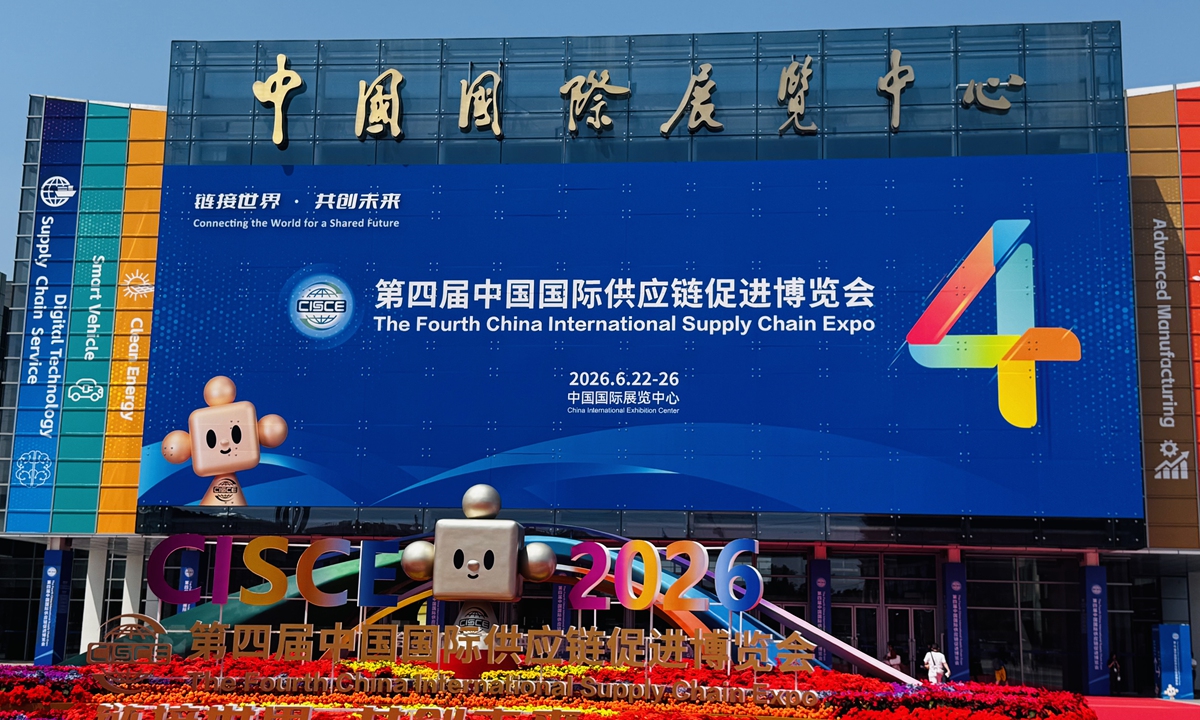
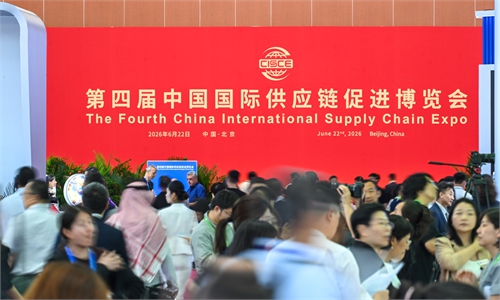
The fourth China International Supply Chain Expo concludes on June 26, 2026 in Beijing. Photo: Liu Yang/GT
The 4th China International Supply Chain Expo (CISCE) concluded on Friday, with US-, European- and Japanese-funded enterprises continuing to lead in exhibition scale, while companies and institutions from ASEAN, Central Asia, Africa, Latin America and other regions showed high enthusiasm for participation, Li Xingqian, vice president of the China Council for the Promotion of International Trade (CCPIT) told a press conference on Friday.
According to Li, a total of 676 Chinese and foreign chain-leading enterprise and related institutions participated in the expo. They came from 85 countries, regions, and international organizations. Foreign enterprises and institutions accounted for 36.5 percent of the total, higher than the previous edition.
Li added that 223 overseas delegations came specifically to China for the expo to conduct business negotiations, representing a 29.7 percent increase compared with the previous edition.
The scale of exhibition and exchanges at this year's expo was further expanded. More than 1,200 exhibitors and their upstream and downstream supply chain partners jointly participated, with the number of exhibiting companies reaching a record high, said Li.
Moreover, 115 Chinese and foreign enterprises and institutions signed letters of intent to participate in the next edition on Friday morning, securing their "tickets" in advance — a 12.7 percent increase compared with the previous expo. Among them, 20 companies signed agreements for three- or five-year participation commitments, Li added.
Lin Shunjie, chairman of China International Exhibition Center Group, said during the press conference that the most frequently heard buzzwords were "confidence," "cooperation," and "friends." According to incomplete statistics, exhibitors established connections with 43,000 upstream and downstream enterprises, exceeding the figure from the previous edition.
Foreign enterprises and institutions participating in the expo generally believe that the CISCE has built an efficient, practical, open and shared cooperation platform for global companies. They look forward to further strengthening supply chain cooperation with China and better integrating into the international innovation and industrial division of labor system, Lin noted.
Multiple industry representatives and companies from the US, EU, Africa, Latin America and other countries highlighted the expo's role as a platform to promote exchanges and provide valuable opportunities to tap into the large Chinese consuming market.
"Given its importance, we will definitely participate in the 5th CISCE next year again. It provides valuable cooperation opportunities for our member companies," Lu Hai, director of Public Affairs at the Mexican Chamber of Commerce in China, told the Global Times on Friday.
"I believe the expo is very valuable. Many exhibitors are large corporations that bring their own supply chain partners, which is quite interesting. For small and medium-sized enterprises like ours, connecting with these big companies is important, as they can open doors to new markets and opportunities that would otherwise be difficult to access," Fabrizio Galluzzi, CEO of TB Engineering, an Italian consulting and trading company and a first-time CISCE participant, told the Global Times during the expo.
Bernardo Mendia, secretary-general of the Portugal-China Chamber of Commerce & Industry, also expressed greater interest in the expo during an exclusive interview with the Global Times.
"This is our second time to participate. Last year, we came with a delegation of six companies and institutions, and this year, we have 10," Mendia said, noting that the primary objective of participation was to help Portuguese companies build direct contacts with Chinese partners, whether for investment, sourcing, sales, or other forms of collaboration.
Nebiyu Mohamed Bogale, minister in the Embassy of Ethiopia in Beijing, told the Global Times that this is his third time to participate in the CISCE, and he appreciates the event as a platform to showcase his country's outstanding products and personally understand the needs of Chinese consumers.
"[Participating in the China International Supply Chain Expo (CISCE)] is able to maintain and build the relationships we have between the US soy industry, starting with our US soy farmers, going through our export supply chain, and then connecting with people here in China that use US soy. So we think it's important to be here to talk about the latest technology and innovations that are coming, but also just to make sure we are maintaining and building those relationships. That's why we are here," Jim Sutter, CEO of the US Soybean Export Council (USSEC), told the Global Times during the expo.
Behind the evolution of the expo lies the strong momentum of China's resilient and thriving economy amid a complex and volatile global landscape and rising risks of supply chain fragmentation, Lin said on Friday.
From the "market dividend" brought by a massive market and low-cost factors, to the "innovation dividend" generated by technological progress and industrial upgrading, more and more companies are deeply integrating into China's innovation and industrial chains. "China Opportunity 2.0" is bringing valuable stability and certainty to the world, Lin noted.
RELATED ARTICLES