China's 'artificial sun' achieves full localization of core technologies with two superconducting magnets making breakthroughs
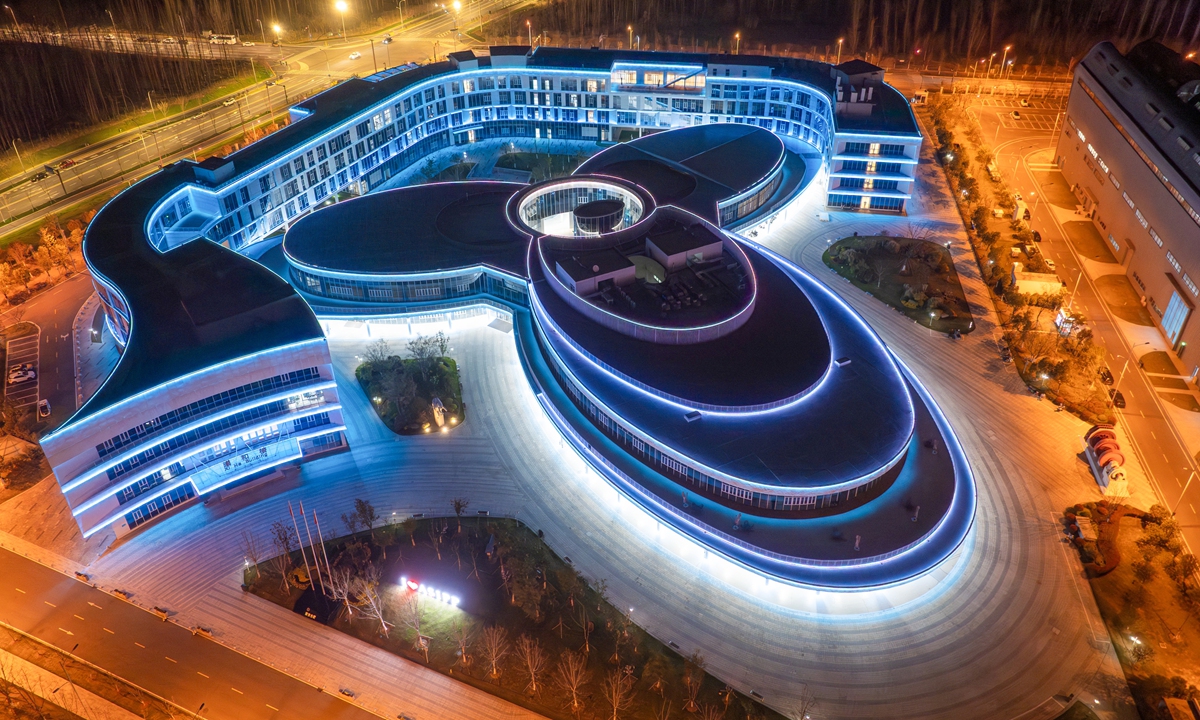
This aerial photo, taken on March 25, 2026, shows a night-time view of an industrial park in Hefei, East China's Anhui Province. Photo: VCG
The two key superconducting magnets for the fusion reactors in the Experimental Advanced Superconducting Tokamak (EAST), known as the "artificial sun," have successfully completed development acceptance and full‑parameter testing, marking the full localization of all core technologies of the project, the Global Times learned from the research team on Sunday.
These breakthroughs were achieved by researchers from the Chinese Academy of Sciences' Institute of Plasma Physics (ASIPP), located in Hefei, East China's Anhui Province.
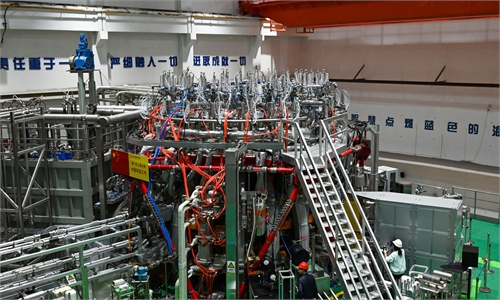
One of the two superconducting magnets used in the fusion reactors is a toroidal field magnet. Shaped like the letter D, it measures 21 meters in length, 12 meters in width, and 3.3 meters in height, with a total weight of 582 metric tons.
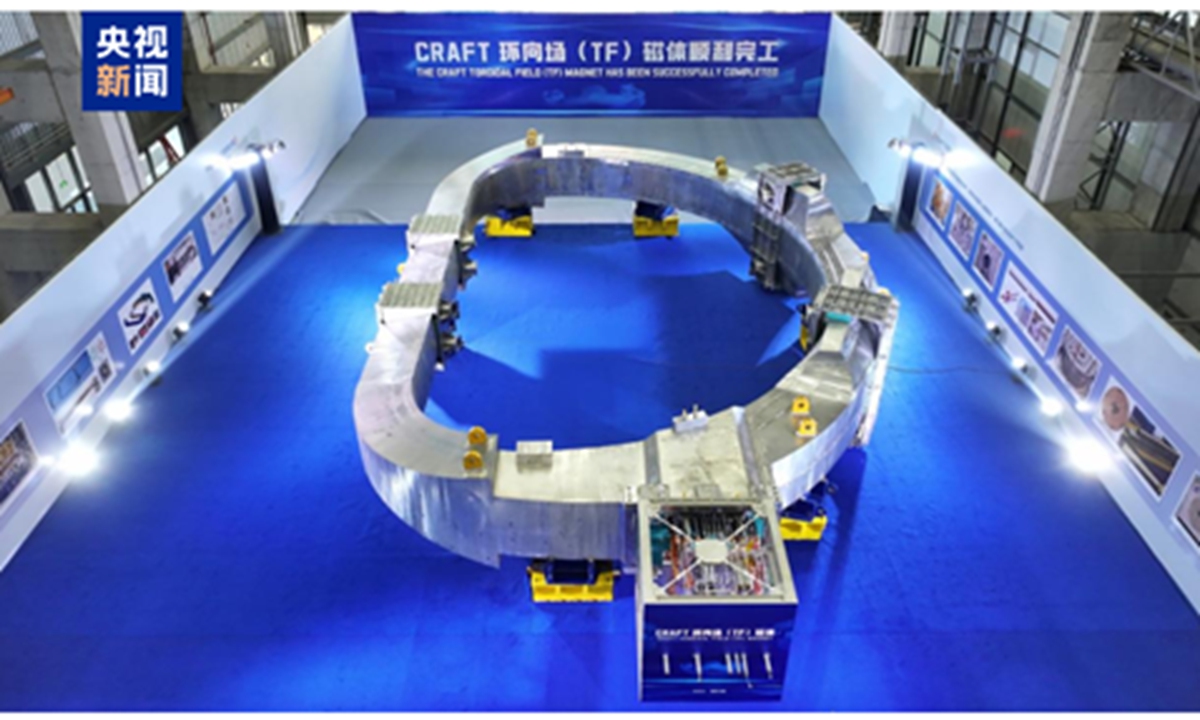
Photo of the toroidal field magnet, one of the two key superconducting magnets for the fusion reactors in the Experimental Advanced Superconducting Tokamak Photo: Screenshot from CCTV News
Wu Yu, a research fellow at the ASIPP, explained that the magnet serves to confine plasma, keeping it confined within the vacuum chamber without striking the walls, China Central Television (CCTV) News reported. Its magnetic field strength correlates with the temperature and density required for plasma in future operations, Wu added.
The toroidal field superconducting magnet can be understood as a sealed cage built of thickened stainless steel, serving as an insulating "enclosure" for the high‑temperature plasma fireball, Song Zhongping, a Chinese technology expert with a background in electromagnetic research, told the Global Times on Sunday. Without this magnet, the plasma cannot be stably bound and would directly disperse, making nuclear fusion reactions impossible, he added.
Song Yuntao, ASIPP director, said that all special stainless steel, insulating materials and superconducting materials deployed in the magnet are made domestically, marking 100 percent localization.
Compared with equivalent magnet developed for the International Thermonuclear Experimental Reactor (ITER), the Chinese model is 1.3 times larger in volume and boasts three times the energy storage capacity, making it the world's largest fusion reactor superconducting magnet to date, per CCTV News.
Wu added that in the future, 16 such toroidal field magnets will be assembled together to form a complete toroidal magnetic field, which will generate a field strength of 6.5 tesla at the center.
In addition to the toroidal field magnet, another key superconducting component - the high-temperature superconducting central solenoid coil - has also passed full-condition parameter testing, according to the ASIPP.
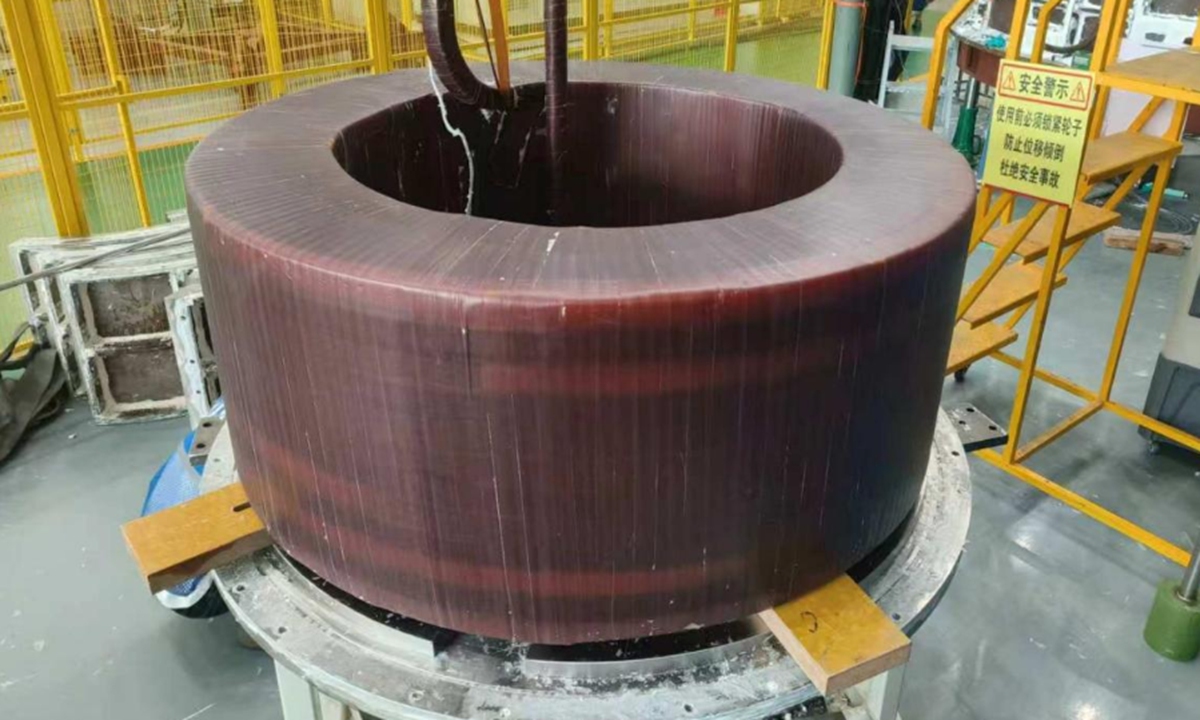
Photo of the high-temperature superconducting central solenoid coil, one of the two key superconducting magnets for the fusion reactors in the Experimental Advanced Superconducting Tokamak Photo: Screenshot from CCTV News
Song Zhongping said the coil can both ignite the plasma to form a high‑temperature fireball and also control the plasma's position throughout the process. Without it, either the plasma will not become a fireball, or the fireball will lose control.
The ASIPP said the central solenoid coil primarily functions to induce and drive plasma current while dynamically adjusting plasma confinement configurations. Measured data show that the coil stably carries a current of 60 kiloamperes and stores 6.03 megajoules of energy, with core performance reaching internationally leading levels.
This breakthrough enables long-duration, high-power steady-state fusion reactions with the capacity to generate sustained energy output, Song Zhongping said.
Qin Jinggang, deputy director of the ASIPP said that the coil's rated operating current of 46.5 kiloamperes is several times that of the EAST facility itself. Its performance is a decisive factor in determining whether fusion technology can progress from experimental facilities to practical applications, Qin added, CCTV News reported.
The central solenoid coil has also achieved full domestic production - from superconducting materials and structural design to the complete fabrication process, Qin was quoted by the CCTV News as saying.
Song Yuntao said successive breakthroughs in the two core superconducting components have further consolidated China's superconducting engineering foundation for fusion reactor construction, boosting the country's independent research and development, and engineering manufacturing capacity for fusion facilities, CCTV News reported.
These two magnets are indispensable parts of high‑temperature nuclear fusion device, and the engineering application of controlled fusion cannot be realized missing either one of them, Song Zhongping said.
Significance of full domestic production is beyond the two equipment, but means that by leveraging the cutting‑edge application scenario of high‑temperature nuclear fusion, two complete industrial chains for both low‑temperature and high‑temperature superconductors are cultivated, driving upgrades across the entire industrial chain, the expert said.
RELATED ARTICLES