Unpacking the logic behind the West’s ‘China Shock 2.0’ narrative
Anxiety and imbalance
Wang Xiaoli Photo: Courtesy of Wang Xiaoli
A so-called "China Shock 2.0" narrative has gained traction in some recent Western think tank reports and media commentary. It claims that China's rapid development in new energy, AI and other high-tech sectors relies on overseas markets to absorb excess capacity, squeezes developed countries' market share across the value chain, confines other emerging-market economies to low-value-added manufacturing, and poses a greater shock to the global economy than the one seen in the era of traditional manufacturing. What drives this narrative, and what purpose does it serve? Is China's development really a so-called "shock"? To answer these questions, the narrative must be carefully unpacked.Three concepts recast
Although "China Shock 2.0" follows the same line of argument as the earlier "China Shock 1.0," its logic is markedly different, as shown most clearly in three conceptual substitutions.
First, "competitiveness" is recast as "overcapacity." On the surface, overcapacity sounds like a neutral technical term. In essence, however, it is often a political judgment measured against another country's domestic demand. Germany produces far more cars than its own consumers buy; the same is true of South Korea's chips and Japan's precision machinery. Yet in these cases, surplus production is treated as competitiveness, not "excess." Why, then, does a similar trade surplus become a target of criticism when China is involved? This double standard shows that "overcapacity" is not an economic judgment, but a political rhetorical tool that turns China's efficiency into an alleged fault.
Critics accuse Chinese products of being too cheap, too abundant and too good, while also calling them "unfair." What unsettles the Western world is not that China is doing badly, but that China is doing too well.
Second, "systemic capability" is recast as "subsidized dumping." The "China Shock 2.0" narrative rests on the claim that massive government subsidies have created artificial overcapacity, leading to low-price dumping worldwide. But judging from the development of China's new-energy industries in recent years, reducing China's lead in electric vehicles, power batteries and photovoltaics simply to subsidies ignores the resilience of China's industrial chains.
China's cost advantage in new energy comes mainly from three factors. First, it has a supply-chain density rarely seen elsewhere, with a closed loop from lithium refining to battery cells and complete vehicles formed within a radius of several hundred kilometers. Second, domestic competition is fierce, with dozens of companies competing in the same market, squeezing margins and pushing efficiency to the limit. Third, scale itself creates a learning-curve effect. The export price of solar modules fell from about 18 cents per watt in 2023 to 13.7 cents in the first half of 2024, not because of subsidies from any single department, but because of the combined effects of capacity, technology and competition.
If subsidies themselves are treated as "unfair," then the economies now raising tariffs can hardly justify their own policies. The US Inflation Reduction Act and CHIPS Act involve hundreds of billions of dollars in industrial support, while the European Union has also used public policy tools to support its clean-tech sector. When subsidies are already common practice among major economies, accusing China alone of "non-market behavior" looks more like selective blindness.
Third, the question of "who benefits" is reframed as "who gets hurt." The "China Shock 2.0" narrative focuses almost entirely on "affected factories," while systematically ignoring one fact: more affordable, better-quality Chinese goods offer a rare "disinflationary dividend" to the global middle class currently under intense inflationary pressure.
The Centre for Economic Policy Research has provided specific estimates: a 1 percent decline in the unit value of imports from China could lower eurozone consumer prices for non-energy industrial goods by about 0.15 percent over three years. With Chinese import prices down about 6.5 percent since the beginning of 2025, this implies a cumulative decline of about 1 percent in related eurozone goods prices by the end of 2028. Industries with the highest import penetration from China have seen the clearest slowdown in producer-price inflation. In other words, the same force described as a "threat" becomes real relief on ordinary household bills.
The nature of tariffs thus becomes clearer: they do not protect consumers, but impose a regressive "protection tax" on them. The more low-income households rely on affordable necessities, the heavier the burden they bear.
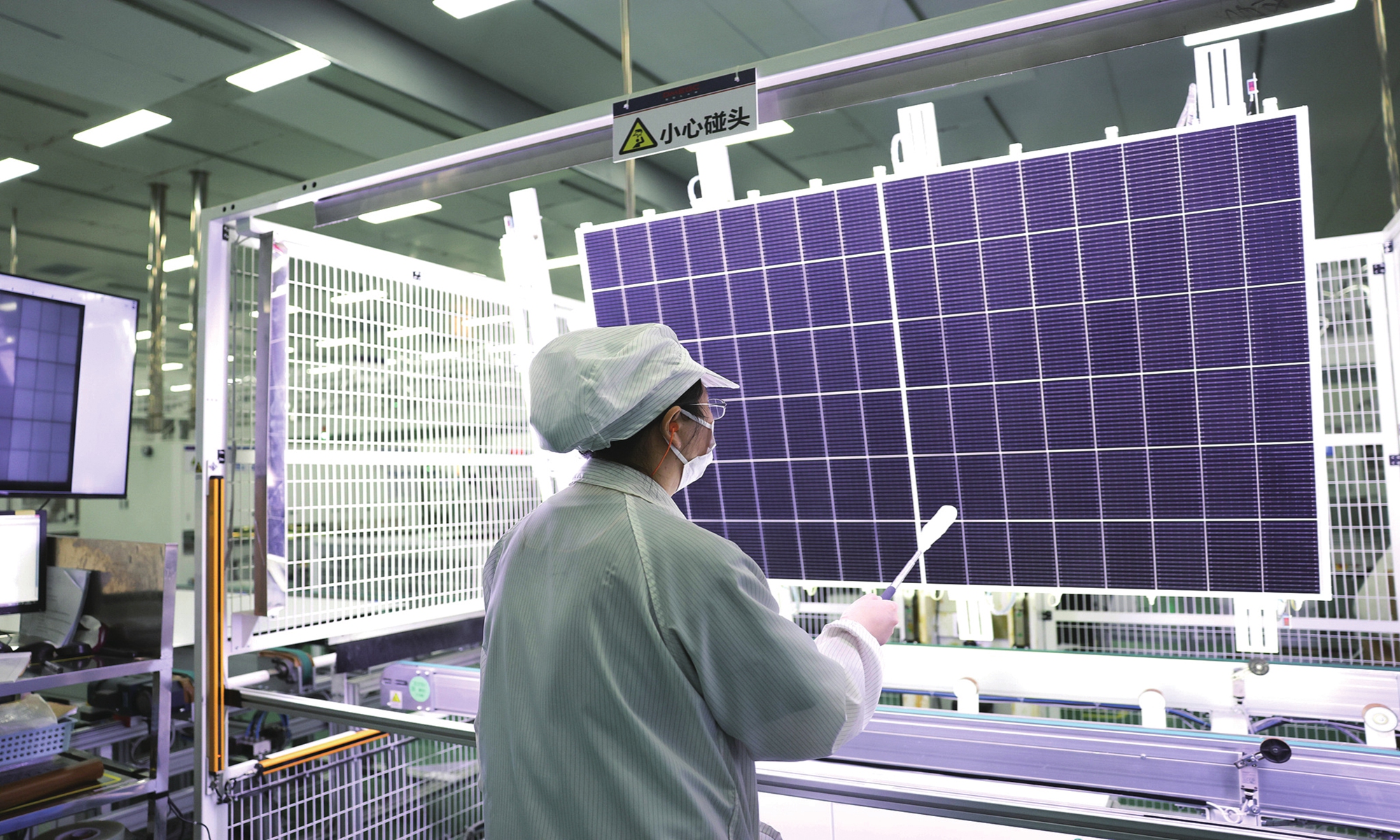
A worker produces solar photovoltaic modules for export to Europe at a new-energy company in Ganyu Economic Development Zone, Lianyungang, East China's Jiangsu Province, on April 30, 2026. Photo: VCG
Structural contradictions
Built on these three conceptual substitutions, the "China Shock 2.0" narrative exposes Western double standards toward China's economic and technological progress. The restrictions targeting China's new-energy industries, in particular, reveal the hypocrisy behind Western claims to support the green transition. Furthermore, there is a methodological tendency to use moral narratives to mask their deep-seated economic structural contradictions.
The first is the green-transition paradox. While Western countries describe climate change as an existential challenge, they have also raised tariff barriers of 20 to 30 percent against the cheapest paths to carbon reduction: China's solar panels, batteries and electric vehicles. If tariffs make a solar panel in Ohio far more expensive than one in Southeast Asia, the green-energy transition will inevitably slow.
According to the International Energy Agency, China accounted for more than 80 percent of global battery cell production in 2025. Instead of treating this capacity as a ready tool for addressing the climate crisis, the "China Shock 2.0" narrative suggests that some would rather make the transition more expensive and slower than allow Chinese manufacturing to take a share in it. Placing geopolitical competition above climate action is the real "distortion" that should be questioned.
The second is a deeper methodological error.The "China Shock 2.0" narrative turns what is essentially a macroeconomic savings-investment issue into a moral narrative of one country harming another. The root of a country's trade surplus or deficit lies in the gap between domestic savings and investment, not in the alleged "unfairness" of its trading partners. The US has long had insufficient savings, excessive consumption and high fiscal deficits, while enjoying the "exorbitant privilege" of the dollar's reserve-currency status. This structure makes trade deficits almost inevitable, whether the surplus country is China, Japan or any other high-savings economy.
Blaming America's macroeconomic imbalance on China's industrial policy reverses cause and effect. Tariffs may block specific categories of Chinese goods, but they cannot block a low-savings economy's structural dependence on external savings. This explains why, even as American tariffs reduced China's direct share of American imports from about 22 percent in 2017 to around 9 percent in 2025, goods have still entered through "transshipment" via Mexico and Vietnam - a sign that global demand for China's efficiency remains rigid.
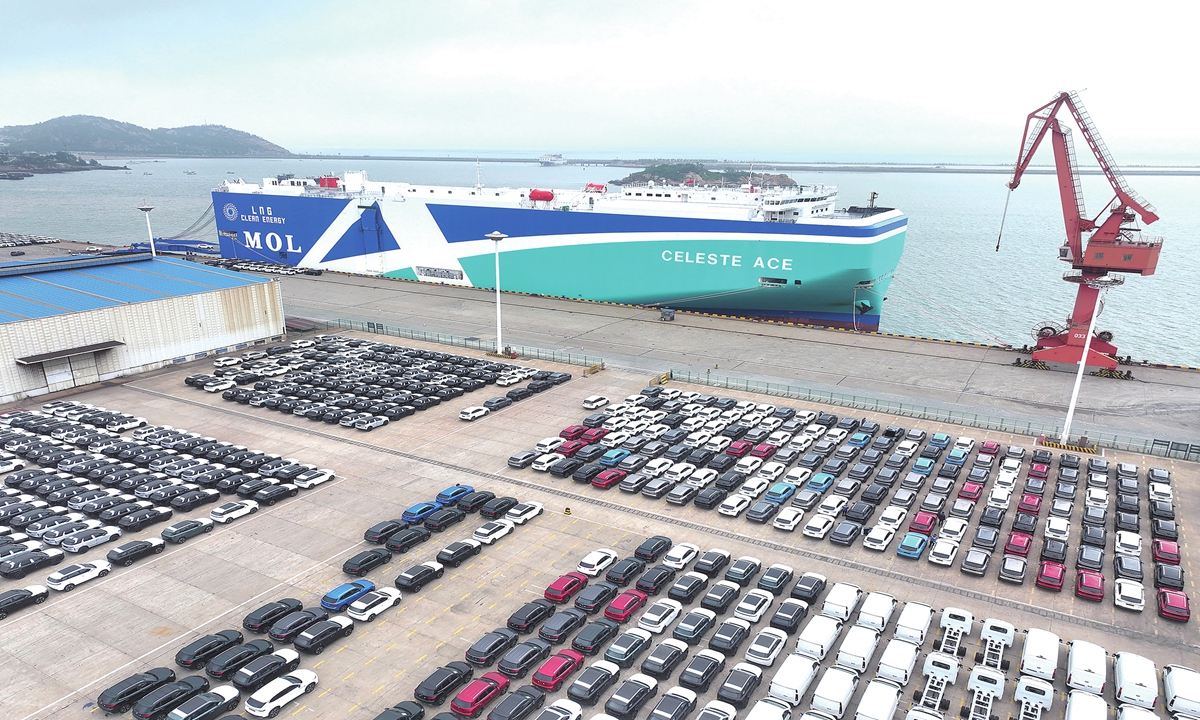
A ro-ro vessel loads electric vehicles for export at a berth of Lianyungang Port's Dongfang Port Branch in Lianyungang, East China's Jiangsu Province, on May 15, 2026. Photo: VCG
'China Opportunity 2.0'
From the "China threat" and "China collapse" theories to the "China overcapacity" narrative, and from "China Shock 1.0" to "China Shock 2.0," the Western world has repeatedly used such narratives to suppress China's development, manufacturing so-called "consensus" and misleading public opinion.
Japan faced a strikingly similar form of narrative bullying in the 1980s. Many countries now accusing latecomers of using industrial policy, tariff protection and export orientation once relied on similar methods themselves - the UK, the US, Japan and South Korea included.
The logic of "China Shock 2.0" is less about China as a "threat" than about the anxiety of those who created the narrative: anxiety over an efficiency gap, the cost of transition, and a world no longer defined by one side's version of "market rules." Calling this anxiety a "China shock" may be politically convenient, but it is economically misleading. Dialogue on trade imbalances, capacity and fair competition is necessary, but it must begin by turning around the mirror of "China Shock 2.0" - because what it reflects has never been China alone.
Although "China Shock 2.0" has recently become a new focus of Western hype, many international institutions and media have also referred to "China Opportunity 2.0." The contrast reflects different starting points in viewing China's rapid development. Those who attach the label of "shock" are perhaps unwilling to acknowledge the validity of China's path and model, and try to offset their anxiety through accusation. Those who speak of "opportunity" recognize the benefits of China's technological and product advances in emerging fields, and the possibility of moving toward the future together.
As the world's second-largest economy, China's market is both its own and an integral part of the global market. At a time when US-led deglobalization is gaining ground, China continues to emphasize deeper opening-up, cooperation and mutual benefit. This openness is not a passive response, but an active strategic choice. When advocates of the "shock" narrative try to define a new landscape with an old script, China must stay firmly on its own development path, strengthen its capabilities, and help the international community share the inclusive dividends brought by new energy, AI and other high-tech fields.
The author is the Executive Dean of the Institute for National Security Studies, Guangdong University of Foreign Studies.
RELATED ARTICLES