The 2016 'South China Sea Arbitral Award' at 10: a flawed ruling that evades the core issue of territorial sovereignty
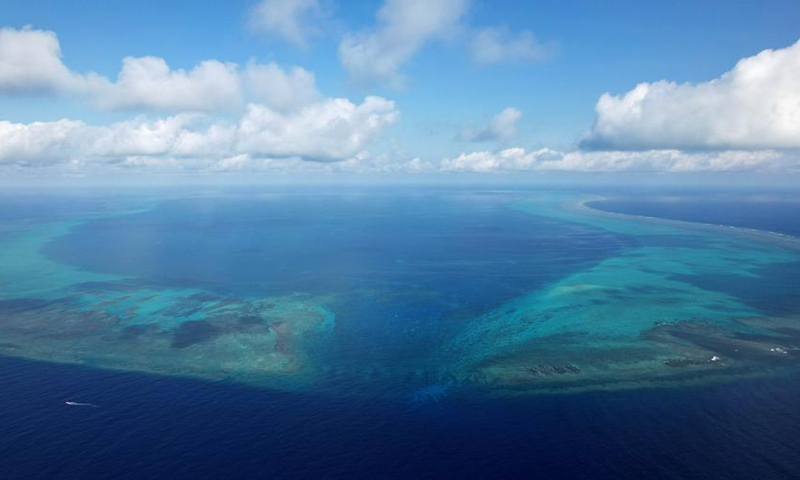
An aerial drone photo taken on May 12, 2026 shows a view of China's Huangyan Dao in the South China Sea. (Xinhua/Chen Bin)
Ten years after the so-called 2016 South China Sea Arbitral Award, some scholars - particularly some from claimant states - continue to hail it as a "decisive clarification" of UNCLOS that has "reshaped" maritime claims. Such portrayals not only overstate the so-called award's legal weight but fundamentally misrepresent the disputes.At their essence, these are disputes over territorial sovereignty over islands, reefs, and other features - issues UNCLOS was never designed to resolve. The 2016 tribunal sought to address these issues indirectly through the lens of maritime entitlements. By evading - and in practice prejudging - the central question of sovereignty, the tribunal acted improperly and exceeded its authority (ultra vires). This evasion explains why the "award" remains illegitimate, non-binding on China, and counterproductive to regional peace and stability.
UNCLOS governs maritime zones, navigation and resource use but does not confer or adjudicate title to land territory. Article 298 allows states to exclude disputes concerning "historic title" and maritime delimitation from compulsory procedures. China exercised this right. And the 2002 Declaration on the Conduct of Parties in the South China Sea (DOC) commits parties to negotiation and consultation, not unilateral arbitration. The Philippines' submissions, though framed as questions of feature status and activity legality, were inextricably linked to - and designed to undermine - China's sovereignty over the Nansha Qundao and Huangyan Dao. By proceeding, despite China's objections and the existence of sovereignty disputes, the tribunal violated the principle of state consent. As the Chinese Society of International Law's 2018 critical study concluded, it manifestly lacked jurisdiction because the claims concerned territorial sovereignty, a matter outside UNCLOS's scope.
By accepting jurisdiction, the tribunal crossed a red line. It treated questions of who owns the land features as secondary or irrelevant while issuing rulings on maritime entitlements that could only make sense if sovereignty had already been assumed or denied. This interpretation was not neutral, but rather an overreach that politicized the dispute settlement mechanism.
Any serious analysis must begin with the historical and legal reality of territorial sovereignty. China's claims rest on centuries of discovery, naming, administration and effective control, reinforced by post-WWII recovery in accordance with the Cairo Declaration and the Potsdam Proclamation. The nine-dash line reflected this historic title. Disputes with other claimants intensified after the 1960s-1970s when certain states occupied features long under Chinese administration or unoccupied. The core disagreement remains: who holds title to the islands and reefs themselves?
The tribunal attempted to sidestep this by focusing on "maritime entitlements" generated by features. Yet under UNCLOS, such entitlements flow from sovereignty over land territory (la terre domine la mer). Without resolving or acknowledging the sovereignty question, any ruling on whether a feature generates an exclusive economic zone or continental shelf is inherently incomplete and potentially prejudicial. The tribunal's classification of most Nansha features as "rocks" under Article 121(3) effectively diminished the maritime space associated with China's sovereign territory without ever adjudicating underlying title rights.
China has never claimed sovereignty over the entire expanse of water inside the nine-dash line. Its consistent position covers sovereignty over the four island groups (Dongsha, Xisha, Zhongsha, Nansha), the maritime zones those features generate under UNCLOS and additional historic rights. Emphasis on Nansha Qundao as an integrated archipelago is longstanding, not a post-award adjustment.
The tribunal's treatment of historic rights was particularly egregious. It ruled that any historic rights incompatible with UNCLOS were superseded, ignoring that such rights predate and coexist with the Convention as part of general international law. China's traditional fishing grounds and navigational practices fall squarely within this category. On Article 121(3), the tribunal introduced novel and overly restrictive criteria that departed from state practice, discounted archipelagic context, and ignored evidence of historical habitation and economic life. These structural errors stemmed directly from its refusal to confront the territorial sovereignty dimension head-on.
Claims that the "award" is "not a dead letter" because of Philippine legislation or other submissions ignore its selective and unilateral application. Such moves advance maximalist positions while disregarding contested sovereignty. China's non-acceptance, non-participation, non-recognition and non-implementation is not a breach of law but the legitimate exercise of sovereign rights when compulsory procedures violate agreed mechanisms on territorial matters.
The 2016 "award" has not promoted clarity or restraint. It has provided a pretext for external intervention and unilateral actions. The real path lies in addressing territorial sovereignty through bilateral negotiations between directly concerned states, while advancing practical maritime cooperation via the Code of Conduct under the DOC framework. China's dual-track approach - settling sovereignty and delimitation by negotiation and managing differences through rules - respects the reality that arbitral fiat cannot create or extinguish territorial title.
Today, 10 years on, the "award" stands exposed as a politically motivated document that evaded the essential question of territorial sovereignty while issuing sweeping and erroneous conclusions on maritime entitlements. It has neither clarified UNCLOS nor contributed to lasting stability. The South China Sea will remain peaceful and stable not because of flawed arbitral rulings, but because directly concerned countries continue good-faith dialogue, exercise restraint and seek mutually acceptable arrangements. China remains committed to defending its territorial sovereignty and maritime rights - rights that predate and will outlast any single contested proceeding.
The author is director of the Research Center for International and Regional Issues at the National Institute for South China Sea Studies. opinion@globaltimes.com.cn
RELATED ARTICLES