Chinese astronomers detect for the first time radio pulses from a central compact object, helping understand formation of neutron star
By Published: Jul 01, 2026 06:53 PM

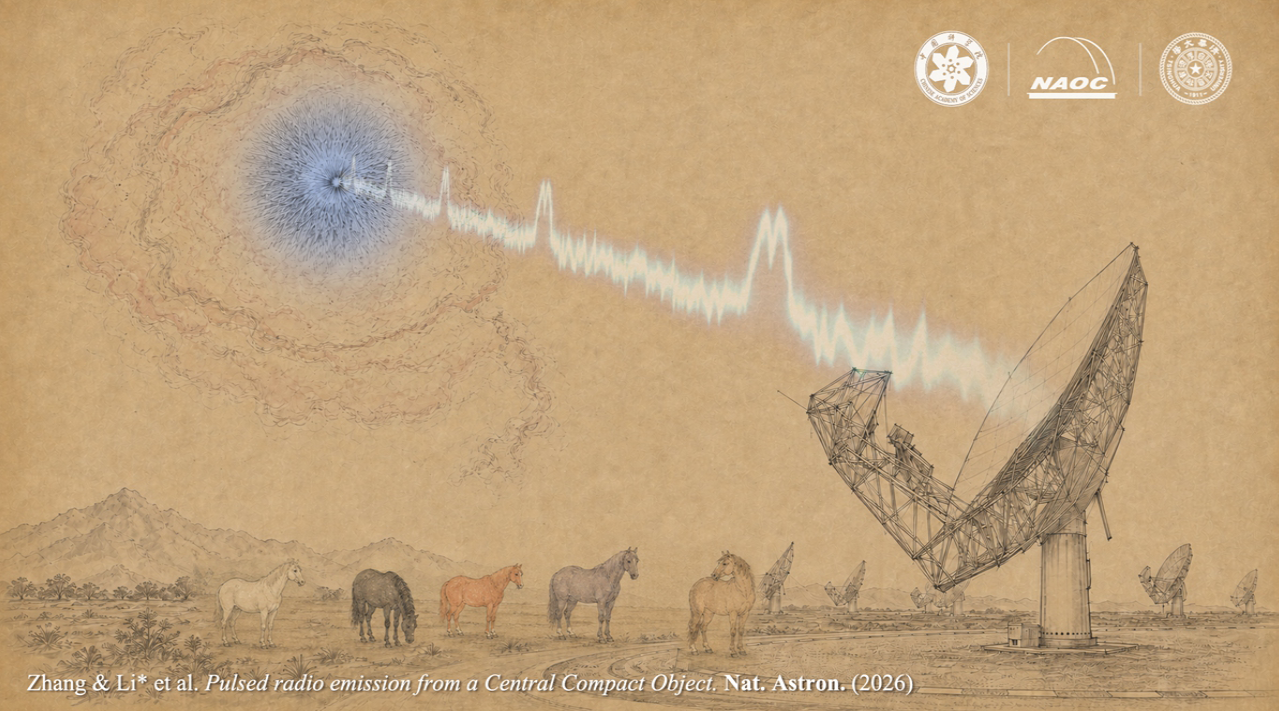
Photo: Screenshot from website
A Chinese research team has for the first time detected radio pulses from a long-term "radio-quiet" young neutron star - central compact objects (CCOs), which is the first successful detection in decades of searches for such objects, providing key evidence for understanding the formation and evolution of young neutron stars (the gravitationally collapsed core of a massive supergiant star), according to National Astronomical Observatories under the Chinese Academy of Sciences (NAOC).
In 1967, the discovery of pulsars opened a new era in neutron star research and eventually led to two Nobel Prizes in Physics. However, within the known neutron star family, there has long been a peculiar class of objects. Located at the centers of supernova remnants, they are bright in the X-ray band and exhibit many characteristics of young neutron stars, yet no radio pulses have ever been detected from them.
These objects are known as CCOs. The question has remained: are CCOs truly "radio silent," or are they simply too faint to be detected?
The research teams from the NAOC and Tsinghua University provides a definitive answer.
The joint research team conducted deep searches of multiple CCO targets using the MeerKAT radio telescope, a precursor array of the Square Kilometre Array (SKA) in South Africa. Zhang Lei from the National Astronomical Observatories, the first author of the research article published in the journal Nature Astronomy, detected a radio pulse signal with a period of about 424 milliseconds emanating from the prototypical CCO at the center of the supernova remnant. Zhang later confirmed its identity as a radio pulsar, according to a statement sent to the Global Times by the NAOC.
In a combined MeerKAT radio and eROSITA X-ray image, the neutron star exhibits a distinctive "blue eye" morphology. Li Di, the corresponding author of the article, referred to it as the "Blue Eye Pulsar."
This discovery was made possible by the extremely high sensitivity of MeerKAT and a specially designed observing strategy for studying CCOs.
The team took advantage of MeerKAT's ability to detect very faint signals, combined it with long, targeted observations and advanced signal-processing techniques to separate the weak radio pulses from background noise.
They also found that in 2015 this neutron star experienced a significant "glitch" (a sudden change in its rotation speed). The researchers suggest that this event may have reshaped its magnetic environment, possibly "switching on" or strengthening its weak radio emission. However, this idea still needs to be confirmed through long-term future observations. This discovery provides the first direct observational link between CCOs and normal radio pulsars, challenging the long-held idea that CCOs are inherently "radio silent."
The results suggest that even young neutron stars with relatively weak magnetic fields can produce radio pulses. It also implies that there may be many more faint young pulsars in our galaxy that we have not yet been able to detect.
RELATED ARTICLES