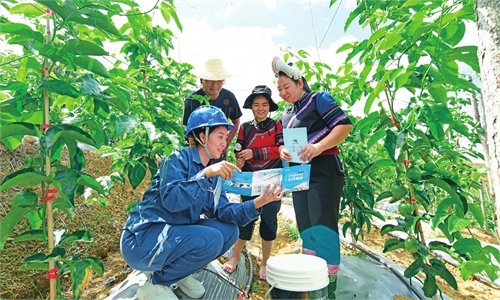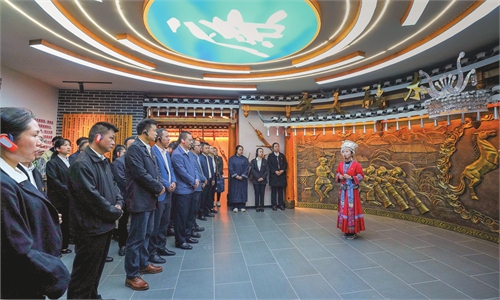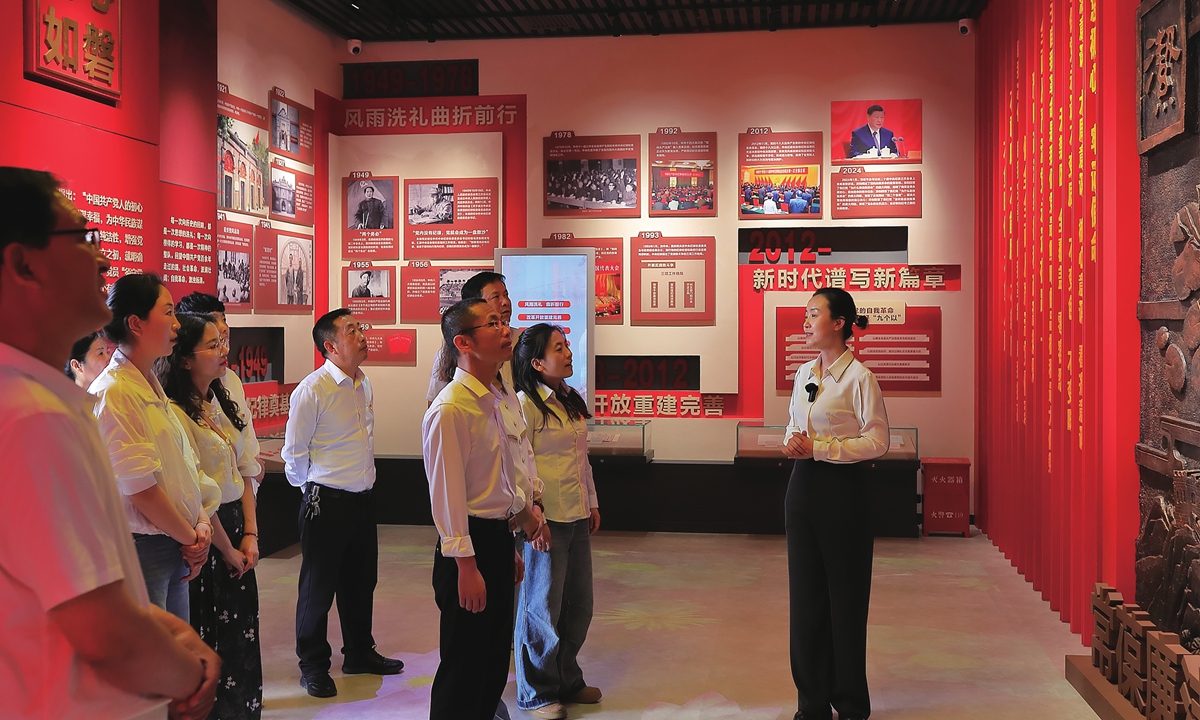
Party members and officials in Dingxi, Northwest China's Gansu Province are on a study tour for integrity education on May 26, 2026. Photo: VCG
Editor's Note:This year marks the 105th anniversary of the founding of the Communist Party of China (CPC). Over the past century and more, the CPC has carried forward its revolutionary traditions while forging new achievements in response to the demands of each era. Anchored in its enduring mission to serve the people, the Party has demonstrated a remarkable capacity for self-reform, an indomitable fighting spirit and an open, adaptive mind-set that enables it to navigate changes and steer the nation forward.
On this significant occasion, the Global Times (GT) presents this special series of interviews with international scholars. Through their diverse lenses, we invite global observers to contemplate the journey of this century-old Party - its enduring historical legacy, governance logic and its dynamically evolving role in an ever-changing world.
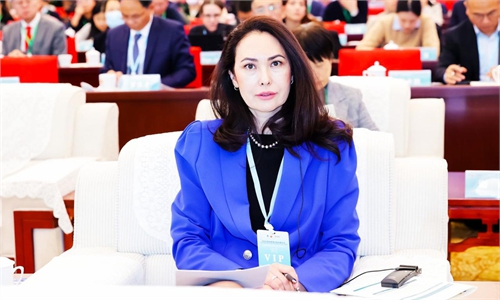
In the second installment of the series, Jorge Malena (Malena), director of the Asian Affairs Committee of the Argentine Council for International Relations, shared his viewpoints on the CPC's capacity for self-reform.
GT: President Xi Jinping, also general secretary of the CPC Central Committee, once stressed the necessity to maintain a heightened sense of self-reform. Why does the CPC place such great importance on self-reform?
Malena: The CPC leadership considers internal weaknesses a greater threat than many external challenges. Self-reform is understood as a mechanism through which the Party seeks to identify and correct problems before they undermine its governing capacity. It aims to strengthen internal discipline, improve institutional effectiveness, prevent factionalism and maintain cohesion around national development goals.
The concept has gained particular prominence in recent years as China faces major economic, technological and geopolitical changes. From the leadership's perspective, political unity and organizational effectiveness are essential for sustaining modernization and national rejuvenation. Self-reform is therefore presented as a way to preserve the Party's vitality and legitimacy over the long term.
Whether these mechanisms will be sufficient to address future challenges remains open to debate, but there is little doubt that this principle has become a central component of contemporary CPC political thinking.
GT: To advance self-reform, the CPC has implemented the "eight-point decision." Based on your observation, why has the CPC's self-reform been able to function so smoothly?
Malena: The CPC's self-reform has functioned because it is supported by strong organizational structures and a political system capable of implementing reforms throughout the Party.
Anti-corruption campaigns, disciplinary inspections and ideological education have been used to address perceived weaknesses and improve cohesion. A key factor behind this process has been the strengthening of institutional mechanisms designed to supervise Party members and government officials.
These efforts are intended not only to punish misconduct but also to address structural weaknesses that could undermine administrative effectiveness, political cohesion and public confidence in governance.
More broadly, supporters of self-reform argue that these measures help prevent the emergence of entrenched interest groups, reinforce accountability and preserve organizational unity in a system responsible for governing a country of continental dimensions. By continuously renewing its institutions and strengthening internal discipline, the CPC seeks to avoid the bureaucratic stagnation and loss of cohesion that have contributed to the decline of other long-ruling political organizations.
GT: Compared with Western political parties, what do you think are some unique strengths of the CPC's approach to self-reform?
Malena: One distinctive aspect is its emphasis on self-correction within the ruling party rather than through electoral competition. Supporters believe that this allows for long-term planning, policy continuity and the implementation of major reforms without frequent political disruption.
Rather than relying primarily on external political competition to address governance problems, the CPC seeks to strengthen internal supervision, discipline and accountability mechanisms. This model provides greater continuity in policymaking and enables the leadership to pursue long-term strategic objectives while retaining the capacity to identify and correct deficiencies within its own ranks.
From this perspective, anti-corruption campaigns and organizational reforms are not isolated initiatives but components of a broader effort to enhance state capacity, preserve political legitimacy and improve governance effectiveness. Compared with Western systems, where accountability often relies heavily on competition between parties, the Chinese model places greater emphasis on intra-party discipline and organizational adaptation.
GT: To what extent do you see the CPC's self-reform as a manifestation of "adaptive governance?"
Malena: Self-reform can be understood as a form of adaptive governance because it seeks to identify and address problems before they threaten political stability or governance effectiveness.
China's rapid economic and social transformation has required continuous adjustments in institutions, policies and administrative practices. The CPC views self-reform as a means of adapting to these changes while preserving its leading political role.
The objective is not merely to preserve existing institutions but to ensure that they remain effective under changing conditions.
GT: In a global context, what inspirations can the CPC's practice of self-reform offer to other political parties around the world?
Malena: China's experience suggests that political parties need mechanisms for self-assessment, organizational renewal and accountability if they wish to remain effective over time.
The specific Chinese model reflects the country's unique political system and historical experience and therefore cannot be easily transferred elsewhere.
The broader lesson is that political organizations must continuously adapt to social and economic change. Maintaining legitimacy requires not only stability but also the capacity to reform, learn from emerging challenges and adjust institutions when necessary. China's experience highlights the importance of organizational resilience, leadership cohesion and long-term strategic planning.
Whether one views these characteristics as strengths depends in part on political perspective. Nonetheless, the Chinese case offers an important example for comparative politics because it illustrates how a long-ruling party has attempted to maintain its governing capacity through internal reform rather than through alternation in power. For that reason, its experience may be more useful as a source of comparative reflection than as a model that can be directly replicated in other political systems.
RELATED ARTICLES