
Illustration: Liu Xidan/GT
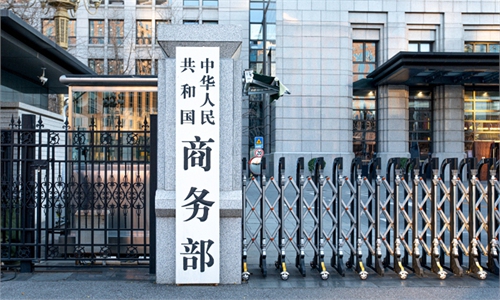
China's Ministry of Commerce placed 20 Japanese entities on the export control list and another 20 on a watch list on Monday. Compared with the initial lists released in February, this latest move marks a highly noteworthy change: The relevant Japanese entities, for the first time, include research institutions that provide research support for the resurrection of militarism in Japan, and the scope is no longer limited to traditional military companies, manufacturing enterprises and supply chain firms. This development indicates that China's export controls on Japan are expanding beyond the level of companies and products, and are further extending into the realms of knowledge production, technological incubation and the supporting system of civil-military integration.For some time, Japan has frequently made erroneous remarks on the Taiwan question, interfered in China's core interests, and continuously advanced the dismantling of postwar constraints on its military in a series of actions that threaten regional peace and security. The Taiwan question is purely China's internal affair and lies at the very core of China's core interests. In recent years, certain Japanese politicians and policy institutions have repeatedly crossed the line on the Taiwan question, turning what should have been a matter requiring Japan's deep reflection on historical responsibility into a dangerous real-world intervention, treating the constraints of Japan's pacifist Constitution as political obstacles that can be bypassed, and repackaging the narrative of a "contingency in surrounding areas" as a pretext for expanding military capabilities.
Such actions have severely undermined the political foundation of China-Japan relations and posed a tangible impact on the postwar international order. Certain forces within Japan have long sought to rebrand military expansion as "national normalization," portray external military cooperation as a "contribution to security" and frame interference in the Taiwan Straits as a "crisis response." Such linguistic games cannot conceal their essence. A country that once launched wars of aggression and brought grave suffering to the peoples of Asia, repeatedly provoked on the Taiwan question, and continuously broke through postwar constraints on its military policies, all while failing to fully reflect on its historical issues, will inevitably trigger a high level of vigilance from its Asian neighbors, including China.
Following the initial export control lists on dual-use items targeting a number of Japanese entities in February, this second batch of lists reflects the continuity, progression and precision of China's policy framework. Export controls have become one of China's core policy tools to curb Japan's resurrection of militarism, and have also become an important institutionalized mechanism for safeguarding national security, maintaining regional peace and upholding the postwar international order. China's export control measures are directed at the material foundations and technological support underpinning Japan's expansion of military capabilities, with the objective of preventing Japan's "re-militarization" and nuclear ambitions. These measures are fully justified, necessary and urgently required.
The expansion of the list indicates that China's previous export control measures have already produced tangible results. These measures are neither symbolic statements nor routine diplomatic posturing; rather, they have already generated significant pressure at the levels of entity operations, supply chain management, compliance review and business expectations. China's policy tools - applied to key raw materials, dual-use items and critical supply chain nodes - are sufficient to reshape Japanese companies' assessments of risk, cost and compliance obligations.
The Japanese government, however, has long adopted a posture of deliberate indifference - choosing to look the other way when it comes to these issues.
On the one hand, Japan has sought to downplay the impact of China's measures in public settings, attempting to create an illusion for its domestic industry and international allies that China's measures are ineffective, and has occasionally staged political farces to convey false signals that it is unafraid of China's measures. On the other hand, Japan has made no substantive correction to its erroneous remarks and actions on the Taiwan question, its military expansion trajectory, or its adjustments to security policy.
This mentality of Japan essentially treats China's core interests as a gambler's chips, regional peace as a political prop, and long-term national responsibility as short-term public opinion fodder. The inclusion of research institutions in the latest control list for the first time carries important policy implications.
In the modern era, the strengthening of military capability does not rely solely on defense industry enterprises, but also on universities, research institutes, experimental platforms, engineering centers and technical service systems. Certain research institutions participate in sensitive technology research under the guise of academic work, support military applications under civilian projects and obtain key knowledge and materials through international cooperation. Such activities must be brought within the scope of export control oversight.
China cannot allow its dual-use items to be used to support Japan in breaking through the constraints of its pacifist Constitution, enhancing offensive military capabilities, intervening in the Taiwan Straits, or undermining regional stability.
If the Japanese government continues to politicize the issue and labels China's lawful export controls as "economic coercion," it will only further mislead Japanese enterprises and the public. The real factors driving Japanese companies into difficulty are not China's lawful policy measures to safeguard national security, but rather the systemic risks generated by Japan's own erroneous moves and rhetoric.
When facing supply chain pressures, Japanese enterprises should first reflect on fundamental questions: Who has pushed the Taiwan question into increasingly dangerous narratives; who has continuously broken through the constraints of Japan's pacifist Constitution; who has drawn enterprises, universities and research institutions into a path of militarization, and who has imposed unnecessary shocks on what could otherwise be a stable China-Japan economic and trade relationship. Once these questions are clearly understood, relevant Japanese entities will naturally recognize the correct course of action and no longer engage in time-wasting and counterproductive efforts.
In short, the only rational solution for the Japanese government and enterprises is to stop advancing dangerous moves aimed at the resurrection of militarism, return to the framework established by the Cairo Declaration, the Potsdam Proclamation and Japan's pacifist Constitution, and truly commit to a path of peaceful development.
The postwar order is not a collection of historical documents that can be arbitrarily rewritten - it is a fundamental cornerstone of peace in Asia and the international rule of law. Any attempt to break through this framework will inevitably meet firm opposition from China and other forces upholding justice in the region.
For Japan, there is still an opportunity to rein itself in before reaching the cliff edge, but obstinate persistence will inevitably come at a cost. If Japan continues down the wrong path of militarism resurrection, it will face stringent countermeasures from China, and its industrial, scientific research and diplomatic space will bear increasingly heavy costs.
Relevant Japanese parties are advised to return to a rational trajectory, return to the framework of the postwar order, and return to the path of peaceful development. History has already proven that militarism leads nowhere. Reality will likewise prove that any attempt to challenge China's core interests is doomed to fail.
The author is a professor at the School of International Relations and Public Affairs of Fudan University. bizopinion@globaltimes.com.cn
RELATED ARTICLES