Understanding the resilience of China-LAC cooperation amid geopolitical challenges
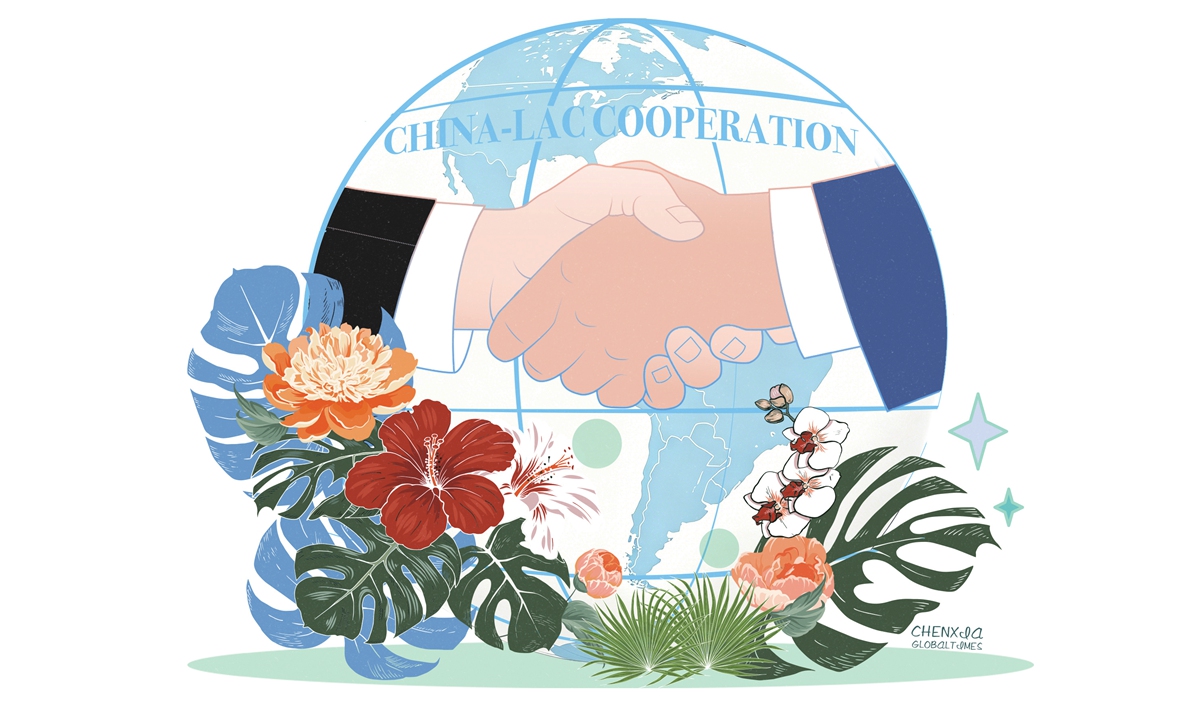
Illustration: Chen Xia/GT
"External pressures and political turnover cannot change the long-term positive trajectory of China-Latin American and Caribbean (LAC) cooperation." At a recent salon marking the first anniversary of the five programs, aimed at boosting shared development and revitalization and building a China-LAC community with a shared future, a Brazilian journalist shared this firsthand observation with me.Recently, I attended "Linjia No. 7 Salon" hosted by the China Public Diplomacy Association, which brought together Chinese officials, scholars, and journalists from multiple LAC countries to reflect on the first year of implementing the five programs. What struck me most was the attentiveness and enthusiasm of the reporters from LAC countries present. During the event, they frequently raised their hands to ask follow-up questions and carefully noted down data points. Even after the session ended, many stayed behind, eager to continue in-depth exchanges with Chinese experts.
On May 13, 2025, China announced that it stands ready to join hands with its LAC partners to launch five programs that advance shared development and revitalization and contribute to a China-LAC community with a shared future. The programs cover solidarity, development, civilization, peace and people-to-people connectivity. The initiative received a positive response from LAC countries.
Now, over a year has passed since these five programs were first proposed. During this time, LAC countries have experienced an intensive election cycle, with several countries undergoing or approaching political transitions. Policy uncertainty has become a common concern overshadowing regional cooperation. Meanwhile, external forces continue to exert pressure in an attempt to disrupt the pace of China-LAC engagement.
How can China-LAC cooperation remain steady and sustainable? This question garners extensive attention among LAC media.
At the event, a journalist from Colombia asked how China-LAC cooperation agreements could be steadily implemented amid the political party rotations in LAC countries. In response, Zhang Run, director-general of the Department of Latin American and Caribbean Affairs of China's Foreign Ministry, stated that China-LAC friendship is rooted in the people, and that China's policy toward LAC countries will remain consistent and stable regardless of changes in internal or external conditions.
Geopolitical tensions were another major concern. Journalists from Brazil, Mexico, Cuba, and other countries raised questions about the challenges facing the implementation of the five programs and China's response strategies. In my view, hard data offers the most convincing evidence of resilience. From January to April this year, China-Latin America trade grew strongly by 18.5 percent year-on-year, with China's imports from the region increasing by 29.4 percent. In 2025, China-Latin America trade exceeded $549 billion, reaching a new record high.
Nelson de Sá of Brazil's UOL media group shared his direct perception of this resilience. External pressure and political turnover, he noted, are unlikely to alter the fundamentally positive trajectory of China-LAC cooperation.
Through vivid stories of Brazil's industrial transformation, Nelson further explained to me why he is so optimistic about China-LAC cooperation. The withdrawal of long-established foreign automakers and energy companies from Brazil had led to industrial hollowing-out and job losses. By contrast, the entry of Chinese firms, such as BYD, Great Wall Motor, CRRC, has not only revitalized idle factories but also filled critical gaps in local industrial chains. These concrete projects have preserved and created large numbers of jobs while spurring the recovery of upstream and downstream industrial clusters.
Infrastructure cooperation has also flourished: The Belo Monte Ultra-High Voltage Direct Current transmission project undertaken by Chinese enterprises in Brazil benefits 22 million people, and the Mexico City Metro Line 1 renovation project has been fully completed and opened to traffic, increasing daily passenger capacity to 1.2 million.
In addition, progress in cultural and people-to-people exchanges has deepened the foundation of mutual engagement. "Cooperation between Uruguay and China covers not only education exchanges, such as student mobility, but also high-tech and medical fields. A large number of Uruguayan medical workers are now coming to China for training," said Florencia Pujadas, a journalist from Uruguay's Channel Canal 4.
China's visa-free policy for certain LAC countries has also boosted travel. These rising figures vividly demonstrate the vitality of bilateral exchanges. Meanwhile, the "visa-free circle of friends" continues to expand. Today, Spanish and Portuguese can often be heard on the streets of Beijing, while Chinese lifestyles are increasingly embraced by young people across LAC countries on social media - vivid reflections of growing mutual understanding.
China and LAC countries share similar historical experiences, cultural foundations, and development missions. As members of the Global South, both sides have a common desire to pursue self-strengthening and shared prosperity.
The experience of the past year shows that this partnership is not built on slogans or hype, but on concrete projects and real benefits for people's livelihoods. Looking ahead, with the continued momentum of the five programs, the building of a China-LAC community with a shared future will move forward steadily and with lasting strength.
The author is a reporter with the Global Times. The article was originally published by Revista Forum, an independent Brazilian media outlet. suyaxuan@globaltimes.com.cn
RELATED ARTICLES