Takaichi's visit to India: an exchange of interests between countries with distinct objectives
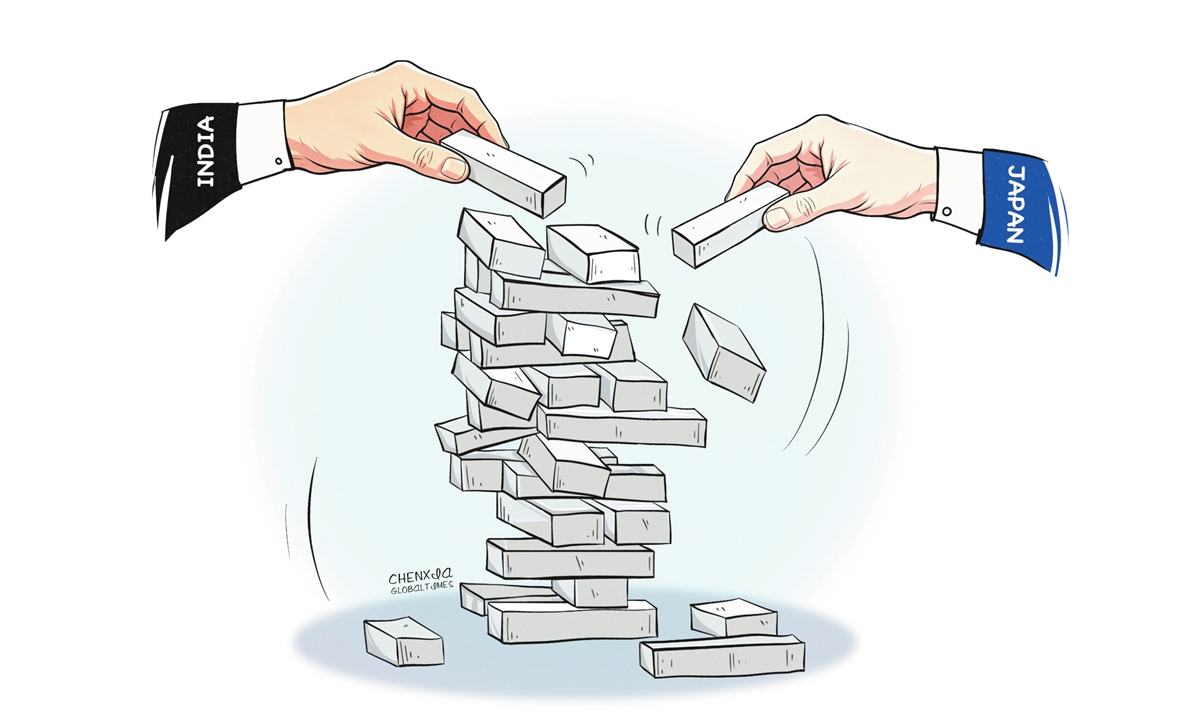
Illustration: Chen Xia/GT
Japanese Prime Minister Sanae Takaichi went on a three-day visit to India from Wednesday to Friday, marking her first official trip to India since assuming office.
On the surface, the Takaichi-Modi summit yielded a number of achievements. They discussed a wide range of areas of cooperation to further enhance their Special Strategic and Global Partnership and signed a number of agreements. Takaichi's accompanying delegation of over 50 Japanese corporate executives aims precisely to deepen economic and trade ties.
As an economy with severe resource constraints, Japan has been actively pursuing supply chain diversification globally in recent years. But the most immediate challenge facing Japan stems from long-standing pain points in India's business environment. Currently, approximately 1,400 Japanese companies have established operations in India, many of which face significant operational hurdles. These include lengthy land acquisition processes, cumbersome administrative approval procedures, substantial policy variations across states, and persistently high logistics costs - all major obstacles for Japanese firms implementing projects. The widely held belief in the international business community that "money earned in India is difficult to transfer smoothly" has also made many Japanese companies cautious about large-scale investments.
Japan's own internal constraints are also slowing down the pace of bilateral cooperation. During Takaichi's visit, it was agreed that Japan will invite 500 highly skilled professionals from India's AI and semiconductor sectors by 2030. However, it is worth noting that according to media reports, Japanese locals were outraged by the news about Japan hiring 500,000 Indian workers, an agreement reached in August last year between then Japanese prime minister Shigeru Ishiba and Modi.
Beyond economy and trade, it is widely believed that Takaichi's agenda was to accelerate Japan's security transition and show that India is an important part of that. However, to what extent India shares the same view remains in doubt.
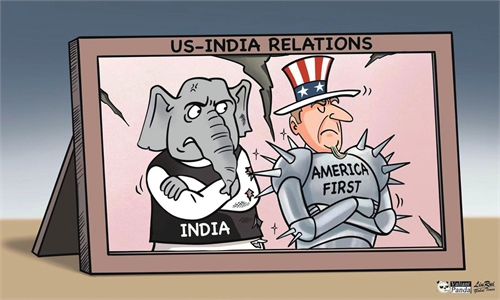
In the past few years, Japan-India cooperation has consistently been framed within the context of a "free and open Indo-Pacific," a notion touted by the US. But as the US War Department recently renamed its "Indo-Pacific Command" back to Pacific Command, a move which apparently downgrades its attention on India, the very foundation upon which Japan's Indo-Pacific strategy has been built is called into question.
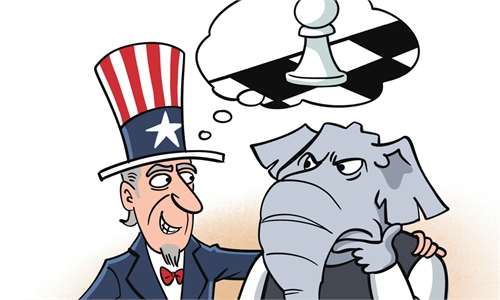
In fact, Japan just seeks to leverage India's geopolitical influence to expand its diplomatic and security reach in the Indian Ocean, South Asia and across the Global South. Its "free and open Indo-Pacific" campaign is to move beyond the Asia-Pacific by drawing India more firmly into alignment as a counterweight to China.
However, Japan's attempt to draw India over to its side has never been an easy task. India has never pursued cooperation entirely according to the "script" of other countries, let alone Japan. The core objective of New Delhi's participation in Japan-India collaboration has always been to secure Japanese investment, technology and industrial expertise to serve its own development goals of "Make in India," rather than aligning with Japan-led geopolitical blocs.
Past practices have long demonstrated that India participates simultaneously in the Quad mechanism while maintaining traditional cooperation with Russia, and its relations with China have recently shown significant improvement. India's foreign cooperation remains absolutely centered on its own interests and will not sacrifice its diplomatic flexibility for Japan's geopolitical objectives.
Overall, Takaichi's visit to India represents an exchange of interests between two countries with distinct objectives against the backdrop of shifting regional and global dynamics. The visit has advanced cooperation in various fields, yet it also reveals the inherent complexity of a relationship where each side's calculations are shaped by its unique geopolitical context.
The author is director of the Research Department at Tsinghua University's National Strategy Institute. opinion@globaltimes.com.cn
RELATED ARTICLES