Foie gras production now becomes backbone industry in Linqu, E.China's Shandong Province
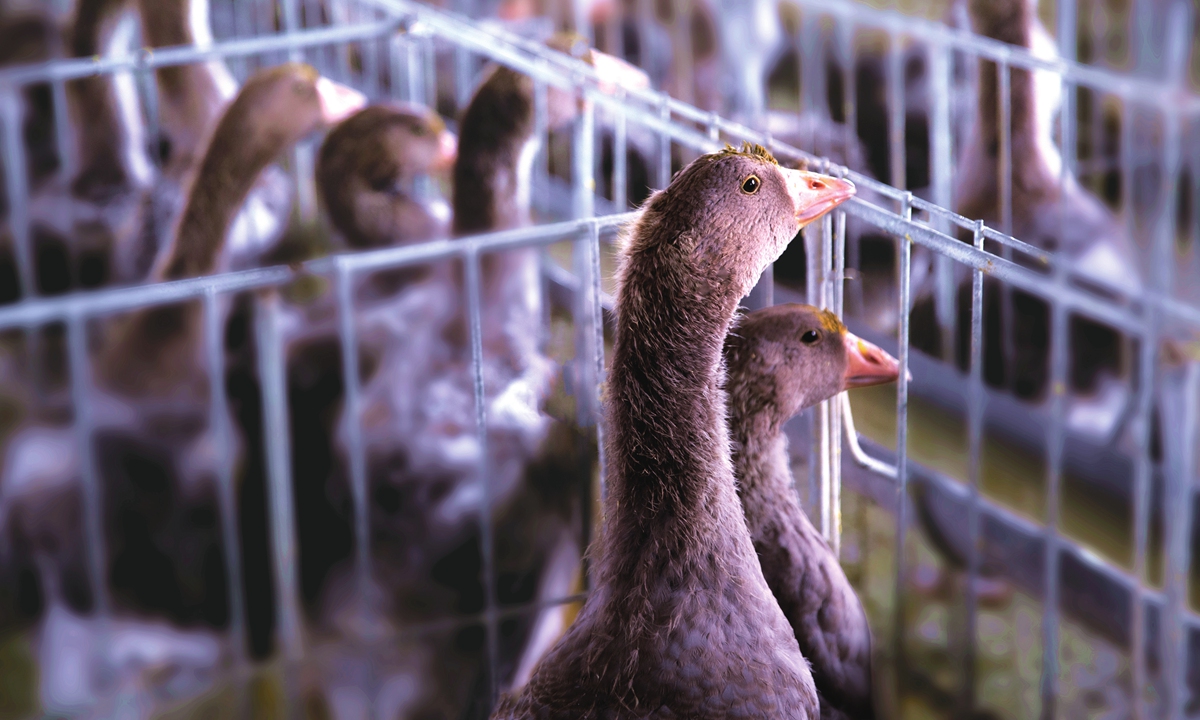
A glimpse of a goose breeding workshop at Shandong Chunguan Food Co in East China's Shandong Province Photo: Courtesy of Shandong Chunguan Food Co
In a processing workshop in Linqu, East China's Shandong Province, a piece of foie gras is undergoing transformation from raw material into food. Unlike the traditional perception of a luxury ingredient often appearing on French restaurant menus, the foie gras produced in Linqu is entering a broader international market through industrialized production.
Once closely tied to French haute cuisine and long labeled as one of the "world's three great delicacies," foie gras is now being redefined in China's county-level industrial hubs.
A search by the Global Times at restaurants in Beijing shows that a serving of foie gras is priced between 30 and 100 yuan ($4.2-$14), which is significantly lower than the 15-40 euros ($16-$44) typically charged in French restaurants. In addition, supermarkets in China sell approximately 150-gram portions of foie gras at prices ranging from 40 to 60 yuan.
According to previously undisclosed estimates from five Chinese industry analysts cited by Reuters, China's foie gras output may have reached 14,000 tons last year, up about 30 percent from 2024, and roughly seven times the estimate about a decade ago.
Increasing product value
"We started out simply with basic raw material exports," Ma Lijun, head of Shandong Chunguan Food Co, told the Global Times. In her view, the industry's early development path was clear - importing the French Landes goose farming model and replicating the entire system, from force-feeding to foie gras extraction and frozen exports. It was, essentially, a direct "copy" of the European production model.
"At that time, it was mostly fresh products, with very thin profit margins - hard-earned money," she said.
"In 2018, we made a crucial decision to move into deep processing," Ma said. The shift marked a restructuring of the industry's logic. Foie gras, once treated purely as a raw material for frozen domestic sales and exports, began to be developed into a range of consumer-facing products.
"We started making ready-to-eat products, so foie gras no longer has to be pan-fried by a chef," she said. Following this strategy, Chunguan Food has developed a series of innovative products, including red wine and blueberry foie gras and foie gras ice cream.
In recent years, some foreign buyers who visited the company said after tasting the products that their form is very different from traditional French-style foie gras, describing them as "highly novel" and noting that they had "never eaten anything like this in their own countries."
Following this transformation, the company's market share expanded significantly. Chunguan Food's sales rose from less than 30 million yuan in 2018 to a size of several hundred million yuan. One flagship innovation, "red wine and blueberry foie gras," once generated annual sales of up to 180 million yuan.
However, growing competition in the domestic market prompted another strategic shift. Since 2021, the company has pivoted toward overseas markets, initially using Hong Kong Special Administrative Region (SAR) and Macao SAR as transitional channels to better understand international consumer demand and gradually build product systems aligned with different national standards.
Ma said that though direct exports require a wide range of domestic and international certifications and procedures, the company is currently advancing multiple international certification systems to access more markets. It is ramping up effort now, trying to expand exports to nearby countries and regions such as Japan, South Korea, Russia, Southeast Asia, and the Middle East.
In her view, the competitiveness of China's foie gras industry should not be built on low prices, but on product innovation and a complete industrial chain. "We hope to give foie gras the value it truly deserves as one of the 'world's three great delicacies,'" she said.
Full industrial chain layout
Located in the Yimeng Mountains, Linqu county in Shandong Province is one of China's key Landes goose farming bases, according to Xinhua News Agency's report. It currently raises around 5 million geese annually, producing over 5,000 tons of foie gras each year. The county accounts for about 70 percent of China's foie gras production and 20 percent of the global production, with an annual output value exceeding 8 billion yuan, the report said.
Linqu, located in central Shandong, has a temperate climate with distinct seasons and a stable supply of feed crops such as corn and wheat. However, natural conditions are not the decisive factor. Its real advantage lies in technology transfer, industrialized farming systems, and a fully integrated industrial chain cluster.
"We sourced our breeding stock with government support, introducing more than 1,200 pure French Landes geese," Ma said.
Linqu county also provides agricultural subsidies to enterprises and farmers, along with support for land transfers and financing, helping attract more private capital into the Landes goose industry, the Linqu County Animal Husbandry Development Center told the Global Times.
In Linqu, the industry has developed a fully integrated value chain covering breeding, farming, force-feeding, processing, and sales. From breeding stock to finished products, multiple stages are standardized and managed through cooperatives and a traceability system, gradually transforming scattered household farming into large-scale, organized production.
The "cooperative-plus" model has helped participating households increase their average annual income by about 120,000 yuan, turning foie gras from a niche product into a major industry driving shared rural prosperity, the center told the Global Times.
Linqu county in Shandong has formed several well-known foie gras brands. The county has developed four major product series, including foie gras paste and foie gras mousse, comprising over 100 products, as well as more than 60 high-end refined products across eight categories such as red wine blueberry foie gras and cherry foie gras.
It has also built an integrated "online + offline" sales network, with products distributed across major cities in China and exported to markets including Russia and Japan.
This shift not only reflects the expansion of industrial scale, but also the transformation of China's agri-food system from fragmented production toward systemic competitive capacity. At its core, the driver is no longer individual enterprise efficiency, but the organizational capability and standardization strength of the entire industrial chain, said Dong Shaopeng, a senior research fellow at the Chongyang Institute for Financial Studies at Renmin University of China.
China has developed strong capabilities in high-end food production, particularly in premium aquaculture and foie gras supply chains, Dong said.
RELATED ARTICLES