UK politician’s claims of national security risks in China-made uniforms reflect cognitive distortion, structural anxiety: Chinese expert
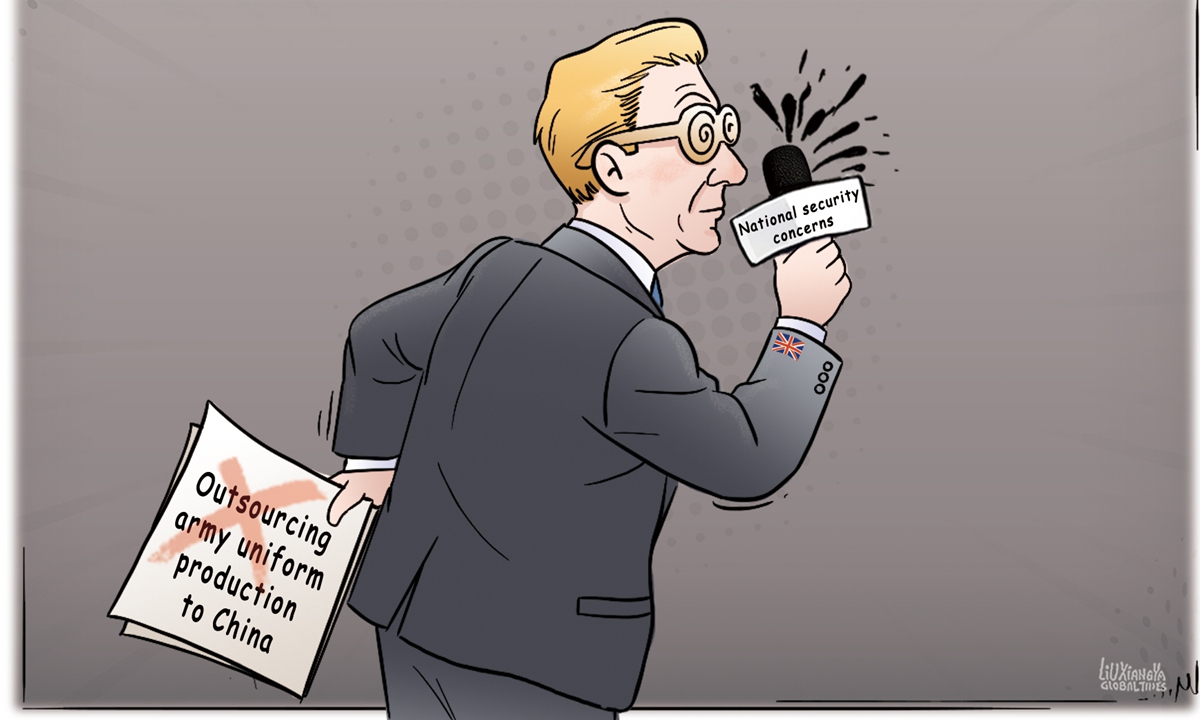
Illustration: Liu Xiangya/GT
A former Tory leader of the UK reportedly warned the UK's Ministry of Defense (MoD) that outsourcing the country's military uniform production to China poses national security risks. A Chinese expert said such false claims essentially reflect a cognitive distortion and a sense of structural anxiety.UK-based media outlet The Telegraph reported on Saturday local time that Iain Duncan Smith, a former Tory leader, cited the "threat" China poses to Britain.
From a psychological perspective, this kind of discourse by certain politicians reflects a typical zero-sum mentality and a sense of structural anxiety. When domestic industries lose clear advantages in global competition in terms of cost or efficiency, instead of analyzing the underlying issues in industrial competitiveness, there is a tendency to externalize the explanation, which is attributing market outcomes to "foreign threats," Li Guanjie, a research fellow with the Shanghai Academy of Global Governance and Area Studies under the Shanghai International Studies University, told the Global Times on Sunday.
The Telegraph also cited claims that uniforms made in China carry a "very high likelihood" of being produced with "forced labor." Li said that such claims of "high likelihood" that the products involve "forced labor" are accusations without any factual evidence or supply chain verification, reflecting a clear cognitive bias.
China's manufacturing competitiveness is rooted in its complete industrial chain, economies of scale, and continuous efficiency and technological improvements, rather than the allegations being implied, Li said.
Andrew Kinniburgh, director general of Make UK Defence, a defense trade association that represents 900 UK defense companies, claimed that it has "always been unacceptable" that British armed forces are being provided with Chinese-made uniforms. He called on the MoD to stop outsourcing to China and back British companies.
In the media report by The Telegraph, an MoD spokesperson said the MoD undertakes procurement in line with the appropriate public procurement regulations which are based on best value for money for the taxpayer.
From a factual perspective, British armed forces procurement, including uniforms, followed the market-based and globalized supply chain, where the cost, quality and delivery capability were thoroughly considered. Chinese manufacturing offers better value for money, and it reflects the reality of China's mature industrial system and reliable production capacity, Li said.
In a June 2024 report by the Financial Times, Susannah Walbank, systems director at Wyedean Weaving, a company based in Yorkshire that manufactures badges for the British military, said that "China is part of our supply chains. We have been there for 15 years, have long-standing relationships, and there has never been any concern."
In essence, military uniforms remain standard industrial goods that are difficult to attach to any geopolitical strategy. The hyping of a "China threat" narrative in this context largely reflects the discomfort of certain UK political figures with shifts in global industrial capabilities and competitiveness, rather than an objective reading of reality, Li added.
RELATED ARTICLES