Exclusive: CCG counters harassment by Japan around Diaoyu Dao; disruptions closely tied to Tokyo's accelerating remilitarization: expert
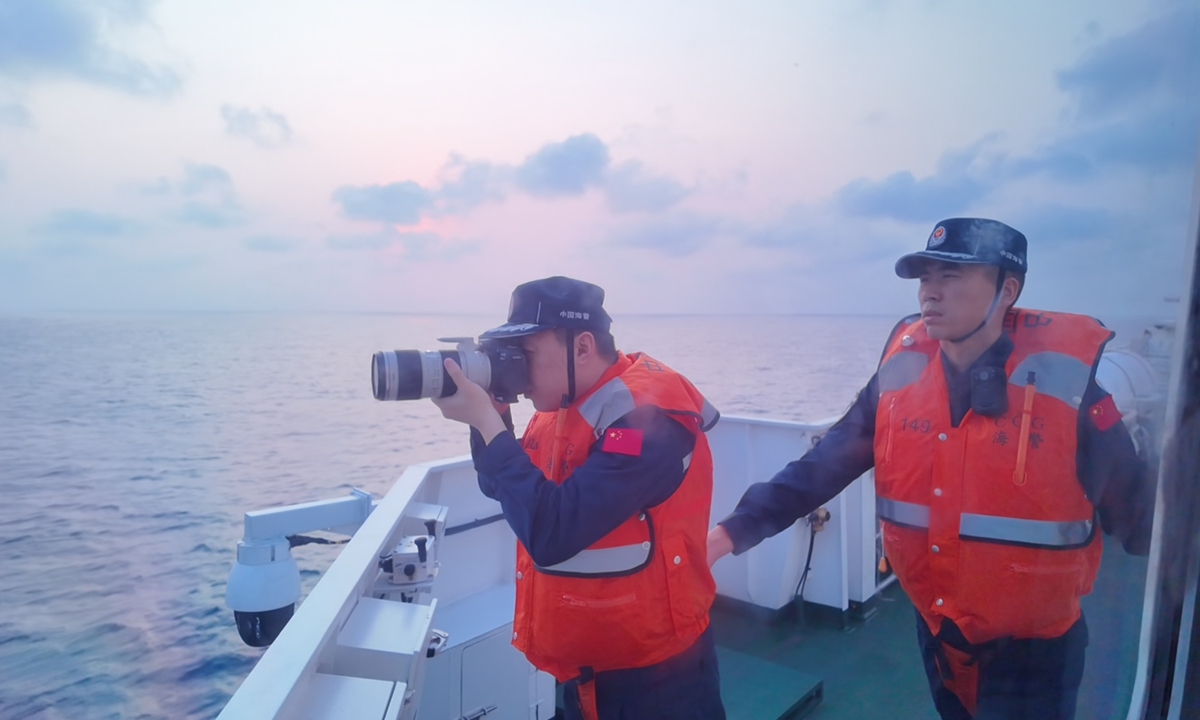
CCG officers aboard vessel Xiamen obtain evidence. Photo: Ding Yazhi/GT
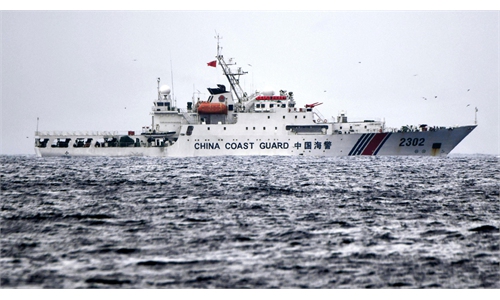
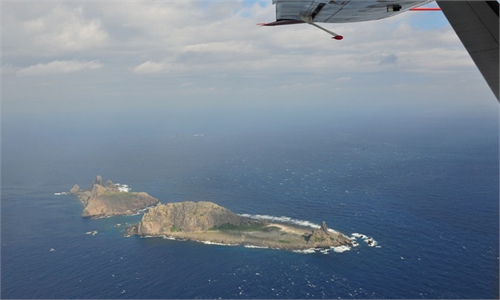
Global Times reporters recently joined a China Coast Guard (CCG) formation led by the Xiamen vessel on a routine patrol and law-enforcement mission around Diaoyu Dao and its affiliated islands, and witnessed how Japan continued to disrupt China's normal rights-protection patrols.
Observers said such disruptive actions are closely linked to Japan's accelerating remilitarization, the rise of right-wing forces and the regression of its historical outlook. The fluctuations around Diaoyu Dao, they said, are not caused by China's lawful patrols, but by Japan's unilateral provocations.
"Japan Coast Guard patrol vessel, this is the China Coast Guard. Diaoyu Dao and its affiliated islands are China's inherent territory since ancient times, and the waters within 12 nautical miles of them are China's territorial sea. Do not intrude into China's territorial waters," Wu Jie, a law-enforcement officer aboard the Xiamen vessel, said through the loudspeaker after warning a Japanese infringing vessel.
At around 6 am, the CCG formation entered the contiguous zone of Diaoyu Dao. Almost at the same time, a bright point appeared on the radar screen - a JCG patrol vessel quickly moved toward the port side of the Chinese formation. Wu has participated in Diaoyu Dao patrols since 2020. "I have lost count of how many times I have come to Diaoyu Dao," he told the Global Times reporter.
High vigilance
The first two numbers to remember during a Diaoyu Dao patrol are 12 nautical miles and 24 nautical miles - the former marking the territorial sea and the latter the contiguous zone. Together, they form the basic legal framework for China to exercise sovereignty and jurisdiction in the waters around Diaoyu Dao.
Looking out from the porthole, the reporter saw a white patrol vessel marked with the words "Japan Coast Guard" sailing about 900 meters away from the Chinese vessel, maintaining almost the same course and speed. Other CCG vessels in the formation also kept a close watch on it, with precise distance control between ships, showing a high level of alertness.
Jin Rui, a law-enforcement officer aboard the CCG vessel Meishan, told the Global Times that Japanese vessels involved in infringing activities can rotate frequently as the port of Ishigaki in Japan's Okinawa Prefecture is relatively close to China's Diaoyu Dao. Command ships usually rotate every seven to 10 days, while other vessels may rotate every three to five days, often at night when visual identification conditions are poor, Jin said.
During the half-month voyage, the reporter noticed that at least three Japanese patrol vessels involved in the infringing activities had rotated, including the Kunigami-class large patrol vessel Taketomi (PL81), the Miyako-class large patrol vessel Miyako (PL201), and the Daito (PL206). The Daito, a new vessel formally commissioned this year, appeared in the waters around Diaoyu Dao for the first time.
Japan's interference manifests not only in its frequent vessel dispatches, but also in frequent provocative and dangerous maneuvers. At around 3 pm on the second day after Chinese formation entered the contiguous zone, when the Xiamen vessel was conducting a normal patrol along its regular route, the Miyako, which had been tailing from the left rear, suddenly accelerated in an attempt to rush toward the bow and obstruct the Chinese vessel's movement.
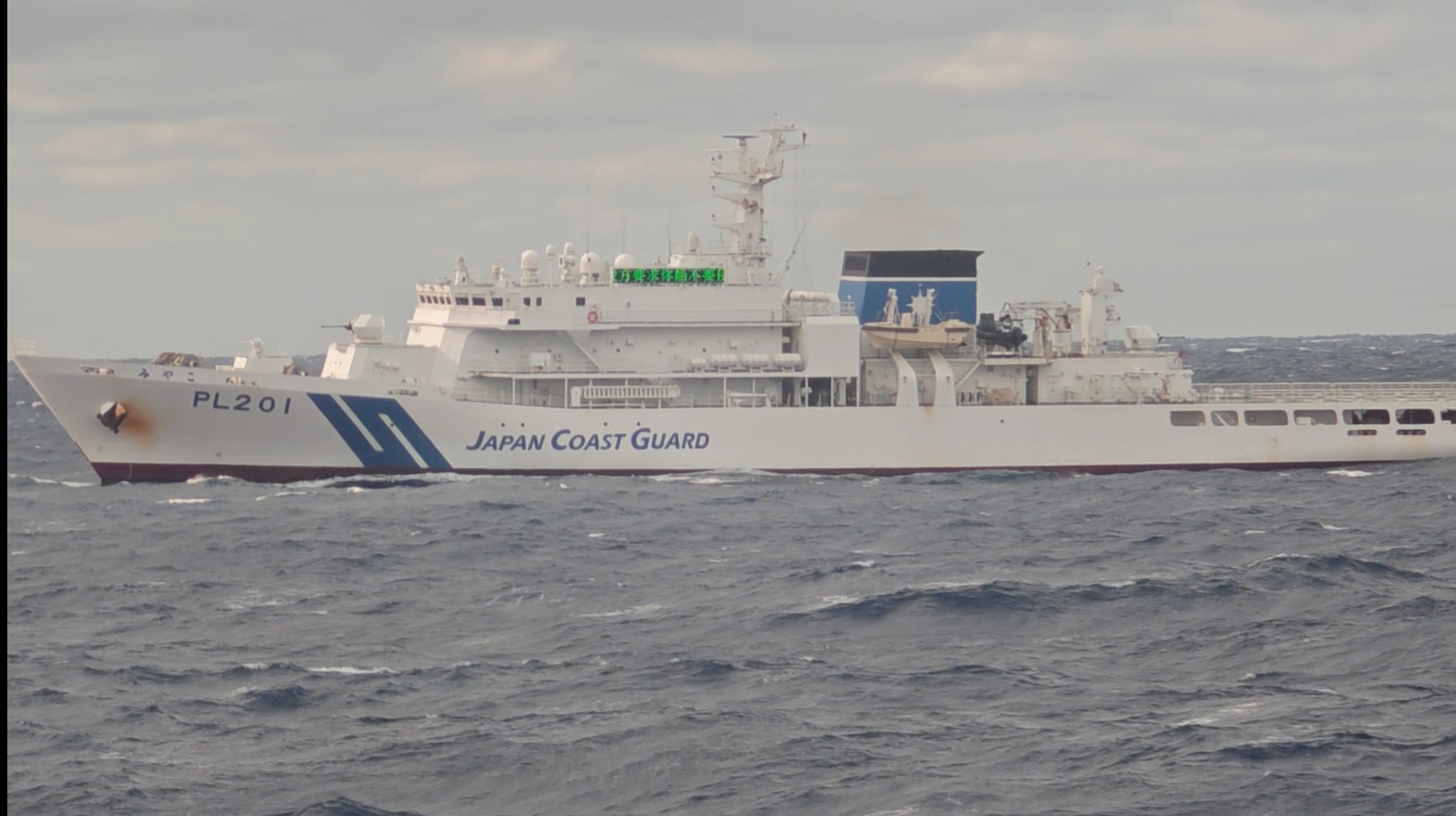
One of the Japan Coast Guard vessels tailing CCG vessel Xiamen Photo: Ding Yazhi/GT
Facing the provocation, the Xiamen vessel immediately accelerated, held its route and blocked the Japanese vessel.
For Zhao Changfeng, a law-enforcement officer aboard the CCG vessel Yushan who has participated in more than 30 Diaoyu Dao patrols, such scenarios are nothing new. He told the Global Times that when Japanese fishing boats attempt to illegally enter China's territorial waters and CCG vessels take necessary control measures and issue warnings to drive them away in accordance with the law, Japanese vessels often seize the chance to close in on Chinese vessels, sometimes to within only 100 to 200 meters.
"Such close-range approaches are dangerous operations and deliberate attempts to create friction and escalate the situation. But we will not back down. We will take further action to drive away Japanese infringing vessels," Zhao said.
Behind equipment buildup
Attempting to portray China as unilaterally changing the status quo around Diaoyu Dao, the JCG has claimed on its official website that CCG vessels repeatedly approached Japanese fishing boats after entering the waters around Diaoyu Dao, and that Chinese law-enforcement vessels carrying naval guns frequently sailed into nearby waters.
However, what the reporter observed during the patrol showed that it is Japan, not China, that has been creating tension and displaying dangerous tendencies. For a long time, JCG patrol vessels have closely tailed Chinese vessels conducting normal patrols, while Japan has continued to commission larger and newer patrol vessels, upgrade tonnage, strengthen onboard weapons and expand frontline maritime forces - moves that have increased the risk of confrontation around Diaoyu Dao.
Jin told the Global Times that since early 2024, Japan has sent various active patrol vessel models to the waters around Diaoyu Dao, from Kunigami-class large patrol vessels and Mizuho-class helicopter-carrying patrol vessels to newer Miyako-class large patrol vessels. Their weapons have also been upgraded from earlier 20mm naval guns to 30mm and 40mm guns.
During this patrol, the JCG patrol vessel Daito (PL206) made its first appearance in the waters around Diaoyu Dao. According to Japanese media reports, the Daito is Japan's sixth domestically built Miyako-class patrol vessel, with a gross tonnage of about 3,500 tons, a length of 120 meters and a maximum speed of over 25 knots, and its main armament consists of two 40mm naval guns.
The reporter also learned during the patrol that the Taketomi (PL81) and the Miyako (PL201) had both been fitted with Starlink, the satellite communications service of US space company SpaceX. Zhang Junjie, a law-enforcement officer aboard the Xiamen vessel, said after comparing evidence-collection footage with images from previous patrols that the additional device on the Japanese vessels could basically be confirmed as Starlink.
Nikkei previously reported that the JCG plans to gradually deploy Starlink on its vessels. The system is expected to be adopted by 66 vessels by the end of fiscal 2025, with another 16 vessels to be added in fiscal 2026.
Zhang Junshe, a Chinese military affairs expert, told the Global Times that the core purpose of equipping JCG patrol vessels responsible for the waters around Diaoyu Dao with Starlink is to strengthen real-time monitoring of the area. The militarized application of satellite communications will greatly enhance Japan's capabilities in maritime surveillance, command and control, and joint operations, further accelerating Japan's militarization, Zhang Junshe said.
Japan's deployment of such satellite communication systems may also serve cognitive warfare purposes and intensify military provocations, and will pose a severe challenge to peace and stability in surrounding areas, Zhang Junshe warned.
The JCG has played an important role in Japan's attempts to stir up the Diaoyu Dao issue. Its 11th Regional Coast Guard Headquarters has deployed a large number of patrol vessels and patrol aircraft near the waters around Diaoyu Dao, essentially to monitor and interfere with the CCG's routine patrols.
Japan's persistent entanglement and equipment expansion around Diaoyu Dao are not isolated maritime moves, experts said. They are deeply linked with the rise of right-wing forces in Japan, the regression of its historical outlook and the resurgence of militarist tendencies, forming a vicious cycle in which maritime provocations feed domestic right-wing momentum, while right-wing expansion at home provides backing for further provocations at sea.
"The Diaoyu Dao issue is the key lever for Japan's right-wing forces to push the country's 'normalization' and break free from the postwar pacifist system," an international affairs scholar told the Global Times. Prolonged tensions around Diaoyu Dao provide Japan's constitutional revision forces with material for public opinion manipulation, social mobilization and political campaigning, the scholar said.
By repeatedly creating tensions around Diaoyu Dao, Japan's Liberal Democratic Party government can justify expanding the defense budget and advancing "counterstrike capabilities," the scholar said. Such a strategy aims to hollow out Article 9 of Japan's pacifist constitution through the fait accompli of military expansion, enabling a strategic shift from "exclusive defense" to external intervention.
Japan is now entering what observers have called the most dangerous round of postwar "military restriction loosening." Since Japanese Prime Minister Sanae Takaichi took office in October 2025, moves related to constitutional revision, military expansion and the relaxation of weapons export restrictions have been rolled out in quick succession.
In early April, Japan's House of Councillors passed the fiscal 2026 budget, with defense spending exceeding 9 trillion yen, a record high. On April 21, the Japanese Cabinet adopted a resolution to amend the "Three Principles on Transfer of Defense Equipment," implementing the lifting of the ban on lethal weapons exports, according to media reports.
From the continuous upgrading of large JCG patrol vessels to the comprehensive enhancement of the Self-Defense Forces' offensive and defensive systems, and from the regression in historical understanding among senior political figures to the repeated breaking of postwar security restraints, Zhang Junshe believed Japan is breaking free from the dual constraints of its pacifist constitution and the postwar international order.
This convergence of historical backpedaling and military adventurism is not only eroding Japan's diplomatic credibility, but also planting long-term risks for peace and stability in the East China Sea and the wider Asia-Pacific region, Zhang Junshe said.
As waves of the East China Sea continue to beat against the reefs of Diaoyu Dao, this confrontation continues. During the patrol, the reporter observed that in the face of Japan's persistent maritime provocations, military restriction loosening and historical regression, China firmly defends its sovereignty over Diaoyu Dao and its maritime rights and interests. Through routine patrols and law-enforcement operations, CCG vessels have maintained control of the maritime situation with professional and restrained actions.
Data previously released by the CCG showed that in 2025 Chinese coast guard vessels patrolled around Diaoyu Dao for 357 days, almost achieving "full-time coverage." A Global Times review found that since the beginning of this year, the CCG has issued at least one statement every month on rights-protection patrols in the territorial waters of Diaoyu Dao and its affiliated islands. As of June 14, the CCG had released 10 such statements this year.
"Over the past five years, the China Coast Guard has continued to innovate its operational strategies, optimize its control models, strengthen capacity building, detect in a timely manner, respond quickly and effectively handle foreign infringement activities, achieving new breakthroughs in three-dimensional patrols over the sea and air around Diaoyu Dao, shaping a new posture of maritime rights protection, and building a new pattern of law-based control over the Taiwan Straits in accordance with the one-China principle," Zhang Jianming, head of the CCG, said previously.
The CCG resolutely safeguards maritime rights, effectively stabilizes the maritime situation with a strong sense of mission and responsibility, prevents and regulates the infringement and provocations of relevant countries in accordance with laws and regulations, and firmly defends national territorial sovereignty and maritime rights and interests, Zhang Jianming said.
RELATED ARTICLES